
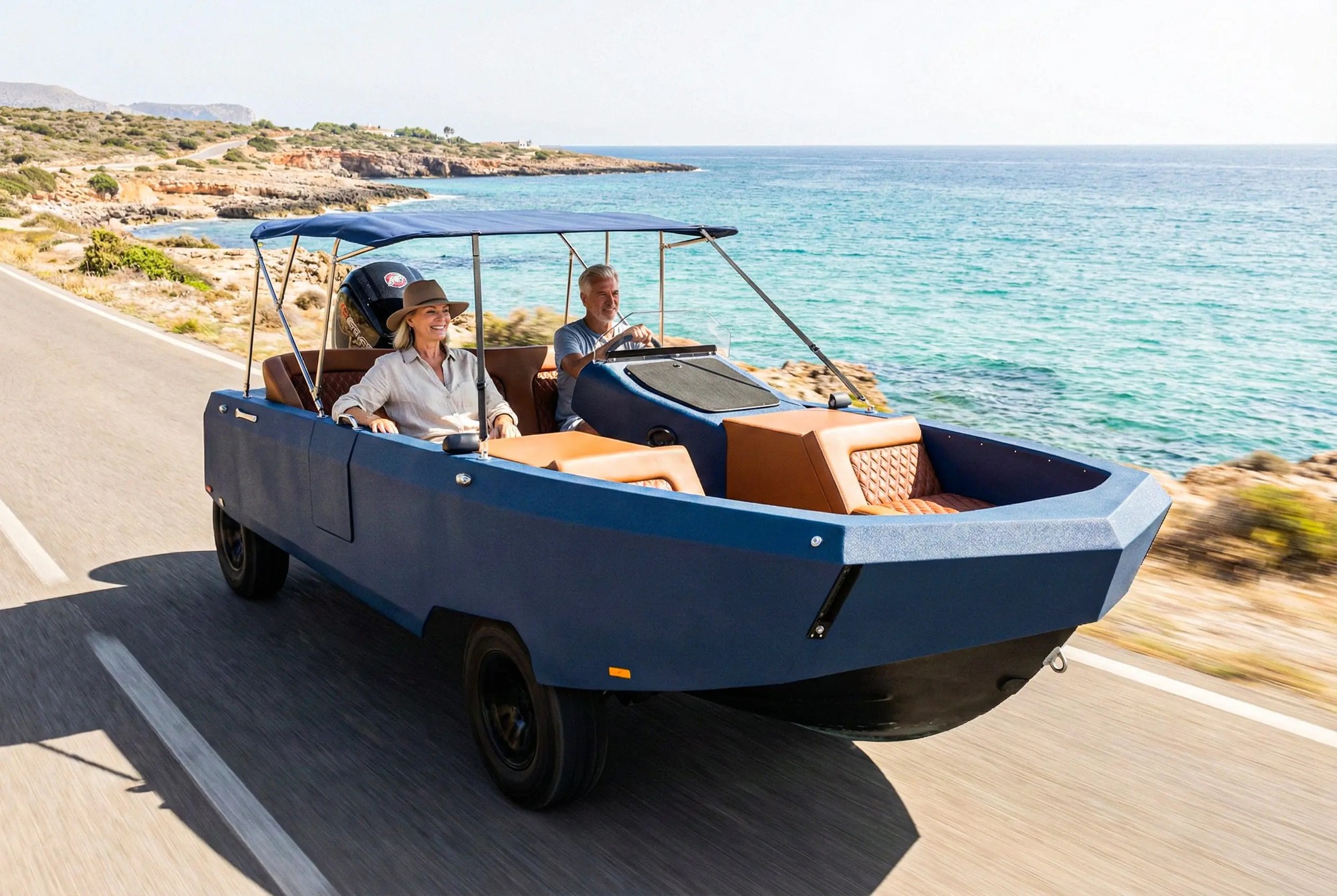
Most vehicles are built for one element. The WaterCar is built for two. A Southern California company of the same name has spent more than 25 years building machines that drive down a road like a car, back down a boat ramp, and pull away as a boat, without a trailer and without leaving anything behind at the dock.
Its current model, the WaterCar EV, is a 19.5-foot amphibious vehicle that tops out at 35 mph on the water and 25 mph on land. It is priced at $170,000 and built to order. The question is whether it is a practical machine or an expensive curiosity. Here is what the WaterCar is, how it switches between road and water, and what it costs.

What Is the WaterCar EV?
The WaterCar EV is a hand-built amphibious vehicle that works as a small boat and a street-legal Low Speed Vehicle (LSV) in one body. It is designed, welded, and assembled by WaterCar Inc. at a 100,000-square-foot facility in Fountain Valley, California.
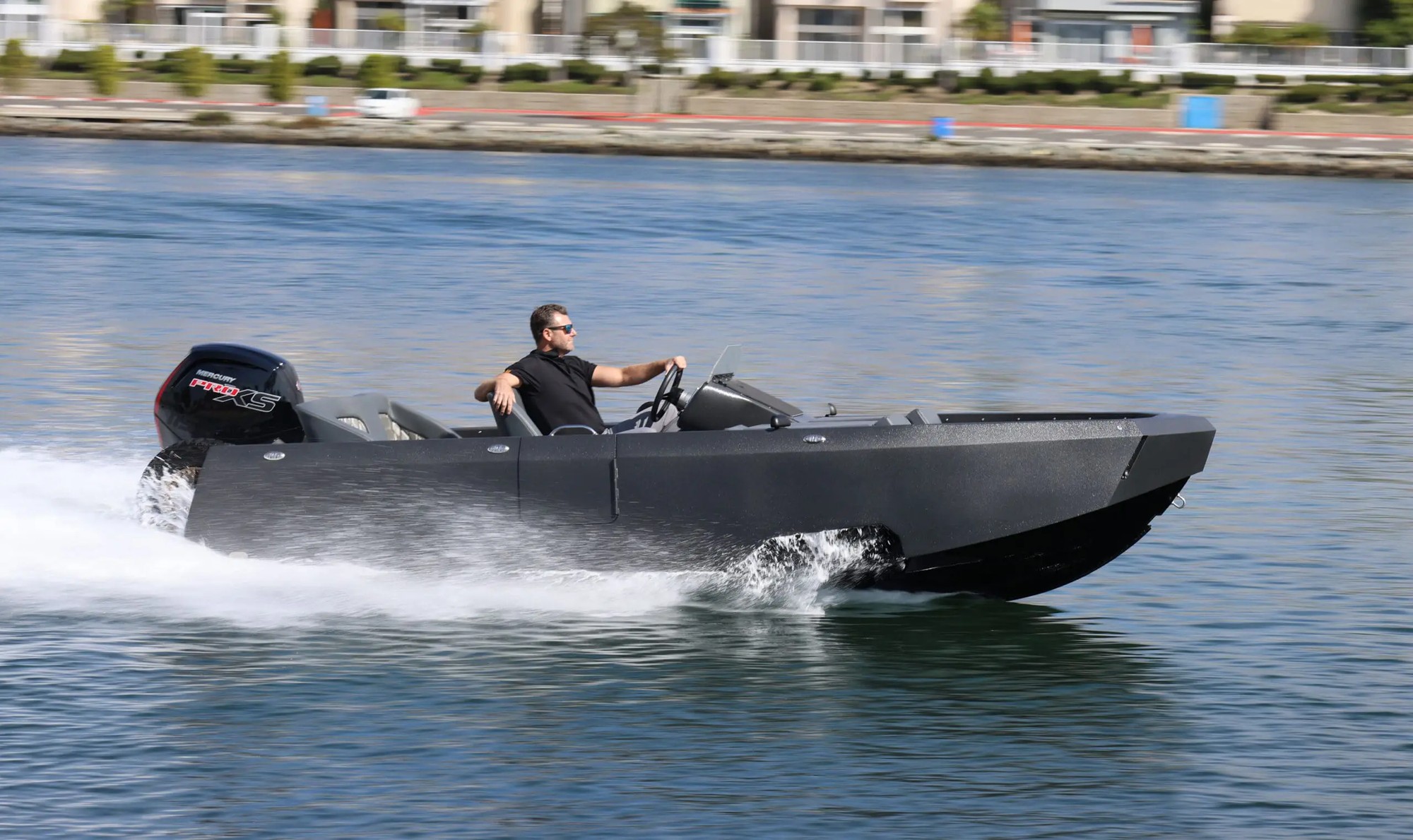
On the water it behaves like a sport boat, powered by a 115-horsepower Mercury Pro XS four-stroke outboard turning a custom four-blade stainless-steel propeller. On land it runs on a waterproof permanent-magnet electric motor fed by a 48V lithium iron phosphate (LiFePO4) battery. The hull and body are a single welded aluminum structure rather than the fiberglass used by most boats.
Each vehicle takes 8 to 12 weeks to build and more than 1,500 hours of labor, according to the company, which sells it worldwide from the California factory.
How Much Does a WaterCar Cost?
The WaterCar EV is priced at $170,000, built to order. That figure is for the standard build; the company says higher-performance versions are available on request.
Buyers reserve a build slot with a $5,000 refundable deposit, which is credited toward the purchase price. Production slots are allocated in the order that deposits are received, and the company asks for payment by wire transfer only after instructions are verified by phone.
At that price the WaterCar sits above a typical family boat or a new electric car, and roughly in the range of a high-end performance car. The comparison the company invites is not to a sedan but to the combined cost of a boat, a tow vehicle, and a trailer.
Sticker price, though, is not the same as total cost of ownership. A comparable 19-foot boat, plus a tow vehicle and a trailer, can approach the same outlay once insurance, storage, and maintenance across three assets are added. The WaterCar collapses those into one registered vehicle, which is the core of its pitch.
Is the WaterCar Street Legal?
Yes, with one important qualifier. The WaterCar EV is built to comply with FMVSS 500, the U.S. federal safety standard for Low Speed Vehicles. It carries a 17-digit NHTSA-registered VIN and DOT-approved lighting, mirrors, seat belts, and turn signals.
That makes it street legal on public roads where Low Speed Vehicles are permitted, which typically means roads with posted speed limits of 35 mph or lower. The 25 mph land speed is a legal limit as much as a design choice: LSVs are governed to a maximum of 25 mph under the federal standard. So the WaterCar can be driven legally on many local roads and neighborhood streets, but it is not a highway vehicle.
On the marine side, the company says the WaterCar is NMMA-certified to ABYC standards and built to meet or exceed applicable U.S. Coast Guard standards, with a Hull Identification Number (HIN) issued. WaterCar states that it is the only NMMA-certified amphibious vehicle manufacturer in the world.
How the WaterCar Transitions From Road to Water
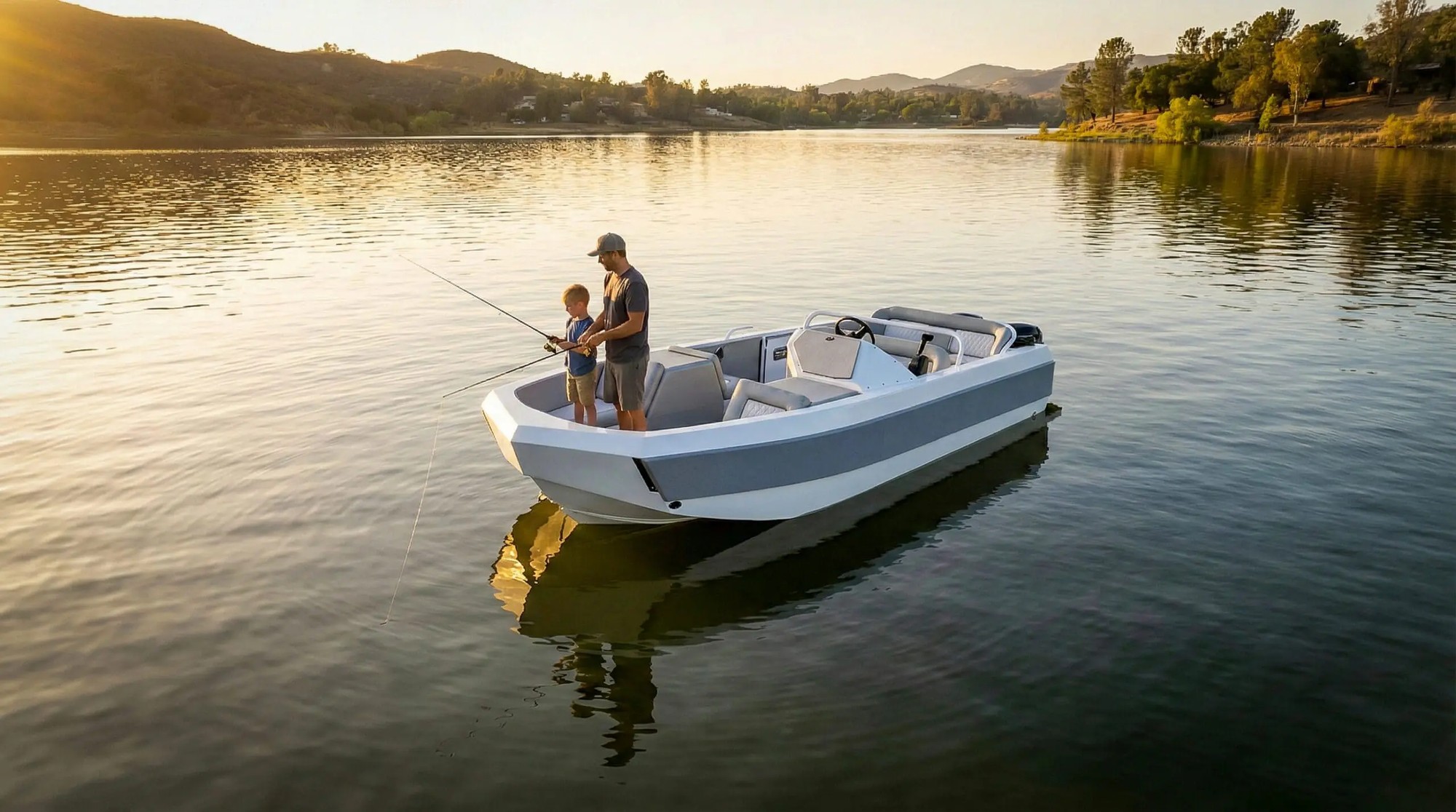
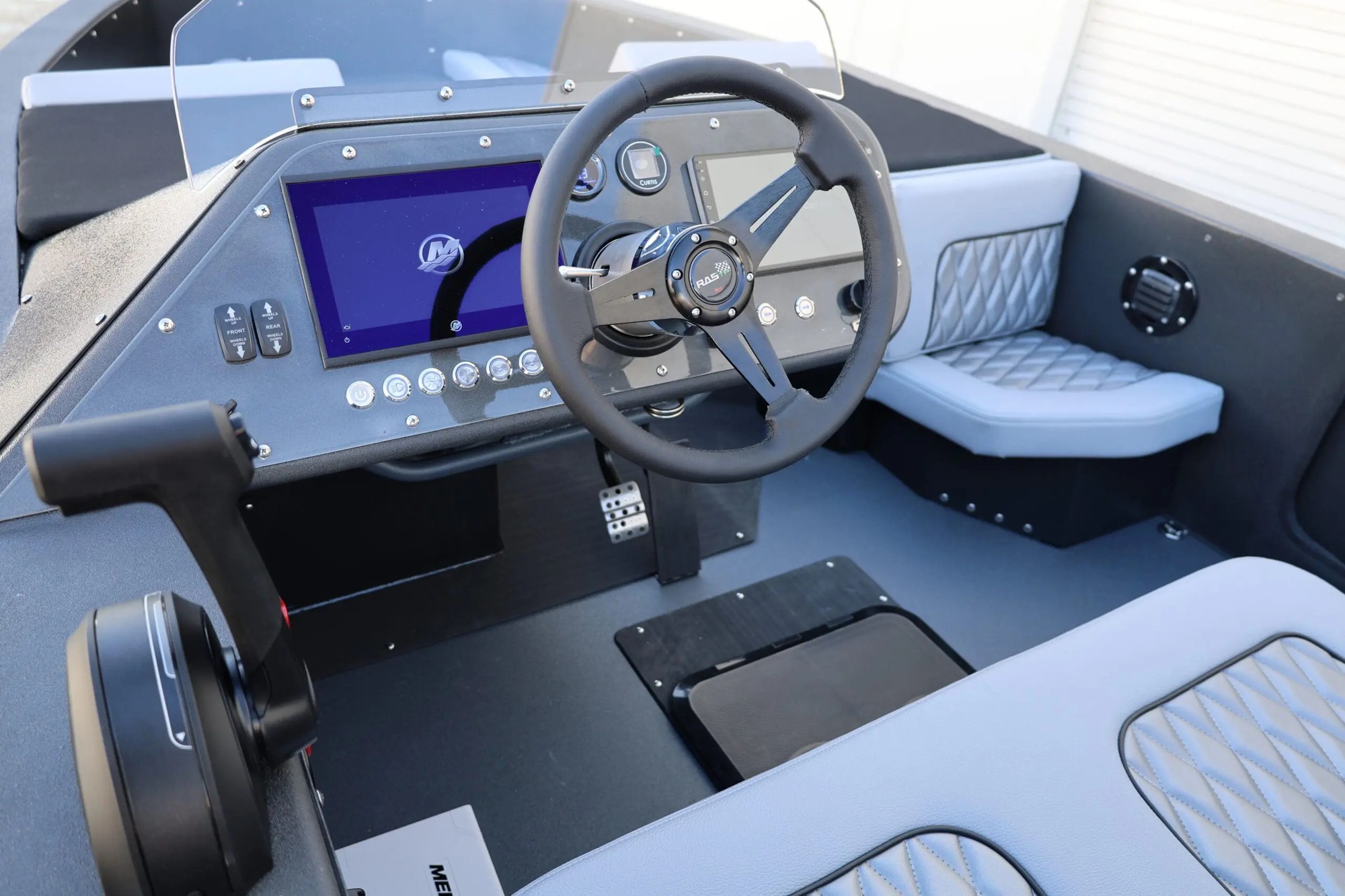
The signature feature is a single-button transition the company calls LaunchMode. At a boat ramp, the driver presses a button and the wheels retract while the outboard lowers, driven by custom stainless-steel hydraulic cylinders at 3,500 PSI through a Mercury OEM pump. The change takes seconds rather than the minutes a conventional trailer launch requires.
Unlike some amphibious designs, the steering never disconnects. The wheels and the outboard turn together in both modes, which the company says keeps the driving feel consistent on land and water.
Towing is handled by a second system called TowLink, which the company describes as the world’s first integrated marine towing system. The vehicle acts as its own trailer: it connects to any standard 2-inch hitch, raises its front wheels, and rides on its own rear wheels in tow mode, with automatic tow lighting. The goal is to remove the need for a boat trailer entirely, which also means the vehicle can be stored in a standard single-car garage.

WaterCar EV Specs: Water and Road Performance
| Specification | On the Water | On the Road |
|---|---|---|
| Top speed | 35 mph (56 km/h) | 25 mph (40 km/h), governed |
| Range | 80 miles (130 km) | 20 miles (32 km) |
| Power source | Mercury Pro XS 115 HP four-stroke outboard; 18-gallon gasoline tank | 48V LiFePO4 battery; waterproof permanent-magnet motor |
| Refuel / charge time | Gasoline refueling | 6 to 8 hours on 110V |
| Length | 19.5 ft (5.9 m) overall; 18 ft (5.4 m) waterline | 19.5 ft (5.9 m) |
| Beam / width | 6.5 ft (1.98 m) | 6.5 ft (1.98 m) |
| Draft | 13 in (0.33 m) | Not applicable |
| Seating | 4 persons / 850 lbs (USCG capacity) | Up to 4 persons |
| Weight | Not applicable | 2,300 lbs dry; 2,990 lbs GVWR |
| Hull | All-welded aluminum unibody, 5000-series marine and 6000-series aircraft alloys | |
| Transition | LaunchMode single-button wheel retraction and outboard deployment | |
Figures are as reported by the manufacturer. The 35 mph water top speed reflects the standard build.

Why It’s Built From Aluminum, Not Fiberglass
Most boats use fiberglass hulls. The WaterCar uses an all-welded aluminum unibody that combines marine-grade 5000-series and aircraft-grade 6000-series alloys, pulse-arc welded by hand inside and out. The company says the structure is epoxy-coated on a 360-degree rotisserie and filled with USCG closed-cell flotation foam, which it describes as making the vehicle virtually unsinkable. During certification, the company says, the hull was load-tested to more than 10,000 pounds.
The trade-off is weight and cost. A dry WaterCar EV weighs about 2,300 pounds, with a gross vehicle weight rating of 2,990 pounds. The aluminum construction is also a major reason the vehicle is expensive relative to a conventional boat of the same length.
Running gear comes from named suppliers rather than custom parts, which the company frames as a serviceability advantage: Eibach and AST coil-over suspension, QA1 rod ends, Timken sealed bearings, Wilwood brakes, Simrad navigation, Victron Energy electrical components, and a Curtis motor controller. Because these are standard marine and automotive components, WaterCar argues that the vehicle can be serviced by any qualified marine or automotive mechanic.
From Amphicar to WaterCar: A Short History
WaterCar Inc. was founded in 1999 by Dave March. As the company tells it, the origin story began with a 1964 Amphicar, the German-built amphibious convertible sold in the United States in the 1960s, that March and his son restored. The Amphicar’s modest performance prompted the family to design something better, and the WaterCar program grew out of that project.
The company’s records include a 2010 Guinness World Record set by a WaterCar model called the Python, which it says reached 72 mph on water and 127 mph on land. In 2014, Dave March drove a WaterCar Panther from the factory through Orange County streets and roughly 30 miles across open ocean to Catalina Island in about 70 minutes. The Panther program ran for 14 years and built an international customer base; the company says the Crown Prince of Dubai ordered six of them.
The current WaterCar EV is, in effect, the electric-road, gasoline-water successor to that lineage. It is a hybrid in the classic sense of the word: two different power sources for two different environments. For a sense of how far the category has come, compare it with the fastest amphibious boat designs that followed and with experimental machines like this solar-powered amphibious superyacht.
WaterCar vs. Amphicar: Six Decades of Progress
The Amphicar, built in West Germany between 1961 and 1968 and sold in small numbers in the United States, was the machine that proved the concept of a car that could swim. It was also the machine that revealed the limits. It was slow on land and barely faster on water, and a single engine drove both the wheels and a pair of propellers mounted at the rear.
The WaterCar takes a different approach. By separating the propulsion systems, an electric motor for the road and a dedicated marine outboard for the water, it can be more competent in each element than a single drivetrain allows. The aluminum hull and modern materials also address the corrosion and weight problems that plagued amphibious vehicles of the past.
The concept is more than 60 years old. The execution is where WaterCar hopes to differ.
Engineering an amphibious vehicle is a study in compromise. A hull heavy enough to float stably and withstand salt water tends to be too heavy and too slow on a road, while a road drivetrain built for speed and efficiency is poorly suited to pushing a boat through water that is roughly 800 times denser than air. Sealing the wheel wells, wiring, and electronics against immersion adds cost and complexity, and every pound devoted to flotation is a pound not spent on performance. That is why, despite more than a century of attempts, amphibious vehicles have largely remained a curiosity rather than a category.
Who Owns WaterCar?
WaterCar Inc. is a private company founded and led by Dave March, who serves as Founder and CEO. March has been fabricating cars and boats in Southern California since 1976, building a collision-repair operation that grew into one of the largest in the United States before turning to amphibious vehicles. Michael March, his son, is listed as co-founder and is the company’s primary media contact.
The company remains based in Fountain Valley and has deliberately kept production small: vehicles are built to order rather than mass-produced.
The Reality Check: Range, Charging, and Everyday Use
The WaterCar’s dual capabilities come with practical limits worth understanding before the price tag.
- Road range is short. The EV has a road range of about 20 miles on a full charge, far less than any conventional electric car. It is designed for short trips to and from the water, not for commuting.
- Charging takes hours. Recharging from a standard 110V to 250V outlet takes approximately 6 to 8 hours, so the vehicle is typically charged overnight.
- Water range depends on fuel. The 18-gallon gasoline tank supports an 80-mile range on the water, so longer excursions require planning.
- Land speed is capped. The 25 mph limit keeps it off highways and restricts it to LSV-permitted roads.
On the environmental side, the WaterCar is a gasoline boat with an electric road mode rather than a fully electric vehicle. The on-water propulsion is a conventional gasoline outboard, so anyone drawn to it for zero-emission operation would be disappointed. Its appeal is practical rather than environmental: it eliminates the trailer and the second vehicle, not the fuel.
Frequently Asked Questions
How much is a WaterCar?
The WaterCar EV is priced at $170,000, built to order, with a $5,000 refundable deposit to reserve a build slot.
Is WaterCar street legal?
Yes, as a federally compliant Low Speed Vehicle. It is legal on roads that permit LSVs, generally those with speed limits of 35 mph or lower, but not on highways.
Is a WaterCar possible?
Amphibious vehicles have existed for decades, but building one that is genuinely competent on both land and water is difficult because water is far denser than air and corrosive to most materials. WaterCar addresses this with a welded aluminum hull, a sealed electric road drivetrain, and a dedicated marine outboard for the water.
Who owns WaterCar?
WaterCar Inc. is a privately held company founded in 1999 by Dave March, who serves as Founder and CEO. His son, Michael March, is a co-founder.
Who Is the WaterCar For?
The WaterCar is a niche product, and its small production runs reflect that. It tends to appeal to a specific kind of buyer.
- Boat owners who dislike trailers. Anyone who has wrestled a trailer at a crowded launch ramp understands the appeal of driving straight into the water and towing the boat home behind the same vehicle that launched it.
- Coastal and lakefront homeowners. With a 20-mile road range and a 25 mph limit, the WaterCar fits short hops between a garage and a nearby harbor or lake rather than long-distance travel.
- Collectors and enthusiasts. As a hand-built, limited-production vehicle with a visible lineage back to the Amphicar, it occupies a small space between a boat and a car that few machines can claim.
- Buyers expecting an everyday car. Not a fit. The limited range, low speed, and LSV restrictions mean the WaterCar complements a normal car rather than replacing one.
The Bottom Line
The WaterCar EV is a rare thing: a vehicle that takes the long-held dream of the amphibious car and turns it into a finished, certified, road-legal product. The $170,000 price, 20-mile road range, and 25 mph land limit mean it will never be a mass-market machine, and its gasoline outboard keeps it from being a green vehicle in any meaningful sense. But for a buyer who wants to skip the trailer and drive straight from the garage to the water, it is one of the most complete amphibious vehicles ever offered to the public. Full details are in the manufacturer’s WaterCar specifications and its WaterCar technology pages.


