
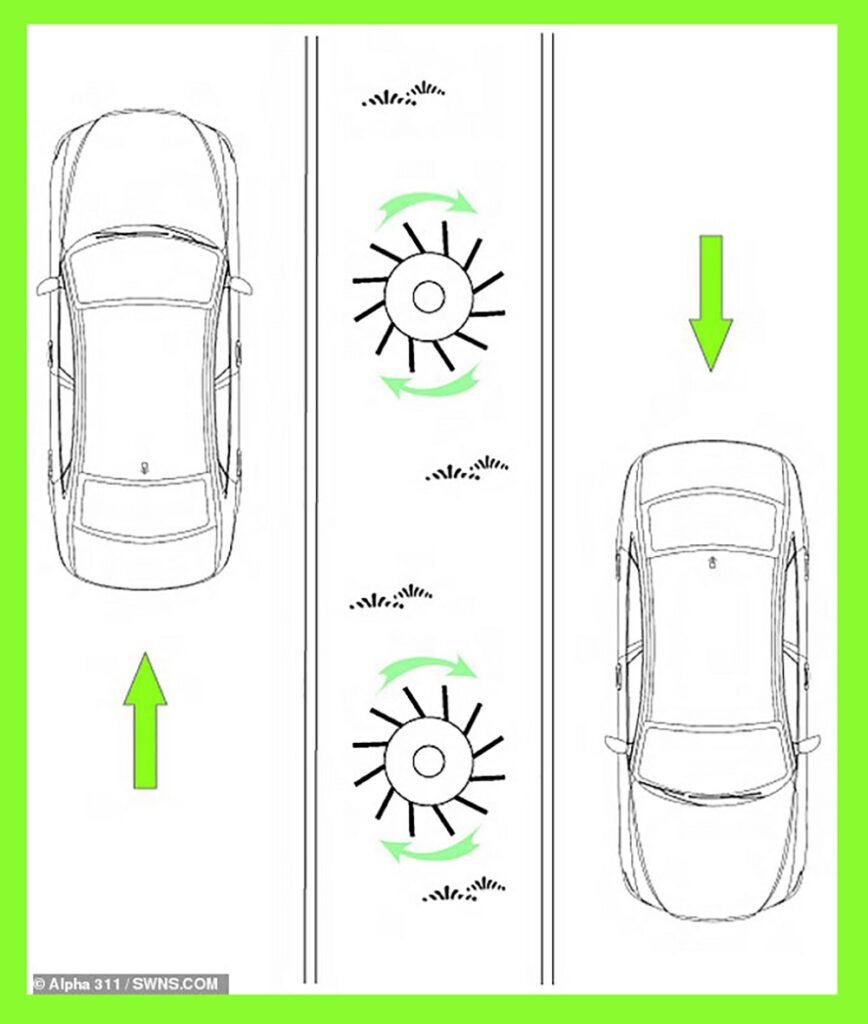
Barry Thompson, a Kent-based businessman and CEO of Alpha 311 has developed wind turbines that fit around typical motorway lamp posts and generate electricity via passing vehicles. The innovative devices could help the UK reach its carbon-neutral target by 2050.
The spinning cylinders will be able to power the lights they are attached to, and eventually, the energy generated could be enough to sell back to the grid.

Thompson said:
If you’ve ever stood by the road and a lorry has gone past, you’ll feel the air that moves – we capture that energy.
Each turbine costs £20,000 to build, measures two meters tall, and produces the same energy capacity as 21 sq. meters of solar panels. However, the turbines are likely to become smaller and more efficient with further development.


On October 6, Prime Minister Boris Johnson promised that an approaching green industrial revolution would power every home in the UK via offshore wind turbines by 2030. Thompson disagrees with the Prime Minister; he believes onshore solutions are also necessary to reach this ambitious target.
Thompson said:
Do I think offshore wind is everything? No, I think onshore wind is the cheaper option, and a distributed network needs to really push this thing forward. Whether we’ll be doing it by 2030, I don’t know, it’s going to need a lot of collaboration.
Some existing green energy schemes have sparked outrage among activists due to environmental concerns. However, these turbines would cause minimal disruption to the environment and existing infrastructure.

The CEO explained:
People have thought of putting wind turbines on top of lighting columns. They’ve considered remaking lighting columns in their entirety, but this is a retrofit solution, so it attaches to what we already have. Therefore, we’re not blighting the landscape with massive turbines; we’re making use of existing infrastructure.
Alpha 311 will lease the turbines to local authorities, rather than forcing the councils to purchase them. The generated energy sold back to the grid would then be split between the board and the company.
According to Thompson, the company is currently speaking with UK local authorities to trial the technology on their roads. A few small cities in the US are also testing out these traffic-powered turbines.


