
The Seaborg molten salt reactor may revolutionize the nuclear power industry. It’s practical, cheap, compact enough to put on floating barges, and much safer. Even in the worst-case scenario, like a terrorist bombing, the consequences of an accident are minor since molten salt nuclear fuel hardens into rock, like lava. The design also features multiple passive safety features.
Next-generation advanced nuclear power technologies like this are a hot topic as the world races to reach zero carbon targets by 2050. Coal- and gas-fired power stations are being retired, and low-carbon options must take their place. And while solar and wind energy will increasingly provide the bulk of our electricity demand, nuclear offers a reliable, affordable, and sustainable way to bolster the baseload and fill the void when renewables aren’t generating.
By a great deal, nuclear is the safest method of power generation, despite some highly high-profile catastrophes, with a “death-print” 330 times lower than coal-fired electricity. And molten salt designs like Seaborg’s promise to be even safer, dramatically lower the consequences of those rare incidents as well.
Its passive safety features, with four layers of redundancy at every point of failure, radically re-focuses the nuclear safety question from total accident prevention to the much simpler consequence mitigation. This will have a considerable impact on the cost of nuclear power.

Seaborg Technologies CEO and co-founder, Troels Schönefeldt, told Radio Spectrum in an interview:
We take a different approach. We’re not reducing the likelihood of an accident to zero; there will be accidents. We should avoid them as much as we can, but there will be accidents. Hopefully, there will be a lot of accidents because we will have a lot of these reactors. So what we do, instead of reducing the likelihood, is reduce the consequence of even the worst disasters. Or even acts of war where you bomb the reactor. The consequence here is that this fluoride salt will flow out of the reactor (or explode out of the reactor) and lie on the field. It’ll solidify. And now you shouldn’t go onto that field. You should keep 10 or 20 feet of distance. But you can go there with a Geiger counter and clean it up. It’s wildly expensive, but you can do it. And that changes the fundamental safety profile of the technology. And in doing so, we change the cost, which again, in turn, changes the business model.
Furthermore, the company’s proposed business model of installing these reactors on barges, mooring them offshore instead of buying up land to develop nuclear power plants, is highly advantageous. It means Seaborg can manufacture the reactors in bulk at a single facility, then deliver them on floating barges worldwide – on timelines that will crush paradigms in the energy industry.
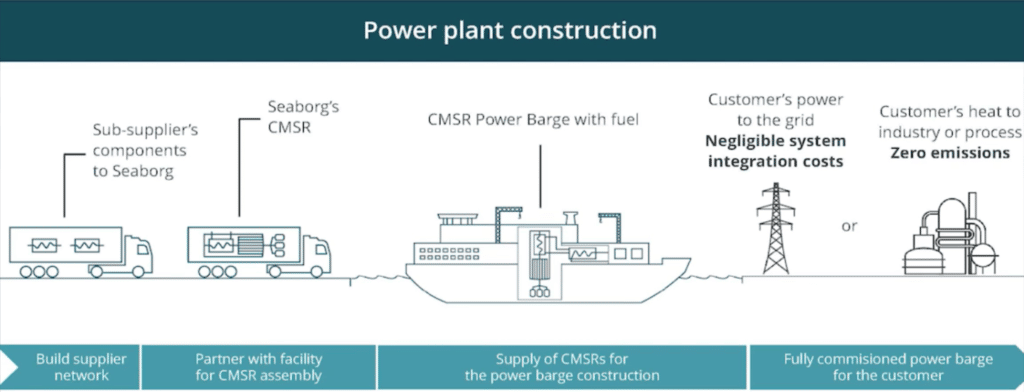
Schönefeldt told Radio Spectrum: If you want us to build not one reactor to start with, but a thousand, we could start by building a thousand. “That will take, like, three or four years on these shipyards. So, it’s unroofed in how fast you can scale it.”
Other benefits include:
- Virtually no site preparation is required; it’s entirely self-contained and straightforward to connect to a power grid.
- It’ll run for approximately 12 years without refueling.
- Its fuel can’t be used in nuclear weapons.
- It’s so compact it’s even easy to move across land.
- It’s capable of running on refined, recycled nuclear waste from older reactors.
- It’ll be helpful in ways other than being a power station because you can draw heat directly from the reactor even more efficiently than drawing electricity.
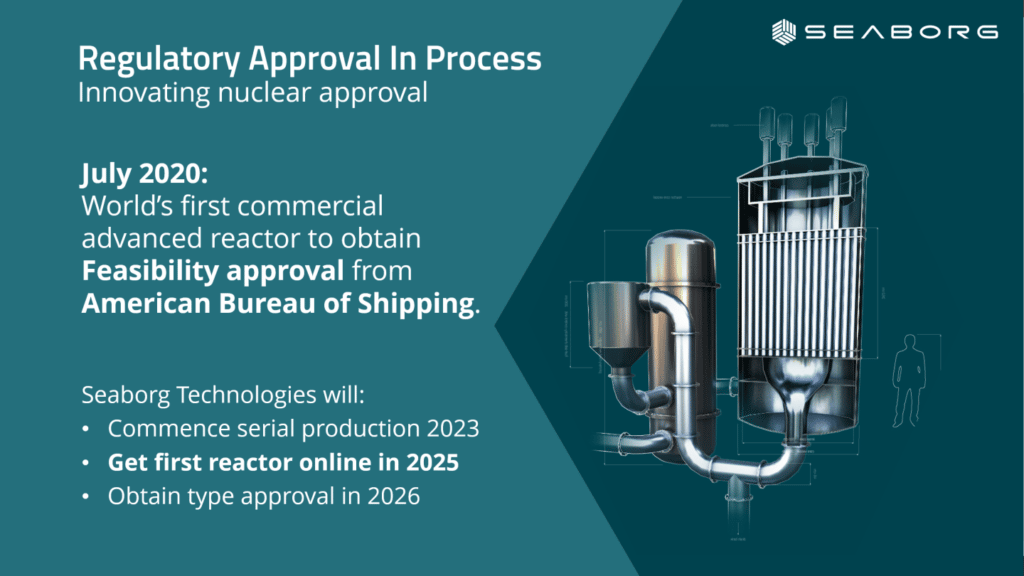
Seaborg Technologies has raised millions of Euros to start building the reactors. That full-scale prototype is scheduled to go online in 2025 and will probably be sent to work off an island in Southeast Asia. After that, it plans to mass manufacture and rollout globally on an unbelievably rapid time scale: it hopes to attain regulatory type approval for its design by 2026 and commercial serial production by 2027.


