
The African turquoise Killifish (Nothobranchius furzeri) can put its development on hold as an embryo by temporarily halting cell and organ growth for up to double its lifespan – which is four to six months. The phenomenon is called diapause, and it is a survival mechanism that lets an animal put its birth on standstill until conditions (in this case drought) in its environment improve. A new study discovered that embryos don’t age while in that state. The research has been published in the journal Science.

The Killifish live in ponds in Zimbabwe and Mozambique. These ponds can disappear for months at a time during the dry season, leaving the fish homeless until it starts to rain again. When the ponds fill up again, the diapause is disengaged, and the embryos commence development.
Co-author Prof Anne Brunet, a geneticist from Stanford University, said:
We actually don’t think the mechanism of diapause is directly caused by drought. But the mechanism is indirectly linked to drought in the sense that drought provided a selective pressure for this African turquoise killifish species: over millions of years of evolution, the African killifish evolved to survive drought by having its embryos enter a state of diapause.

The scientists wanted to understand the genetic programming of the mechanism so that maybe they could apply it to helping humans pause aging or treat aging-related diseases.
Prof Brunet said:
Nature has identified ways to pause the clock. Knowing how killifish pause their lives could help scientists figure out how to treat aging-related diseases or learn how to preserve human organs long-term. One can hypothesize that turning on a ‘diapause-like’ state – or tapping into the molecular machinery of diapause – in some adult tissues or cells could help preserve them.
The fish could put growth on hold from five to up to twenty-four months. Scaled-up to human years, if we could do something similar, it would mean an 80-year-old person might have a lifespan from 160 to nearly 400 years!
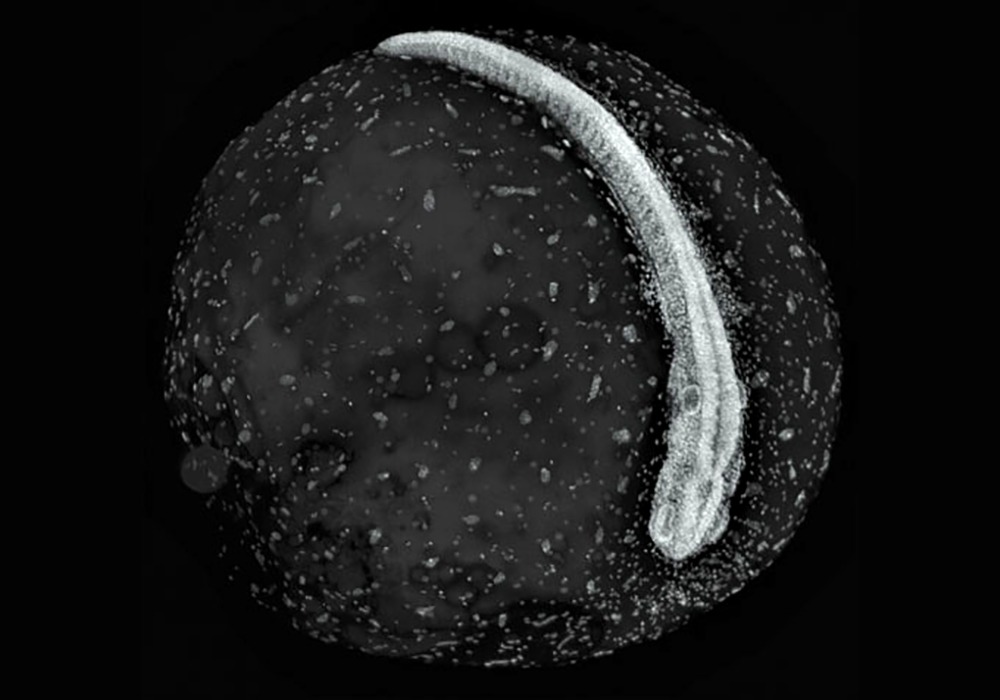
When they analyzed the genetics behind diapause in killifish, they discovered that the state of halted development has no impact on the fish’s anticipated lifespan, their growth as an adult, or their fertility.
Brunet said:
Diapause is a fascinating state of ‘suspended life’ that can preserve a complex organism long-term, with no apparent trade-off for subsequent life.
The analysis also revealed that the young Killifish had developed hearts, muscles, and brains before diapause. Then, the genes involved in cell proliferation and organ development were turned off, and diapause began. Meanwhile, other genes were put on hyper-mode.
The cranked-up genes were those responsible for making a protein called CBX7 (the chromobox 7 gene) – during diapause; they were producing extra of this protein. CBX7 is involved in metabolism and muscle function – so the abundance of it was maintaining the muscles through diapause.

These new findings show that during diapause, the animals’ cells are coordinating responses that protect it from the passing of time. The embryos aren’t passively waiting for better environmental conditions wholly frozen.
Molecular geneticist Christoph Englert, from the Leibniz Institute on Aging, who wasn’t involved in the study, said,
We have always looked at this diapause state as more passive — nothing happens there. But the new research shifts the paradigm of diapause as a passive, boring state to an active state of embryonic nondevelopment.
But could understanding the method lead to an anti-aging treatment for humans?
Brunet said:
We think it’s interesting from a fundamental point of view to understand how the accumulation of the damage due to the passage of time can be stopped or suspended. Diapause offers us a way to understand this. Such an understanding may provide clues as to how to slow the ‘aging clock.’
However, at the moment, the proposition is still speculative. Other fish take the opposite approach to developmental timing: European eels spend five to twenty years maturing before they ever spawn.


