
Globally, neck and head cancers are responsible for 6% of all cancers and kill over 300,000 people each year. While treatments are effective if the disease is recognized at an early stage, it’s frequently not, with the late-stage forms bringing a poor diagnosis.
With this factor in mind, medical researchers worldwide have searched to find early-stage cancer screening methods that are accurate, rapid, non-invasive, and inexpensive. Researchers from Australia’s Flinders University are claiming significant progress in developing a breath test that can quickly detect exhaled breath profiles associated with neck and head cancers. The breath-based biomarker detection tool demonstrated a considerable level of accuracy in early trials.
Dr. Roger Yazbek, the study’s lead author, said:
Our grand vision is for a handheld device that could be used at point-of-care to rapidly provide information to physicians about whether or not a person has a suspected head and neck cancer.
Researchers have developed several promising breath tests for cancer over the years. Many of these tools work by observing volatile organic compounds (VOCs) in the breath. When the disease disrupts our body’s metabolism, VOCs can appear as unique patterns.
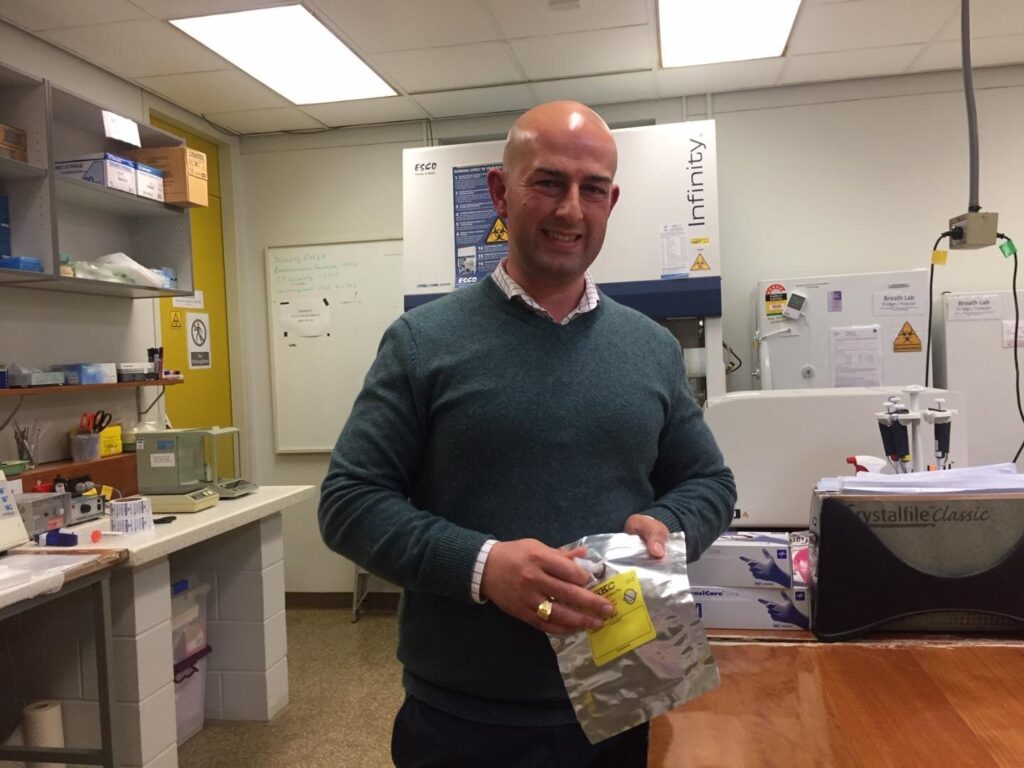
Dr. Yazbek added:
Our work has identified a unique profile of VOCs in an Australian patient cohort that can differentiate head and neck cancer patients from non-cancer patients.
For the study, published in the British Journal of Cancer, the researchers recruited a cohort of 181 patients with suspected early-stage neck and head cancer, who hadn’t received any prior treatment. The team used an ion flow-tube mass spectrometer to analyze their breath for VOCs and verify a specific pattern linked with neck and head cancer.
The results showed the breath test accurately detecting cancer 80% of the time and detecting benign cases, 86%. These outcomes were confirmed through tissue biopsy analysis and a second cohort of patients.
Dr. Yazbek explained:
A key advantage of our work is that we used an independent group to confirm the accuracy of our test. Even though the number of patients in this study was relatively low, the fact that the accuracy of the test was preserved in this independent group of patients gives us greater confidence in the usability of the test in clinical application.
The Flinders University team plan to build on these results with more extensive trials consisting of diverse patient groups, including different genders, ages, ethnicities, and cancer stages. Once the technology proves successful across a larger cohort, it could make its way into clinical use.


