
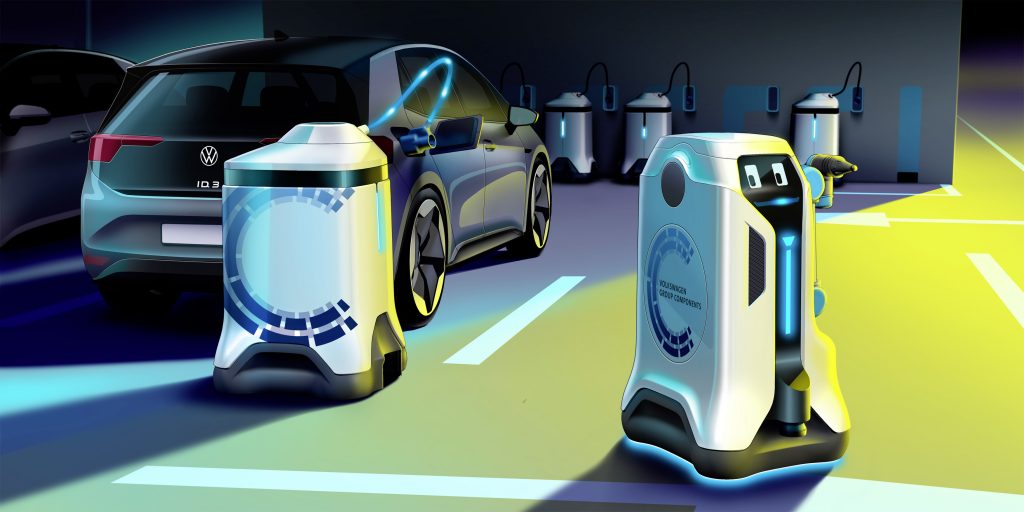
Volkswagen Group Components presents a futuristic idea of providing mobile charging robots so that you never have to search for an open charging station for your electric car ever again! The convenient technology makes its way autonomously to your vehicle and takes care of the whole procedure of charging it on its own too.
How It Works
- You park your EV (electric vehicle) in any spot in the parking lot.
- Then you launch the app or V2X communication that signals the mobile robot to your service. Your part of the process is complete.
- The robot drives itself to your EV with a trailer (the mobile energy storage device, aka battery wagon). It opens the charging socket flap to connect the plug to decoupling – the entire process happens without human interaction. It plugs the car into the trailer and moves on to do the same with the next car in line.
- The mobile energy storage device remains with the vehicle until it is fully charged. Then, the robot returns to collect it and bring it back to the charging station.

Mark Möller, Head of Development at Volkswagen Group Components, said:
The mobile charging robot will spark a revolution when it comes to charging in different parking facilities, such as multi-story car parks, parking spaces, and underground car parks because we bring the charging infrastructure to the car and not the other way around. With this, we are making almost every car park electric, without any complex individual infrastructural measures. It’s a visionary prototype, which can be made into reality quite quickly if the general conditions are right.

Möller said that Volkswagen Group Components is busy researching different approaches to the assembly of charging infrastructure. It is one of the company’s goals to develop better ways to flexibly and quickly charge EV’s. It has already developed several successful products and come up with many more creative ideas, such as these charging robots.
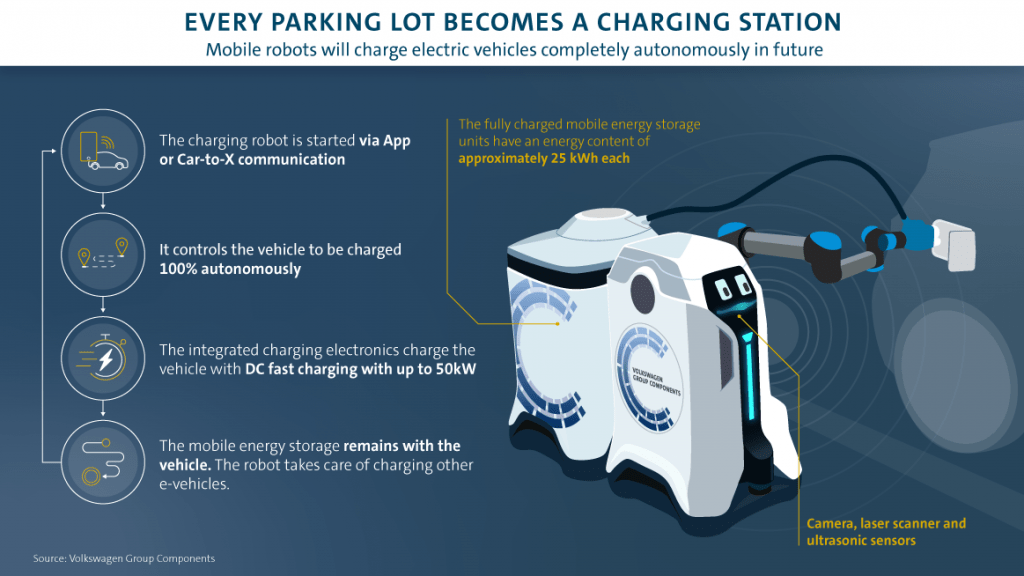
A single charging robot can transport several battery wagons at once. A wagon consists of integrated charging electronics that allow for DC quick charging with up to 50 kW on the vehicle. The robot is fitted with cameras, ultrasonic sensors, and laser scanners for safety and mobility. The combination of these systems is how the device can roam around autonomously – recognizing any obstacles and reacting to them in time – and how they can see what they are doing throughout the charging process.
The design of the robot is compact, so they can be employed in areas too small for charging infrastructures or restricted parking areas such as underground car parks. For now, the project is just in the prototype phase, and there is no date set for market launch.


