
In Northern California, there are five ancient stumps, remnants of redwoods from a giant sequoia known as General Sherman. These trees were so big, they were larger than the largest tree standing today. One of the stumps, for example, is a 35-foot-wide (11-meter) Fieldbrook stump, left by a coast redwood that was about 400 feet tall and more than 3,000 years old when it was cut down in 1890. Now, these redwood trees are an endangered species.

Archangel Ancient Tree Archive (AATA), a nonprofit group that creates “living libraries of old-growth tree genetics,” discovered that these stumps were still alive. Immediately, AATA co-founder David Milarch and his team led an expedition to clone them. Low and behold, born of DNA that conservationists retrieved from ancient redwood stumps came 75 little cloned saplings. These saplings carry on a valuable genetic legacy that dates back thousands of years!

The process to produce the saplings they planted was a long and complicated one. It takes about 2.5 years from the point when the source material is collected from a redwood stump, then to cultivate the saplings, and finally grow them large enough to plant. The method they use is actually mimicking a natural kind of asexual redwood propagation.
In the wild, coast redwoods can reproduce by self-cloning from masses of unsprouted bud tissue known as burl, as the U.S. National Park Service explains:
“Occasionally, a near perfect circle of redwood trees grows in the forest. These ‘fairy rings’ or ‘family circles’ sprouted from the basal burls of one parent tree, long harvested or fallen. … If a redwood falls or is otherwise damaged, the burl may begin to sprout from the trunk or branch it developed on, sharing or taking over the established root system of the parent tree. The new tree is an exact clone of the original tree, carrying its genetic identity far into the future.”
The AATA is calling their cloned saplings “champion trees,” a term for the largest tree of a given species, because they are clones of trees that were larger than any currently living redwoods. The nonprofit group has planted them all at a park called the Presidio, a national park beneath the southern end of San Francisco’s Golden Gate Bridge. They have created a new “super grove” of endangered coast redwood trees. There’s no guarantee they’ll live up to their champion title, but their genes and protected location at least give them a chance.

If they survive, they won’t only be the champions of their species by size, but also by their contribution to the wellness of our (and all other) species. The AATA points out:
“A mature coast redwood can remove huge amounts of carbon dioxide from the air sequestering as much as 250 tons of the greenhouse gas per tree. They also perform other important ecosystem services, like filtering water and soil, and they’re highly resistant to wildfires, droughts and pests.”
Milarch said in a statement:
“We’re excited to set the standard for environmental recovery. These trees have the capacity to fight climate change and revitalize forests and our ecology in a way we haven’t seen before.”
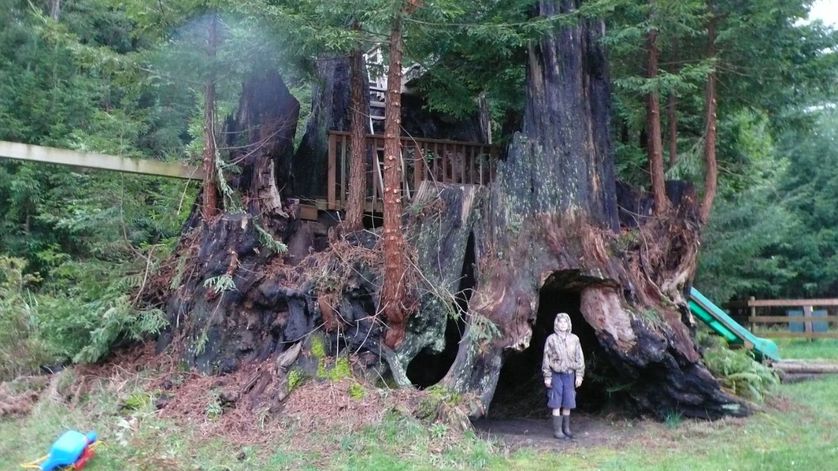
In addition to the Fieldbrook stump, which yielded 20 saplings, the AATA created clones from four other coast redwood stumps with diameters of at least 31 feet (9 meters): the Barrett stump (25 saplings), Barrett stump No. 2 (14 saplings), Big John stump (11 saplings) and Ayers stump (five saplings). Milarch says:
“These saplings have extraordinary potential to purify our air, water and soil for generations to come. We hope this ‘super grove,’ which has the capability to become an eternal forest, is allowed to grow unmolested by manmade or natural disasters and thus propagate forever.”


