
Two Chinese labs shipped open-weight “Flash” models 15 days apart, and both landed in the same narrow band of the market: roughly a million tokens of context, MIT-licensed weights, and API prices low enough to undercut closed frontier systems by an order of magnitude. Z.ai released GLM 5.3 Flash on August 26, 2026. DeepSeek followed with V4.1 Flash on September 10. Both belong to a broader wave, and our analysis of why Chinese AI models cost so much less explains the economics underneath that price gap.
On a spec sheet the two look like near-twins. Underneath, they were built on very different ideas about where cheap inference should come from, though the balance between them has shifted sharply since launch. This DeepSeek V4.1 Flash vs. GLM 5.3 Flash comparison rests on independently measured scores from Artificial Analysis v4.3.2 and Vals.ai, alongside each vendor’s own published numbers, so the head-to-head is built on tests that both models actually sat. Both labs also published full release documentation, including DeepSeek’s official API changelog and Z.ai’s GLM-5.3-Flash launch post.
At a Glance: Key Specifications
The two models share a licensing model, a context size, and a price band. Nearly everything else differs.
| Specification | DeepSeek V4.1 Flash | GLM 5.3 Flash |
|---|---|---|
| Developer | DeepSeek | Z.ai (Zhipu AI) |
| Released | September 10, 2026 (1017 refresh October 17) | August 26, 2026 |
| Total parameters | About 748B (552B backbone + 196B Engram memory) | 320B |
| Active per token | 8B prefill, 16B decode | 18B |
| Architecture | MoE with Causal Encoder-Decoder and Compressed Sparse Attention 2 | MoE with hybrid linear attention and sparse MLA |
| Context window | 1M tokens | 1,048,576 tokens |
| Maximum output | 384K tokens | 131,072 tokens |
| Input modalities | Text, image | Text, image, video |
| Reasoning control | Adjustable effort from 1 to 100 | Low, high, or max |
| License | MIT | MIT |
| Download size | 510 GB | 328 GB |
DeepSeek is the heavier model by total parameters, but it activates less per token than GLM does, which is the trick that keeps its serving costs competitive. Z.ai takes the opposite route: a leaner model with a bigger active slice and a wider input modality set. For the earlier generation of that design, see our breakdown of DeepSeek’s V4 MoE architecture.
Benchmark Comparison: Artificial Analysis Head-to-Head
This is where most comparisons fall apart, because vendor benchmarks use different harnesses and rarely overlap. Artificial Analysis tested both models on its own suite at v4.3.2, which makes the following numbers directly comparable in a way that vendor tables are not.
| Benchmark (Artificial Analysis v4.3.2) | DeepSeek V4.1 Flash | GLM 5.3 Flash | Edge |
|---|---|---|---|
| AA Intelligence Index | 45 | 42 | DeepSeek +3 |
| AA-LCR v1.1 (long-context reasoning) | 82.7% | 80.0% | DeepSeek +2.7 |
| AutomationBench-AA | 66.6% | 60.4% | DeepSeek +6.2 |
| Terminal-Bench v4.0 | 33.8% | 32.8% | DeepSeek +1.0 |
| SciCode (scientific programming) | 55.9% | 51.6% | DeepSeek +4.3 |
| Humanity’s Last Exam | 43.3% | 39.9% | DeepSeek +3.4 |
| GDP.pdf (all-pass) | 17.2% | 15.4% | DeepSeek +1.8 |
| CritPt | 24.0% | 15.4% | DeepSeek +8.6 |
| MMMU-Pro (multimodal reasoning) | 81% | Not published | DeepSeek only |
| GDPval-AA v2.1 (Elo, knowledge work) | 1746 | 1669 | DeepSeek +77 |
| AA-Briefcase Elo (enterprise) | 1570 | 1455 | DeepSeek +115 |
| AA-Omniscience Index | 5 | 7 | GLM +2 |
DeepSeek’s figures are the 1017 scores under Artificial Analysis v4.3.2. GLM 5.3 Flash has not been re-measured under v4.3.2, so its column carries the v4.3 figures from August. The 1017 release also reports four evaluations with no GLM counterpart: Terminal-Bench-Science 0.1 at 12.9%, FrontierCode 1.1 at 43.7%, MLCR-AA at 26.7%, and an AA-Omniscience non-hallucination rate of 33%.
The pattern is clean, and it now runs one way. DeepSeek leads every shared benchmark in this table except one. The widest margins are on CritPt physics reasoning at 24.0% against 15.4%, and on AutomationBench-AA at 66.6% against 60.4%.
The AutomationBench-AA gap is narrower than the September build recorded. That earlier release scored 68.9% there, which Artificial Analysis reported as the highest of any model on the test; the 1017 build gives back 2.3 points. Xiaomi's live training dashboard has been posting its own mid-training AutomationBench 1.0.6 scores alongside DeepSWE v1.1 results, covered in our report on the MiMo-V2.6 RL training dashboard.
Enterprise knowledge work has flipped outright. DeepSeek now leads GDPval-AA v2.1 by 77 Elo points (1746 to 1669) and AA-Briefcase by 115 (1570 to 1455), and it edges Terminal-Bench v4.0 by a single point. GLM's only remaining lead is the AA-Omniscience Index, and it has shrunk from twelve points to two.
That Omniscience result is worth reading carefully, because it measures knowledge reliability rather than raw recall. GLM sits at 7 and DeepSeek at 5 on a scale where zero means as many correct answers as incorrect ones, so the two are now close to level on hallucination risk, a sharp swing from the negative reading we flagged in its head-to-head against Muse Spark Open.
Science and reasoning are no longer a tie. SciCode now separates them by 4.3 points and Humanity's Last Exam by 3.4, both in DeepSeek's favour.
Benchmark Comparison: Vals.ai Agentic and Professional Suites
Vals.ai runs an agent-oriented evaluation suite built around real professional tasks rather than academic questions, and it scored both models. Its results tell a different story from the Artificial Analysis numbers, and the contrast is the most useful thing in this comparison.
| Benchmark (Vals.ai, 1017 release where restated) | DeepSeek V4.1 Flash | GLM 5.3 Flash | Edge |
|---|---|---|---|
| Vals Index (overall) | 61.26% | 47.22% | DeepSeek +14.0 |
| Terminal Bench 2.1 | 74.53% | 62.92% | DeepSeek +11.6 |
| Vibe Code Bench v1.1 | 87.73% | 30.76% | DeepSeek +57.0 |
| Code Migration | 67.52% | 20.52% | DeepSeek +47.0 |
| SkillsBench | 69.80% | 40.16% | DeepSeek +29.6 |
| ProofBench v1.1 | 54.00% | 21.00% | DeepSeek +33.0 |
| EMB | 69.17% | 55.93% | DeepSeek +13.2 |
| Legal Research Bench | 45.19% | 45.19% | Tie |
| Finance Agent v2 | 62.93% | 57.85% | DeepSeek +5.1 |
| MedScribe | 85.50% | 88.94% | GLM +3.4 |
| LegalBench | 83.28% | 83.93% | GLM +0.7 |
| Harvey's Legal Agent | 6.67% | 6.67% | Tie |
The Vals Index, Vibe Code Bench, Code Migration, EMB, Legal Research Bench, and Finance Agent rows reflect the October 17 release. Terminal Bench 2.1, SkillsBench, ProofBench v1.1, MedScribe, LegalBench, and Harvey's Legal Agent retain their September figures, which the 1017 refresh did not restate.
On agentic execution, DeepSeek wins almost everything. It takes the Vals Index by 14 points, leads Code Migration by 47 points, SkillsBench by nearly 30, and ProofBench by 33.
The Vibe Code Bench gap is the headline: 87.73% against 30.76%, a difference of nearly 57 points on a benchmark that measures how well a model builds working software from a plain-language brief.
GLM's wins have narrowed to a single domain: medical transcription, where it leads 88.94% to 85.50%. Legal research is now a dead heat at 45.19%, and finance agents have flipped to DeepSeek by 5.1 points. Both models still collapse on Harvey's Legal Agent at an identical 6.67%, which says more about that benchmark's difficulty than about either model.
Read the two suites together, and the 1017 refresh has sharpened the split almost to a clean sweep. GLM 5.3 Flash keeps only a two-point edge on knowledge reliability and a lead on medical transcription. V4.1 Flash is the stronger executor by a wider margin, and since the refresh it also leads the aggregate Intelligence Index, both Elo benchmarks, and every science and terminal test on the Artificial Analysis side.
Vendor-Reported Benchmarks and the Harness Caveat
Both labs publish their own tables, and the numbers there flatter each model. They are worth showing, but only with a warning attached: DeepSeek's table compares V4.1 Flash against GLM-5.3, the Z.ai flagship, not against GLM 5.3 Flash. That single detail invalidates most casual readings of the two pages side by side.
| Benchmark | DeepSeek V4.1 Flash (DeepSeek harness) | GLM 5.3 Flash (Z.ai) | GLM-5.3 flagship (in DeepSeek's table) |
|---|---|---|---|
| Terminal-Bench 2.1 | 90.6 | 84.3 | 88.2 |
| DeepSWE v1.1 | 74.2 | 63.4 | 66.9 |
| AutomationBench | 54.8 | 48.8 | 48.8 |
| Agents' Last Exam | 31.8 | 26.3 | 28.5 |
| HLE with tools | 63.9 | 55.3 | 62.5 |
| CyberGym | 88.1 | Not published | 84.5 |
| GPQA Diamond | 90.9 | Not published | 88.1 |
Two things stand out. First, Z.ai's own numbers for GLM 5.3 Flash land slightly below the GLM-5.3 flagship figures in DeepSeek's table, which is the expected direction: the Flash tier trades some depth for cost and speed.
Second, the harness effect is enormous. DeepSeek reports 90.6 on Terminal-Bench 2.1 using its own scaffold, while Vals.ai measured the same model at 74.53% on the same benchmark. That is a 16-point swing from test conditions alone. Vendor-only comparisons have the mirror problem, covered in our Flint vs Bonsai 2 27B comparison, where the shared parent model serves as the sanity check.
DeepSeek published its instruct results at maximum reasoning effort with temperature 1.0 and top_p 0.95. Lower effort settings score below those figures, and the DeepSeek Harness, Claude Code harness, and official scaffolds were each used for different task types.
None of that makes the numbers wrong, but it does mean vendor tables answer a different question than independent suites do: not "how good is this model" but "how good is this model with a lot of help."
Architecture: Two Routes to Cheap Long-Context Inference
The pricing on both models is only possible because of architectural choices, and the two labs solved the same problem from opposite directions. The goal in both cases was to stop long context and cached input from making inference unaffordable.
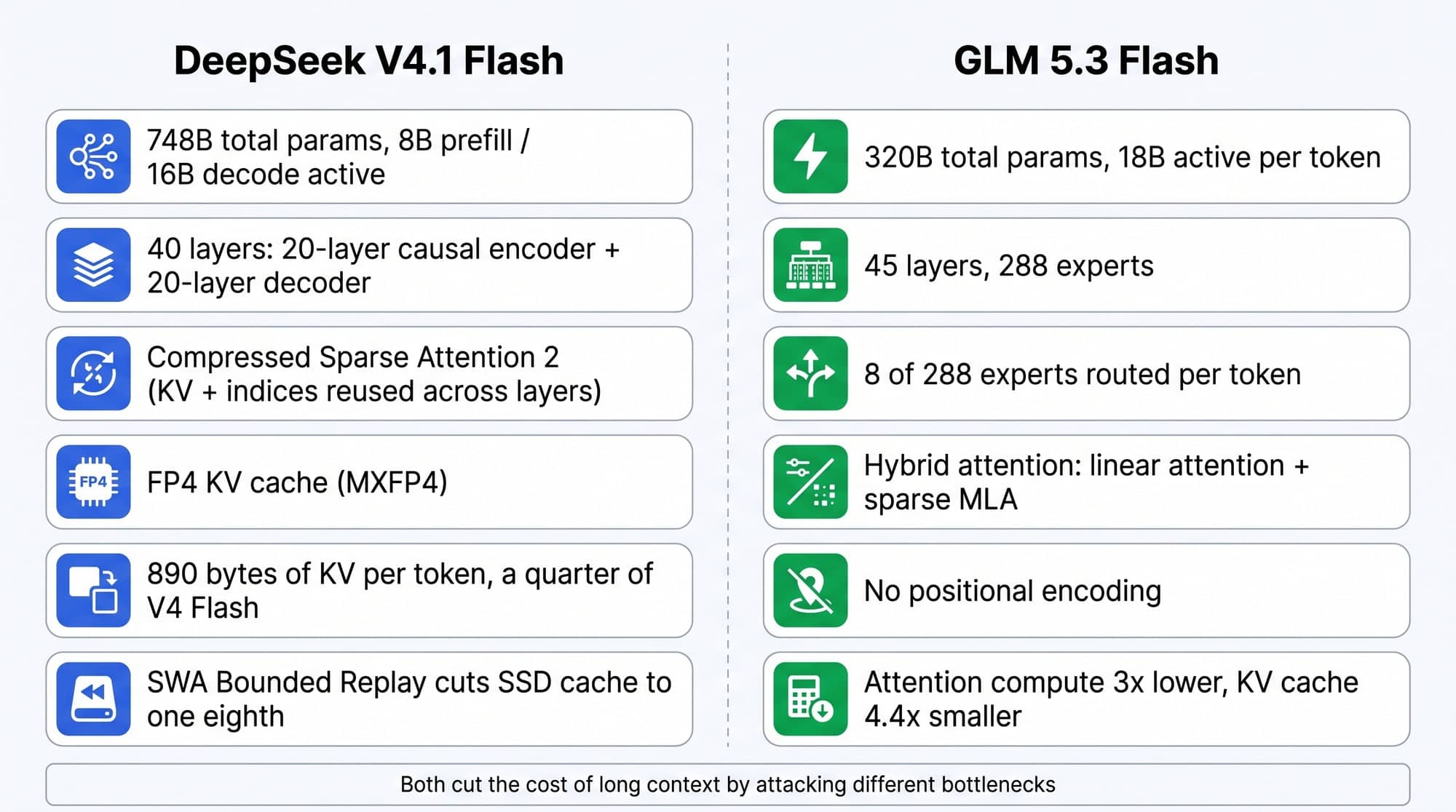
DeepSeek attacked the KV cache. V4.1 Flash splits its 40 layers into a 20-layer causal encoder and a 20-layer decoder, then projects the decoder's KV from the encoder's final hidden states rather than recomputing it per layer. Its Compressed Sparse Attention 2 lets each layer reuse both KV values and attention indices from a prior layer, and the main cache runs in MXFP4, a 4-bit format.
Together these bring the global KV cache to roughly 890 bytes per token, about a quarter of V4 Flash and a 437x reduction against DeepSeek V1. The company also added SWA Bounded Replay, which reconstructs sliding-window state by replaying recent tokens instead of writing it to SSD, cutting persistent cache to about one-eighth of V4 Flash.
Z.ai attacked the attention math instead. Its 320B model uses 45 layers, 288 experts, and routes each token through 8 of them. The attention stack is hybrid, combining linear attention with sparse multi-head latent attention in a no-positional-encoding scheme. Z.ai says this cuts attention compute by roughly 3x and KV cache size by about 4.4x against GLM-5.3. The model reached the public through a stealth preview, and our report on how Ox Alpha was identified as GLM-5.3-Flash covers that launch. For the training work behind the series, see our breakdown of how Z.ai achieved 6x coding gains without retraining its base model.
Both approaches produce the same practical result. A million tokens of context no longer implies a proportionate jump in cost, which is precisely what makes agentic workloads viable at Flash prices.
The two models also diverge on input. DeepSeek built a from-scratch vision encoder that handles images at arbitrary resolutions up to about 1344x1344 pixels, and it trained text and images jointly from the start of pre-training rather than bolting vision on afterward, continuing the direction set by its earlier experimental V4 Flash Vision model. Z.ai goes further on modality breadth, accepting video as a native input alongside text and images.
DeepSeek published a model card and technical report alongside the V4.1 Flash weights, and Z.ai released GLM 5.3 Flash under the same MIT terms.
API Pricing and Real Cost at Scale
Headline token prices make these models look nearly identical. The fine print does not.
| Billing item (per 1M tokens) | DeepSeek V4.1 Flash | GLM 5.3 Flash |
|---|---|---|
| Input, cache miss | $0.15 off-peak / $0.30 peak | $0.15 flat |
| Input, cache hit | $0.003 off-peak / $0.006 peak | $0.03 flat |
| Output | $0.60 off-peak / $1.20 peak | $0.50 flat |
| Web search | Not listed separately | $0.01 per call |
The key difference is the billing model. Z.ai charges a flat rate at all hours. DeepSeek charges double during peak windows, which run from 01:00 to 04:00 and 06:00 to 10:00 UTC on weekdays. Everything outside those windows is billed at half the peak rate.
For a wider view of how Flash-tier pricing compares across vendors, see our LLM API pricing comparison.
DeepSeek also charges ten times less for cached input. On a cache-heavy agent workload, that discount outweighs GLM's cheaper output price entirely. Here is what a batch of 10 million input tokens and 2 million output tokens actually costs:
| Scenario | DeepSeek V4.1 Flash | GLM 5.3 Flash |
|---|---|---|
| All input uncached, off-peak | $2.70 | $2.50 |
| 80% of input cached, off-peak | $1.52 | $1.54 |
| All input uncached, peak hours | $5.40 | $2.50 |
The verdict depends entirely on your traffic shape. GLM is cheaper on a straight uncached comparison, by about 7% off-peak and by more than half during DeepSeek's peak windows.
But the moment a workload reuses a long prompt prefix, DeepSeek's $0.003 cache-hit rate pulls it level, and it edges ahead during off-peak hours.
That distinction matters because the two use cases behave differently. A chatbot with fresh conversations on every request rarely hits the cache, so GLM wins on price. A coding agent looping over the same repository or document for dozens of turns hits the cache constantly, which is exactly the workload DeepSeek optimized for.
Speed, Latency, and Output Limits
Artificial Analysis has now measured both models, and raw throughput is where the two separate most sharply.
| Metric | DeepSeek V4.1 Flash | GLM 5.3 Flash |
|---|---|---|
| Output speed | 173.4 tokens/second | 90 tokens/second |
| Relative throughput | 1.9x faster | Baseline |
| Maximum output | 384K tokens | 131,072 tokens |
Artificial Analysis measures V4.1 Flash at 173.4 output tokens per second against 90 for GLM 5.3 Flash, which makes DeepSeek roughly 1.9 times faster on raw throughput.
That reverses the usual assumption about which tier is quicker. It matters most for interactive work, where a response that arrives in half the time changes what a product can do, and it compounds with output length, since a faster model finishes a long response sooner on both counts.
Early beta reports of decoding rates between 300 and 500 tokens per second were taken in an overloaded preview window and should be disregarded.
For scale, Artificial Analysis lists the previous V4 Flash at 201 tokens per second on maximum reasoning effort, so the 1017 build gives up roughly 14% of its predecessor's throughput in exchange for the higher scores.
On output limits, DeepSeek's 384K ceiling is nearly three times GLM's 131,072 tokens.
For agents that emit long file trees or full reports in one pass, that is a functional difference rather than a spec-sheet footnote.
Which Model Should You Choose?
The honest answer is that these models are close enough on headline specs that the choice should follow your workload, not a leaderboard. Here is how the evidence lines up. Flash-tier models have also been closing on Pro-tier coding performance for months, as our comparison of Qwen3.8-Flash against DeepSeek V4 Pro showed.
Choose DeepSeek V4.1 Flash if you need:
- Long-horizon agentic execution: It leads every shared Vals.ai agentic benchmark, including a 57-point gap on Vibe Code Bench and a 33-point lead on ProofBench.
- Heavy cache reuse: At $0.003 per million cached tokens off-peak, it is ten times cheaper than GLM for prompted prefixes that repeat across turns.
- Automation and orchestration: 66.6% on AutomationBench-AA against GLM's 60.4%, though that is 2.3 points below the September build.
- Very long outputs: 384K maximum output tokens supports single-pass generation that GLM's 131,072-token ceiling cannot match.
- Long-context reasoning: 82.7% on AA-LCR v1.1 against GLM's 80.0%.
- Native image understanding: A from-scratch vision encoder trained jointly with text, rather than an added module.
- Terminal-heavy workflows: 74.53% on Terminal Bench 2.1 against 62.92%, a gap of nearly 12 points measured on the same harness.
- Scientific programming: A clear lead on SciCode at 55.9% against 51.6%.
- Enterprise knowledge work: Leads GDPval-AA v2.1 by 77 Elo points and AA-Briefcase by 115, reversing GLM's advantage on both.
- Lower per-token compute: The model activates 8B parameters during prefill and 16B during decode, below the 18B active slice GLM uses.
- Faster output: 173.4 tokens per second against GLM's 90 under the same Artificial Analysis harness, a gap of roughly 1.9x.
Choose GLM 5.3 Flash if you need:
- Predictable flat pricing: No peak-hour doubling, which makes it far cheaper for latency-tolerant work scheduled during DeepSeek's peak windows.
- Knowledge reliability: It still leads the AA-Omniscience Index, though by only two points now, 7 against 5.
- Near parity on terminal work: Terminal-Bench v4.0 now separates the two by just 1.0 point, down from six in September.
- Video input: GLM accepts video natively, while DeepSeek's multimodal support covers text and images.
- Domain professional tasks: A lead on medical transcription at 88.94% against 85.50%, and a dead heat on legal research at 45.19%.
- Lighter self-hosting footprint: About 328 GB of weights against DeepSeek's roughly 510 GB download, which cuts storage and transfer costs.
- Cheaper during peak windows: With no peak-hour surcharge, a fully uncached workload costs $2.50 against DeepSeek's $5.40 at peak.
Frequently Asked Questions
Is DeepSeek V4.1 Flash better than GLM 5.3 Flash?
Neither model wins outright, though the 1017 refresh tilted the balance. DeepSeek now leads the aggregate Intelligence Index as well as agentic execution, long-context reasoning, cache-heavy cost efficiency, and maximum output length. GLM retains the edge on knowledge reliability, flat-rate pricing predictability, and native video input. Which one is better depends entirely on whether your workload is an executor or a generalist.
Which model is cheaper?
It depends on caching and timing. On uncached input, GLM 5.3 Flash is cheaper at $0.15 in and $0.50 out per million tokens, against DeepSeek's $0.15 and $0.60 off-peak. Once a workload reuses a long prompt prefix, DeepSeek's $0.003 cache-hit rate brings the two level and pulls slightly ahead off-peak. During DeepSeek's peak windows, though, GLM is more than twice as cheap.
Can I self-host both models?
Yes. Both ship open weights under the MIT license, which permits downloading, modifying, and deploying without an API dependency. GLM 5.3 Flash weighs about 328 GB, while DeepSeek V4.1 Flash is about 510 GB to download.
Neither fits on a single consumer GPU, and GLM's hardware floor in practice is a multi-GPU node.
Which one is faster?
DeepSeek V4.1 Flash is substantially faster. Artificial Analysis measures it at 173.4 output tokens per second against 90 for GLM 5.3 Flash, a gap of roughly 1.9x.
Do both models support images and video?
Both handle images natively. Only GLM 5.3 Flash accepts video as a first-class input. DeepSeek's native multimodal support covers text and images through its DeepSeek-ViT encoder.
Are these benchmark numbers directly comparable?
The Artificial Analysis and Vals.ai tables are because each platform tested both models on its own harness. The vendor-reported table is not, and the differences are large. DeepSeek reports 90.6 on Terminal-Bench 2.1 with its own scaffold, while Vals.ai measured 74.53% on the same model and benchmark. Always check which harness produced a number before comparing it to another vendor's.
Conclusion
DeepSeek V4.1 Flash and GLM 5.3 Flash sit closer together than almost any other pair of models in the affordable tier, which makes the decision less about raw capability and more about workload shape. GLM's case has narrowed to predictable flat pricing, native video input, a two-point edge on knowledge reliability, and a lead on medical transcription, though the October 17 refresh cost it the aggregate lead.
DeepSeek is the better tool for sustained work. It wins nearly every agentic benchmark in the shared Vals.ai suite, leads ten of the eleven shared Artificial Analysis benchmarks, generates almost three times as much output per response at nearly twice the throughput, and rewards cache-heavy workloads with a cache-hit rate an order of magnitude below its rival's. A third challenger now competes in the same price band: Unisound's U2-Flash, a 266B sparse MoE that activates just 10B parameters and benchmarks itself against both DeepSeek and GLM Flash checkpoints.
The competitive pressure between them points to something larger. Both are MIT-licensed, both offer roughly a million tokens of context, and both cost a fraction of what closed frontier models charge, yet neither was designed to be a cheaper copy of the other. The architectures diverge sharply, from DeepSeek's radically compressed KV cache to Z.ai's hybrid attention stack.
Two labs solving the cost problem in opposite directions and arriving at the same price point is a more interesting result than either model's benchmark sheet. DeepSeek's September work was not confined to the API, though: the lab also began a DeepSeek voice chat gray test in its consumer app, with four selectable voices. The broader trend behind that convergence is covered in our analysis of the open-weight advantage Chinese labs have built.
For a broader view of how these models stack up against the wider field, see our full breakdown of the DeepSeek V4.1 Flash release and the Gemini 3.8 Flash vs GLM 5.3 Flash comparison. Developers weighing the caching economics in more detail can also review how cache hits drive DeepSeek's agent costs.
Update (October 27, 2026): DeepSeek shipped a V4.1 Flash 1017 refresh on October 17, and it shifts several of the results in this article. On Vals.ai the Vals Index rose from 57.86% to 61.26%, Code Migration from 45.62% to 67.52%, Vibe Code Bench from 84.74% to 87.73%, and EMB from 57.21% to 69.17%. On Artificial Analysis the Intelligence Index climbed from 40 to 45, which now places DeepSeek three points ahead of GLM 5.3 Flash's 42 rather than two points behind it. The refresh appears to trade some throughput for capability, with Artificial Analysis measuring the 1017 release at 173.4 output tokens per second, down from the 194 recorded for the September build and still well ahead of GLM's 90. The practical effect is a wider DeepSeek lead on agentic and coding work and a reversed verdict on aggregate intelligence. The benchmark tables above have been updated to the 1017 figures.


