
Twenty-five years of exhaustive negotiations culminated in January 2026 when the European Union and the Mercosur bloc, comprising Brazil, Argentina, Paraguay, and Uruguay, finalised their historic trade agreement. The landmark pact, described by the European Commission as the EU’s largest trade deal to date, unites a massive consumer base of more than 700 million people and roughly a quarter of the world’s GDP.
Amid celebration in Brussels and Asunción, diverse environmental and agricultural advocates across Europe are confronting a pivotal concern: Can this deal truly align with the EU’s deforestation-free promises as the Amazon tipping point looms? The intersection of the EU–Mercosur trade agreement and the newly established EU Deforestation Regulation (EUDR) creates a defining moment for global climate policy.
While the deal aims to remove tariffs on over 90 per cent of goods, it simultaneously tests the EU’s unwavering commitment to establishing deforestation-free supply chains that meet strict EUDR standards. For Europe to lead the world on environmental protection, it must ensure that expanding South American agricultural exports (particularly beef and soy) do not accelerate the collapse of critical carbon sinks like the Amazon and Cerrado. The agreement is no longer just a trade instrument; it serves as a definitive gauge for climate-compatible trade within our increasingly resource-constrained global economy.
Supporters of the deal advocate for the partnership as a strategic alliance that shifts the EU’s supply chains away from heavy reliance on China and the United States. Critics, by contrast, maintain the agreement clashes with European climate commitments and the newly established EU Deforestation Regulation (EUDR), which requires that all imported commodities be verified as deforestation-free.
At its core, this deal represents a tension between two European ambitions: expanding global trade and leading the world on environmental protection. In a world where only one country produces sufficient food to match its internal diet patterns, the Amazon and Cerrado (critical carbon sinks already at the brink of irreversible decline) may become the proving grounds for whether Europe can pursue both without sacrificing one.

Strategic Overview: EU-Mercosur Trade Pact Quick Facts
- Signed: January 17, 2026, in Asunción, Paraguay.
- Parties: European Union and Mercosur (Brazil, Argentina, Paraguay, Uruguay).
- Population Covered: Over 700 million people.
- Tariff Scope: Eliminates more than 90% of tariffs between the blocs.
- Key Exports:
- EU exports: cars, machinery, wine, and pharmaceuticals.
- Mercosur exports: beef, soy, sugar, poultry, and ethanol.
- Environmental Concern: Potential increase in deforestation and carbon emissions from agricultural expansion in the Amazon and Cerrado, even as pioneering Welsh deforestation-free procurement strategies demonstrate how governments are starting to link trade decisions with forest protection.
- Legal Context: Must still be ratified by the European Parliament and each Mercosur national legislature.
- Related Policy: The EU deforestation regulation establishes mandatory due diligence to ensure that goods sold in the EU are not linked to deforestation after 2020.

Core Mechanisms of the EU–Mercosur Partnership
Market Expansion and Industrial Synergy
The EU–Mercosur trade agreement aims to open trade borders and spark economic collaboration between the European Union and South America’s dominant economies. European industries stand to gain significantly from the newly established trade framework.
- Industrial giants will enjoy lower tariffs on passenger vehicles and automotive components.
- Machinery and technical equipment manufacturers can expand South American operations.
- Chemical and pharmaceutical sectors will benefit from reduced non-tariff barriers.
- Wine and spirit producers gain protected geographical indications for their exports.
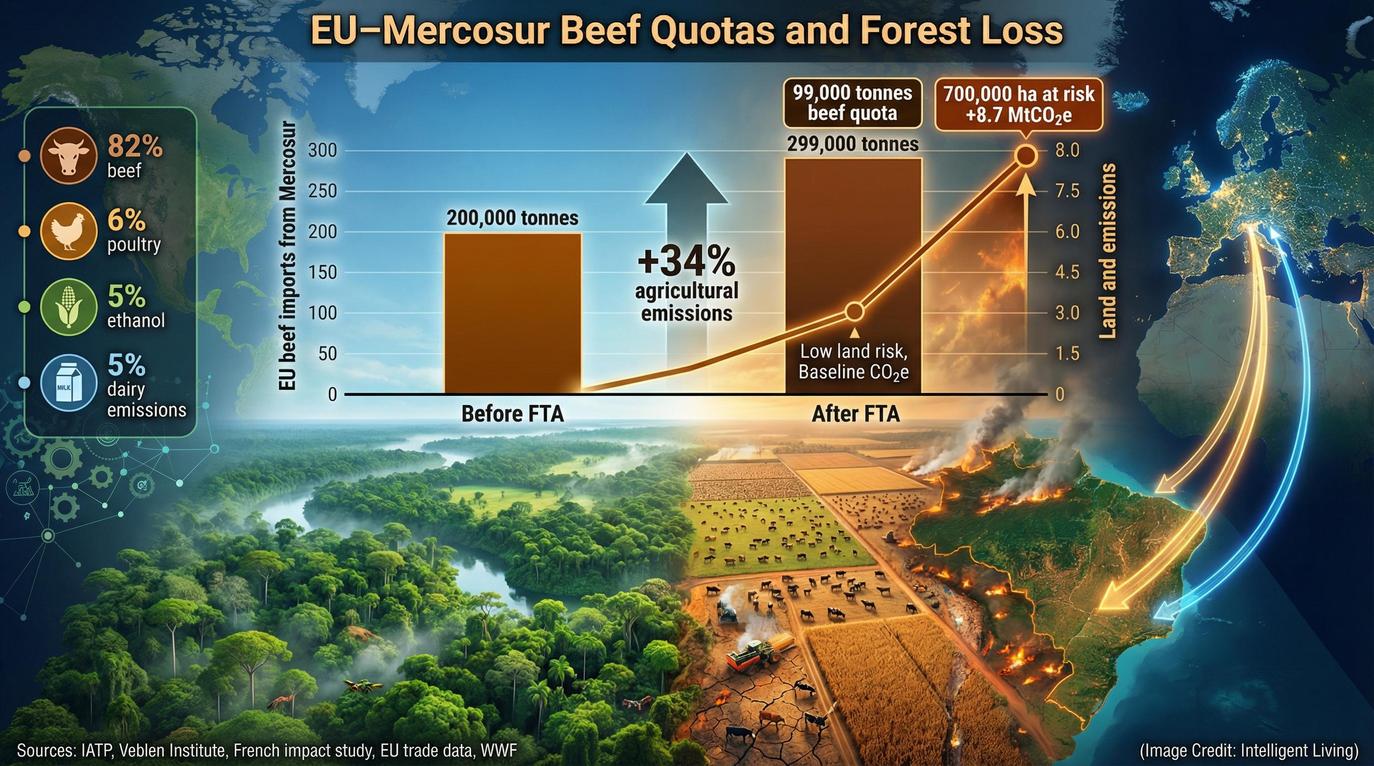
Streamlined export conditions are designed to bolster European manufacturing while diversifying international trade partners. In return, Mercosur countries gain expanded quotas for agricultural exports, such as 99,000 tonnes of beef at a 7.5 per cent tariff, and additional access for poultry, sugar, and ethanol. The agreement also covers digital trade, intellectual property rights, and government procurement contracts.
Reconciling Economic Ambition with Environmental Mandates
Supporters of the deal advocate for the partnership within the European Commission, arguing that it strengthens transatlantic cooperation, positions Europe as a key ally in South America, and supports economic diversification away from reliance on China.
Environmental organisations emphasise a stark incongruity: the agreement surfaces just as Europe begins enforcing its landmark deforestation-free import mandates. Critics warn that boosting trade in high-risk commodities like beef and soy could undermine Europe’s environmental regulations before they are fully implemented. Advocates of regenerative capitalism and circular economics counter that we must construct modern trade policy from the ground up to reinforce ecosystem limits rather than test them.
The Legal Limitations of Sustainable Development Chapters
The sustainability chapter of the deal, officially termed the Trade and Sustainable Development (TSD) chapter, references the Paris Agreement and includes language on forest protection, labour rights, and biodiversity.
Unlike tariff disputes, environmental provisions cannot trigger sanctions or trade suspension. Consequently, while the deal is ambitious in economic scope, its environmental commitments remain dependent on goodwill rather than legal obligation.
For many policymakers and citizens, the EU–Mercosur agreement is more than a trade deal—it serves as a definitive gauge for climate-compatible trade within our increasingly resource-constrained global economy while still expanding global trade.
The Forest Reality Check: Amazon and Cerrado Under Pressure
Satellite Monitoring and Real-Time Carbon Sink Verification
The Amazon rainforest and the Cerrado savanna serve as the twin lungs of South America. These ecosystems absorb billions of tonnes of carbon dioxide annually while regulating vital rainfall patterns across the entire continent. Decades of unchecked agricultural growth have pushed both ecosystems to the threshold of collapse. Recent research confirms that parts of the Amazon now contribute to global warming as net emitters of carbon due to deforestation and fires.
Primary Drivers of Ecosystem Clearance
Approximately 80 per cent of regional forest loss results directly from cattle ranching operations. The link is substantiated by investigations linking forest loss to global beef supply chains. Simultaneously, intensive soy production—primarily for European and Chinese animal feed—drives the rapid clearance of the Cerrado biome.
A comprehensive assessment of land-use change under the new trade framework estimates that roughly 76 per cent of the EU’s land-use change emissions come from imported oilseeds and vegetable oils, including soy. Satellite data confirms that blazes are three times more likely within cattle ranching zones than elsewhere in the forest.
Ecological Projections and Economic Trade-Offs
Expanding agricultural exports under the EU–Mercosur deal could accelerate these trends. The European Commission projects a modest 0.1 per percent GDP boost for the EU and 0.46 per cent for Brazil, but environmental scientists argue the ecological cost may far outweigh the economic gain. Models from forest-monitoring NGOs predict that the deal could indirectly cause up to 700,000 hectares of additional deforestation through expanded cattle and soy production.
Indigenous communities tethered to intact forests for survival grapple with escalating threats from land grabbing and unauthorised logging. Environmental defenders in Brazil have already warned that any surge in demand for beef and soy without strict deforestation safeguards will intensify conflict in these regions.
Europe’s challenge is therefore not only moral but practical: how to ensure that its appetite for cheap protein and biofuels does not turn the Amazon—once a vital carbon sink—into a permanent source of greenhouse gases.

Decoding the EU Deforestation Regulation Compliance Framework
Geospatial Data and Transparent Geolocation Standards
The EU Deforestation Regulation (EUDR), passed in 2023, is one of the world’s most ambitious attempts to separate trade from forest loss. The regulation imposes comprehensive requirements across several critical commodities most frequently linked to tropical forest loss.
- Cattle and associated leather or meat products.
- Soy used for global animal feed and biofuels.
- Coffee and cocoa destined for European consumers.
- Oil palm and its numerous industrial derivatives.
- Rubber and wood products, including furniture and paper.
The comprehensive scope ensures that nearly all high-risk imports must undergo rigorous EUDR compliance checks before entering the market. The law mirrors due-diligence ideas in measures such as the UK Environment Bill that obliges companies to reveal the sources of raw materials to curb illegal deforestation.
To comply, companies must provide geolocation data identifying where each product was produced. For farms larger than four hectares, they must submit polygons rather than single coordinates, offering detailed boundaries that can be cross-checked with satellite imagery. This geospatial data feeds into an EU information system that authorities use to verify deforestation-free claims.
The European Space Agency’s Sentinel-2 satellites, which provide high-resolution spectral imagery that provides an unprecedented view of planetary health, are already being used to track land-use change in near real time. Work showing how Sentinel-2 spectral satellite data verifies EUDR compliance demonstrates that multispectral imagery now provides a level of transparency that was impossible only a few years ago.
Phased Implementation and Global Risk Metrics
Originally, the EUDR was set to apply by the end of 2025, but after strong lobbying from member states and industry groups, enforcement was postponed.
Large companies now have until December 30, 2026, to comply, while small and medium-sized enterprises (SMEs) have until June 30, 2027. The regulation also introduced a risk-based inspection model: 9 per cent of imports from high-risk countries will be checked, 3 per percent from standard-risk, and 1 per cent from low-risk. Notably, Brazil (home to some of the world’s highest deforestation rates) is currently classified as “standard risk”.
Critics say these delays and classifications dilute the regulation’s power. Environmental NGOs argue that by the time the EUDR is fully implemented, deforestation could surge due to the expanded trade enabled by EU–Mercosur. Proponents counter that the regulation’s digital transparency tools, when paired with independent monitoring and consumer awareness, can still drive meaningful change. The effectiveness of Europe’s technology in outpacing deforestation on the ground will determine if the EUDR fulfils its promise as the backbone of a truly deforestation-free market.
Where EU–Mercosur and EUDR Clash—or Could Reinforce Each Other
Regulatory Friction and the Enforcement Paradox
The intersection of the EU–Mercosur pact and the EUDR reveals a friction where timelines, incentives, and enforcement protocols often diverge. Trade liberalisation can increase the flow of deforestation-linked goods faster than monitoring systems can verify them. Legal experts warn that this creates a conflicting set of rules: the EU may import more commodities just as its ability to trace them weakens.
Greenpeace and the authors of a review of deforestation trade risks maintain that the agreement could undermine EUDR implementation by increasing political pressure to soften enforcement for key exporters. The agreement’s sustainability provisions remain primarily symbolic and operate without the teeth of binding sanctions for environmental negligence. Without clear consequences, forest protection risks becoming an optional clause rather than a core requirement.
Technological Synergy and Biodiversity Trust
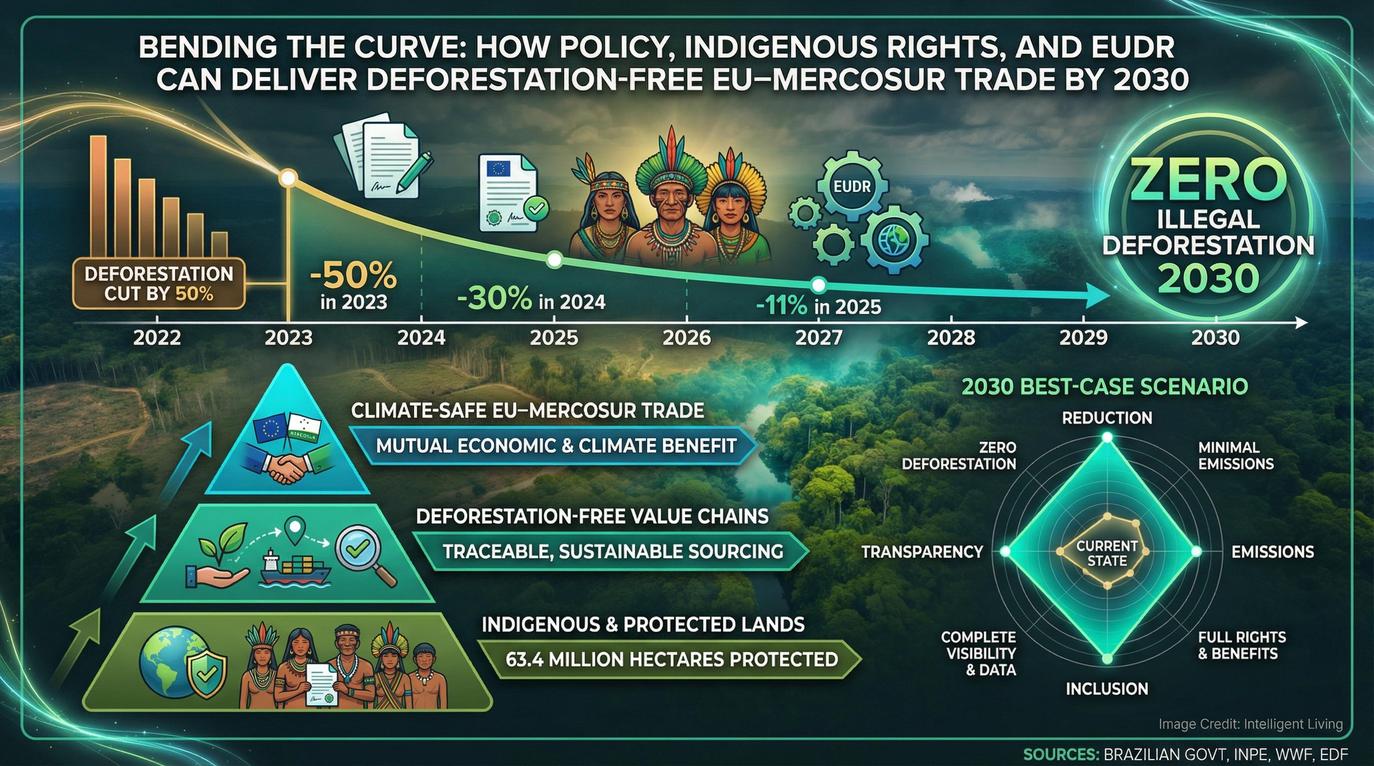
Some analysts see potential synergy. If implemented responsibly, the EUDR’s satellite-driven transparency tools and emerging QR-based digital product passports could complement the trade deal by ensuring that only verified deforestation-free goods enter the EU. Coordinated data sharing between customs, environmental agencies, and Mercosur governments could turn the agreement into a model for climate-compatible trade. The challenge lies in bridging the gap between policy ambition and enforcement reality.

Strategic Pathways for Climate-Compatible Trade Agreements
Technical Adjustments and Real-Time Verification
To align the trade agreement with global climate goals, experts suggest a series of policy and technical adjustments. Policy experts have outlined several technical adjustments to ensure the trade deal remains climate-compatible.
- Upgrade high-deforestation zones in Brazil and Paraguay to ‘high-risk’ status.
- Link all tariff reductions for beef and soy to verifiable, real-time forest data.
- Integrate geospatial MRV that binds satellite data to supply chain traceability directly into the trade framework.
- Redirect funding toward smallholder farmers transitioning to regenerative agriculture.
These measures would transform the agreement from a potential threat into a robust engine for environmental stewardship. Another improvement would be to embed independent monitoring systems within the trade framework. Satellite data from programmes such as Sentinel-2 could provide real-time verification of land use, allowing authorities to pause or revoke preferential access if deforestation spikes.
Safeguarding Indigenous Rights and Forest Stewardship
Protecting Indigenous and local communities is a foundational element for any climate-compatible trade agreement. Recognising their land rights and investing in forest stewardship programmes can create long-term resilience against illegal logging and land grabbing.
Structural Shifts within Global Food Systems
Modern trade policy must eventually align with the food system transformation described in a science-based 23-point roadmap for a food system that protects health and nature. Shifting away from imported feedstock while championing plant-based proteins would effectively dismantle the structural demand currently fuelling global deforestation.
Geopolitical Impacts on Farmers and Agricultural Supply Chains
Promoting Regenerative Agriculture and Economic Equity for Smallholders
The EU–Mercosur agreement affects farmers in Europe and South America in very different ways. For Mercosur producers, it offers new market opportunities but also new compliance costs. Meeting EUDR requirements demands technology, traceability, and certification systems that small farmers may struggle to afford. Without financial and technical support, many could be excluded from lucrative EU markets.
Competitive Pressures on European Welfare Standards
In Europe, the reaction has been one of concern. Farmers across France, Ireland, and Poland fear an influx of lower-cost South American beef that could place local producers at a severe competitive disadvantage.
Potential market saturation has sparked protests and urgent calls for compensation from the European Commission. While policymakers promise safeguards, the broader question remains: can European agriculture remain competitive while adhering to higher environmental principles? Recent agricultural breakthroughs in 2025 suggest that support for climate-resilient crops, early-warning systems, and fairer value chains will strongly influence that outcome.
Pathways Toward a Just Agricultural Transition
A just transition will require ensuring economic fairness while upholding ecological integrity.
Both regions can benefit from exchanging technology and sharing sustainability goals, particularly through young farmers who adopt regenerative methods to rebuild soils and ecosystems, such as utilising carbon sequestration projects or local supply chain innovations. These initiatives could turn perceived trade threats into opportunities for collaboration.

Individual Action and Consumer Influence on Global Deforestation
Sustainable Diet Choices and the Planetary Health Perspective
The fate of the EU–Mercosur deal now rests with parliaments, but everyday citizens hold the key to shifting the market. European readers can contact Members of the European Parliament (MEPs) to urge stronger deforestation safeguards before ratification. Supporting retailers and brands that commit to deforestation-free supply chains sends a powerful market signal that sustainability matters.
Everyday citizens hold the key to shifting the market footprint through daily choices.
- Moderating beef consumption to lower the demand for Amazonian pasture.
- Selecting only verified sustainable products with clear supply chain transparency.
- Supporting brands that publicly commit to rigorous EUDR compliance.
Personal shifts in eating patterns can significantly lower individual emissions while sending a clear signal to global retailers.
Scientific Advancements within the Global Food Chain
Detailed guides regarding household food waste impacts demonstrate how everyday habits across the food chain can either amplify or reduce demand for deforestation-linked commodities.
Alternative innovations, such as experimental animal feed that uses CO₂ captured from industrial smokestacks as a carbon source, demonstrate how science can relieve pressure on tropical forests by reducing demand for soy-based feed.
Incremental lifestyle shifts, combined with political advocacy, can collectively shift demand toward climate-positive trade.
Navigating Trade Realities Within a Planetary Budget
The EU–Mercosur agreement represents far more than a simple economic milestone; it serves as a decisive ethical juncture for Europe’s environmental leadership. The coming years will reveal whether the EU’s rigorous deforestation regulation and its global trade ambitions can truly coexist or if ecological integrity must eventually give way to market expansion.
Implementing advanced satellite monitoring, equitable farmer support, and transparent accountability protocols will determine whether this partnership helps preserve the Amazon or merely accelerates its inevitable decline. If Europe succeeds in this delicate balancing act, it could establish a global precedent for climate-safe trade that harmonises with emerging circular economy strategies that could help rescue biodiversity by 2026.
Such a victory would prove that economic prosperity does not require the destruction of our most vital biodiversity hotspots. Conversely, a failure to enforce EUDR compliance within these new supply chains could mean that the world’s largest rainforest, and the planet’s long-term climate stability, will pay the ultimate price for short-term commercial gains.

Essential Insights into Trade and Forest Protection
1. What defines the core of the EU–Mercosur trade agreement?
This comprehensive free trade deal between the European Union and Mercosur nations (Brazil, Argentina, Paraguay, and Uruguay) removes industrial tariffs while significantly expanding South American agricultural exports into European markets.
2. Why is the Amazon tipping point critical to this deal?
Increased demand for beef and soy can drive land clearing; if deforestation exceeds 20-25%, the Amazon may transition from a carbon sink into a dry savanna, triggering a global climate catastrophe.
3. How does the EU Deforestation Regulation (EUDR) ensure compliance?
The EUDR mandates that companies prove their products are not linked to forest loss after 2020 by providing precise geolocation data and utilising Sentinel-2 satellite imagery for verification.
4. When must companies meet these new environmental standards?
Large-scale corporations are required to achieve full EUDR compliance by December 30, 2026, while small and medium-sized enterprises have an extended deadline until June 30, 2027.
5. Can consumers truly influence deforestation-free supply chains?
Individuals shift market demand by choosing verified sustainable products, reducing beef consumption, and advocating for trade agreements that prioritise measurable environmental outcomes over profit.
6. How do individual diet choices influence climate outcomes?
Shifts in eating patterns, described in work on examinations of how everyday diet choices influence climate outcomes and planetary health, can also significantly lower individual emissions while sending a clear signal to global retailers about the importance of planetary health.


