
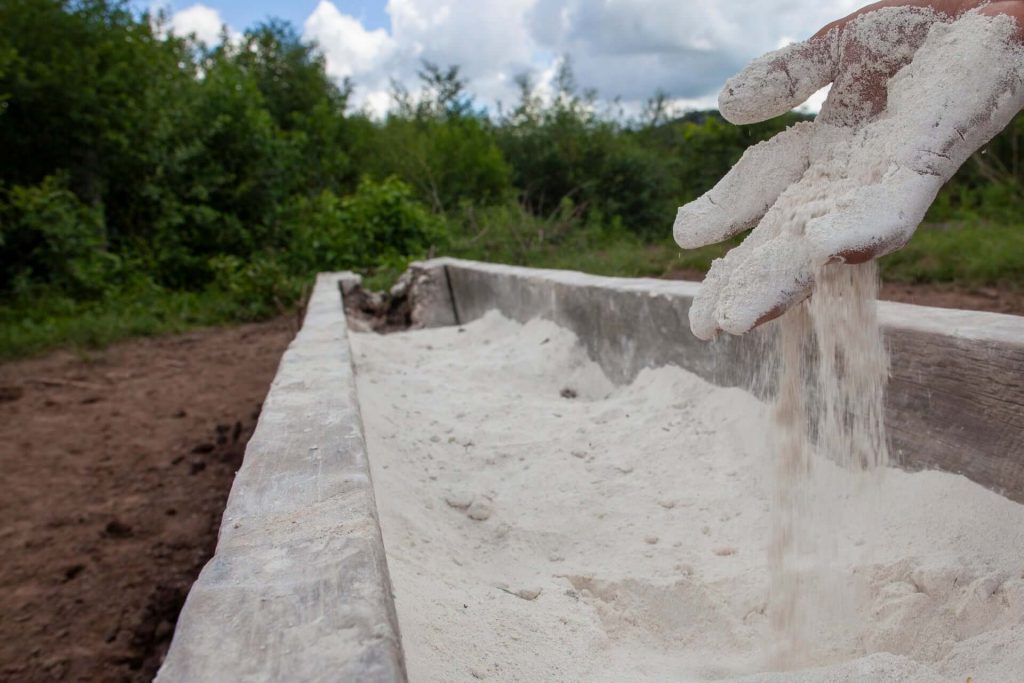
If you had just passed through the Lagoa do Triunfo cattle farm you’d think it was a perfectly peaceful, normal pastoral scene. As far as you can see there are signs of fresh pasture there – short grass, feeding troughs, and salt for cattle. It is a vast 145,000-hectare (358,302-acre) farm. You’d never know the land has been forbidden to use for cattle since 2010 when it was embargoed by Brazil’s government’s environmental agency Ibama for illegal deforestation.
This farm is but one of many owned by the company AgroSB Agropecuária SA – known in the region as Santa Bárbara. Lagoa do Triunfo is an environmentally protected area, over 600km (372 miles) from the capital of the Amazon state of Pará. This region is on the western fringes of Brazil’s “agricultural frontier” – where farming eats into the rainforest.

At one point, you could only get to this cattle town by plane, but now there are dirt roads hours long that lead you to a ferry ride from nearby São Félix do Xingu. The town of São Félix do Xingu has a population of 125,000 people and more than two million cattle, and it covers an area bigger than Scotland. Cattle farming fed the area’s growth and there are clear signs of wealth here.
A farm is embargoed when the landowners cut down trees and deforest illegally. It’s a form punishment for environmental violations but it also serves to protect the planet allowing for the land to recover. Between 2010-2013 at least 12 areas of land on Lagoa do Triunfo were embargoed. Not only was the land prohibited for use, but Ibama also imposed heavy fines in the millions of dollars on AgroSB for deforestation on the Lagoa do Triunfo farm.
AgroSB, supplies cattle to JBS, the world’s biggest meatpacking company and single top supplier of beef, as well as chicken and leather globally. JBS is so massive it has 350,000 customers in more than 150 countries.

The Guardian, Repórter Brasil, and the Bureau of Investigative Journalism collaborated on an investigation in 2018 and found that the Lagoa do Triunfo farm delivered hundreds of heads of cattle to other farms also owned by AgroSB for fattening. These cattle were then sent from those farms to slaughter in JBS plants.

The lands they investigated were land clearly demarcated as embargoed on government websites but they found cows grazing there. Upon questioning a farm worker there, he said the cattle were allowed to roam in areas employees knew were embargoed. “You can’t cut down the vegetation,” the employee said. “The vegetation grows and we work the cattle inside.”
Yet, work by NGO Trase reveals thousands of hectares of Amazon are being felled every year to provide meat for world markets. It makes clear the extent to which the international demand for beef is driving deforestation.

AgroSB is a powerful farming empire that owns half a million hectares across Pará and has long attracted controversy. JBS is familiar with scandal as well. The company has already been fined millions for buying cattle from farms with embargoed areas, including another farm owned by AgroSB. Since then, they’ve pledged to stop buying cattle from such farms but it seems they have found loopholes around that.
As The Guardian reports:
The independent audit found the company had made impressive progress in tightening up procedures and shutting out farms with areas embargoed by Ibama. However, although the system excludes farms that have embargoed areas, the audit noted that other farms owned by the same company may still sell to JBS. It concluded that: “Indirect suppliers of cattle to JBS are not yet checked systematically, since JBS has not yet managed to adopt auditable procedures for its indirect suppliers.”
Official state documents seen by the Guardian and Repórter Brasil show that from January to October 2018, Santa Bárbara delivered at least 296 cattle from the Lagoa do Triunfo farm to its Espiríto Santo farm in Xinguara, in the same state.
Between July and December 2018, Santa Bárbara sent least 1,977 cattle from the Espiríto Santo farm to two JBS slaughterhouses in Pará. In January at least 936 cattle were sent from the Espírito Santo farm to JBS’s slaughterhouse in Redenção in Pará.
Throughout 2018, Santa Bárbara also sent at least 729 cattle from the Lagoa do Triunfo farm to be fattened at its Porto Rico farm in Xinguara. In April 2018, 36 cattle from the Porto Rico farm were sent to slaughter at JBS’s plant in Tucumã in Pará.

What all this goes to show is that the growing international demand for beef has become a key driver in the destruction of the Amazon rainforest and it’s linked to a handful of major food corporations. According to data assembled by Trase, companies in JBS’s supply chain are potentially responsible for the destruction of between 28,000 and 32,000 hectares (280-320 sq km) of forest each year for exported beef.
Erasmus zu Ermgassen, lead researcher at Trase, said that “while some slaughterhouses monitor their direct suppliers, none monitor their indirect suppliers.” However, all this deforestation is unnecessary. “There is enormous potential to use land more efficiently and sustainably in the Brazilian beef sector, and to improve rural livelihoods by investing in cattle ranching on existing pasturelands,” Ermgassen says.


