
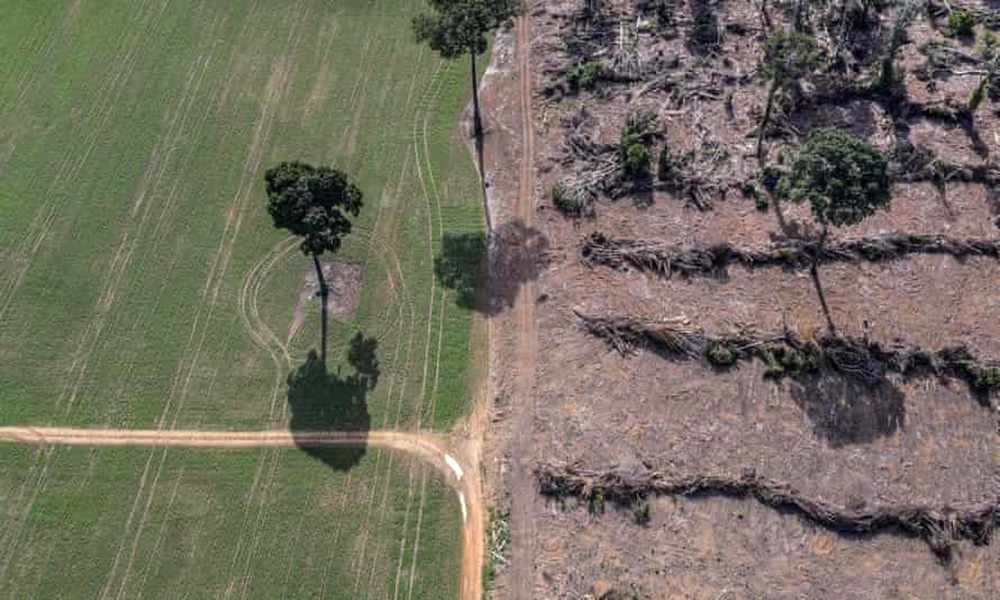
Farmers raising livestock need lots of animal feed that’s high in protein. It’s one factor that makes animal husbandry so bad for the environment and meat-eating so unsustainable. Many animals are fed soy, which is linked to deforestation in the Amazon rainforest and other regions, or fishmeal, linked to overfishing. It requires large quantities of wild-caught fish to produce.
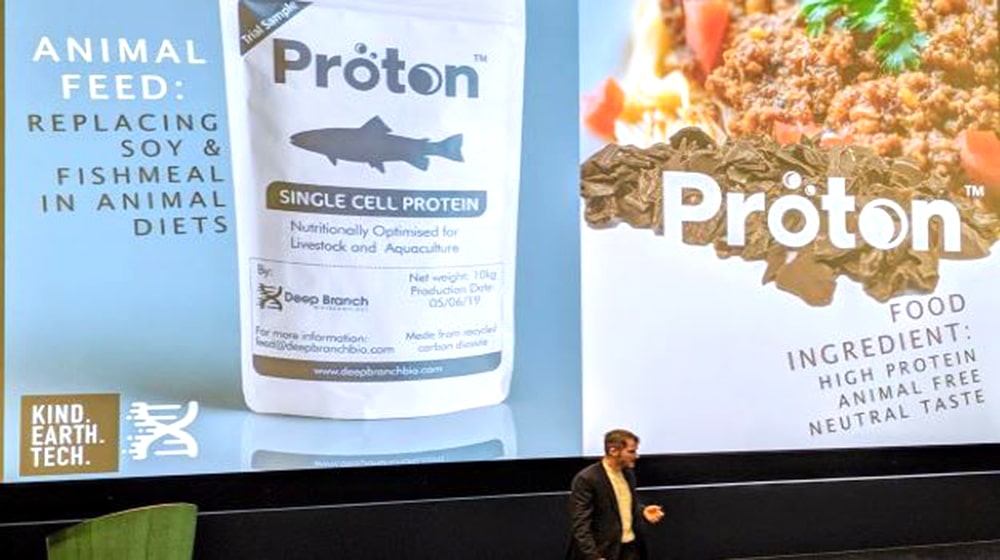
These natural protein sources are an ecological disaster, so a UK company called Deep Branch developed a way to turn carbon dioxide into high-quality protein for animal feed. It raised €8m (£6.8m) in funding because others see the value in displacing the use of deforestation-linked soy too. The protein, which the company will make in Europe, offers a more sustainable and secure food source that’s less affected by seasonality, climate, or geopolitics.
Deep Branch’s co-founder, Peter Rowe, said, “There are big sustainability drawbacks from the proteins we currently use to produce animal products like salmon fillets and chicken drumsticks, but we can produce a high-quality protein without requiring any arable land or fish.”
Making the protein involves feeding carbon and hydrogen to microorganisms in a fermentation process akin to a brewery. However, in this case, instead of alcohol, the output is a protein that can be dried and turned into pellets to feed livestock. The same principle is being applied to fats elsewhere, with a palm oil substitute now fermented from industrial exhaust gases.
The carbon will be recycled—sourced from industrial emitters. The company puts the waste gas through a chemical purification process before using it to produce protein. The process separates the CO2 from other gases.
Mike Allen, an environmental sciences professor at the University of Exeter and Plymouth Marine Laboratory, said the company shouldn’t be seen as a climate-saving project. He said, “Any process that utilizes industrial CO2 emissions is great in theory, but they’ll have to be honest and realistic about how much CO2 they are remediating and what their overall carbon footprint is. Most of the CO2 run through their bioreactors will pass straight through, I imagine. And the hydrogen will come with a carbon footprint too. This isn’t a carbon capture technology, despite how it may be branded—it’s a protein production platform.”
Nevertheless, Deep Branch’s protein feed is still a more sustainable alternative, and global demand for meat remains high. Rowe said, “Yes, reducing meat consumption also reduces our impact on the environment, but not everyone sees it that way, so if we can reduce the impact of animal protein production, then that’s only a good thing.”
Piers Hart, WWF’s aquaculture lead, said the charity welcomes attempts like this to reduce dependence on soy. He said, “These bacterial processes using excess materials like carbon dioxide and agricultural byproducts are a good thing, as they don’t, like soy, cause deforestation, biodiversity loss and don’t need freshwater or fertilizer.
We shouldn’t be using precious land and fresh water to grow crops for feed when it could be used to grow crops for food, so we shouldn’t be using soy and maize to feed animals. Whether they [alternative proteins] will completely displace soy will come down to cost in the end. We hope that increasing demand and scaling production will bring the price down and also that people will say that, yes, it may be slightly more expensive, but it’s that much better for the planet that we will use it.”
This summer, the company plans to begin commercial trials on salmon and chickens and is closing a deal to build its first commercial manufacturing facility in Norway. The country is the world’s biggest salmon exporter and has several carbon capture and storage projects in development, so it’s the ideal place to set up shop.
Deep Branch still has challenges to face before the trial. Mr. Allen pointed out, “It won’t all be plain sailing from here, though. I imagine they will face significant challenges with scaling up their process. They’ll still need to blend their product with other biomass types to provide the complete nutrient profile required for healthy animal growth.”
Recently, insects have been growing in popularity as a sustainable protein-rich alternative too. However, Rowe said his company’s protein is easier to produce at a lower cost if located near an industrial plant capturing CO2 and simpler to scale up. Meanwhile, plant molecular farming is emerging as another frontier, where crops like tobacco and lettuce are engineered to produce animal proteins directly in their leaves.


