
Incandescent light bulbs have been under attack in recent years as proponents of energy saving technology support energy-saving LED and CFL bulbs, some of the old bulbs have even been banned in the United States and other countries. As our society continues to strive for more efficient, more affordable and longer lasting light bulbs, many doors are opened up for innovative solutions to improve the industry. Enter a new light bulb which uses induction technology largely demonstrated by Nikola Tesla and later developed by Peter Cooper Hewitt, Finally!
 The company Finally has developed a new technology it calls acandescent, it basically takes all of the large equipment usually required for induction and miniaturizes it enough to fit it all into a bulb that is similar in shape and size to traditional incandescent bulbs. Not only is it the shape familiar but the color that it produces as well. Running on only 14.5 watts and generating a 60-watt equivalent, these bulbs are rated for 15,000 hours of life and fit into standard light fixtures. In a recent comparison of the color rendering index, CRI, to a Cree LED light, the Cree has a rating of 80 and Finally a rating of 83, for reference the old incandescent bulbs have a rating of 100.
We watched as the big lighting manufacturers (and the US government) tried to convince you that the harsh and glaring light generated by LED and CFL technologies is worth getting used to. Until we couldn’t take it anymore. You know that compromising light quality compromises the very essence of your daily life. So we engineered the solution. Introducing Finally™, the only energy-efficient light bulb which shines just like the incandescent you grew up with. – FinallyBulbs.com

Explaining Induction Lighting
Nikola Tesla vastly improved induction technologies with his 1890 patent, “Electrical Transformer or Induction Device“, later, in 1891, moving on to show that he can wirelessly power light bulbs that don’t have any electrodes with the patent, “System of Electrical Lighting“. Tesla also demonstrated the power of induction to work within motor technologies in the 1880s, which eventually led Tesla to develop the first AC Induction Motors in the 1890s as well.
The disruptive discharge of a condenser is especially suited for operating such lamps—with no outward electrical connections—by means of electromagnetic induction, the electromagnetic inductive effects being excessively high; and I have been able to produce the desired incandescence with only a few short turns of wire. Incandescence may also be produced in this manner in a simple closed filament. – Nikola Tesla
The American Energy Department has this to say about the benefits of using induction lighting.

Despite its high initial cost, induction lighting has many superior characteristics, including the following:
- Virtually maintenance-free operation
- High efficacy—in many cases, 60+ or 70+ lumens per watt
- Long life
- Excellent color rendering index (CRI)—80+ and in some cases 90+
- Choice of warm white to cool white (2,700–6,500 K) color temperature
- Instant start and restrike operation
- No flickering, strobing, or noise
- Low-temperature operation
- Dimmable capability with some units
- High power factor: .90+
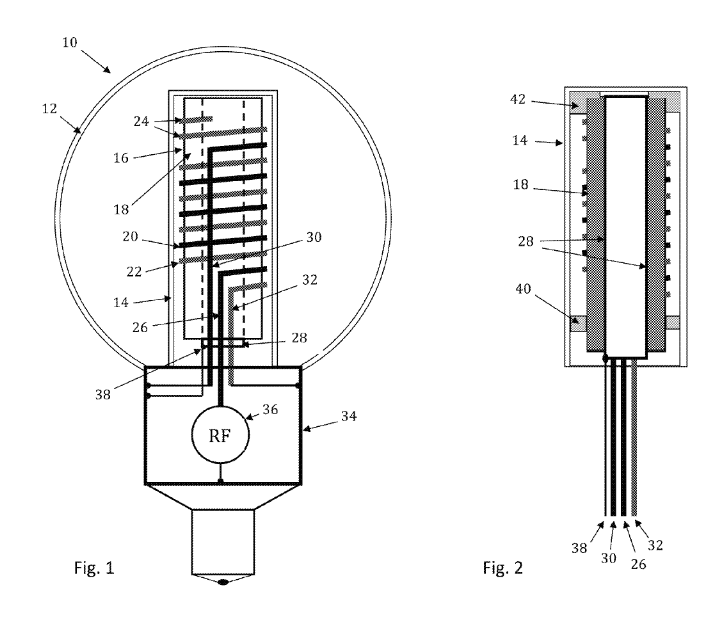
Explaining induction lighting in the most basic of terms; miniature coils produce a high-frequency electromagnetic field which excites particles within the bulb, all without the electrodes or filaments that are so prone to failure. This excitement causes the particles to release UV light when the inner area of the bulb is lined with a phosphorescent the UV light exits the bulb as a harmless white light.
In order for the Finally acandescent bulb to be created, the company had to take induction technology and make it small enough to fit into an incandescent light, this is done by making the copper wrapped antenna required for induction a mere 3 inches tall. The Finally Bulb is made by Lucidity Lights, Inc., founded 2010 in Boston, Massachusetts on a funding budget of 19.2 million dollars. Lucidity Lights seems to have applied for 27 patents relating to improving light bulbs. One of those patents is linked by clicking the picture below.
These bulbs can be pre-ordered for only $10 at the Finally website, orders will be fulfilled with the release of this innovative light bulb in the fall of 2014.


To be brutally clear, LED bulbs that cost less then 9$CAD and use 15w and last 25,000 hours at 1600 lumens and use ZERO dangerous chemicals already exist and are in mass production by companies like Cree. This is NOT innovation. This is someone trying to shove planned obsolescence down our throats.
These are inferior to existing LED tech in every way, why is this being funded?
https://www.kickstarter.com/projects/nanoleaf/nanolight-the-worlds-most-energy-efficient-lightbu
I agree that LEDs are better, but I still find the advance in technology interesting.
Yet another instance of fluorescence (LED lamps are really fluorescence devices, but without the plasma). I hope these are not going to be a source of RF! noise as CFL lamps can be, but given their method of operation, I fear they will be.
absolutely they will be. They use EMF to create the light, so i imagine they’ll be even worse then CFL is/was. we should stick to LED, they’re already great and already cheap and already available.