
Melting snow and ice glaciers in Greenland are causing global seas to rise about an average of a millimeter per year. Global warming isn’t helping, and the annual snowfall is no longer enough to replenish the ice lost in the summertime. If all of Greenland’s ice melts, the amount of water released into the oceans will push sea levels up by about six meters, swamping many coastal cities worldwide.
Unfortunately, new research by Ohio State University scientists shows that Greenland’s ice sheets may have melted beyond the point of return, with mass gain happening only once every 100 years. Therefore, all the ice will likely disappear even if climate-warming emissions were to cease today (also if the climate cooled). The team came to this conclusion from studying satellite data of 234 Arctic glaciers for 34 years (until 2018).
Lead author Michalea King, a researcher at the Byrd Polar and Climate Research Center, said:
“We’ve been looking at these remote sensing observations to study how ice discharge and accumulation have varied. And what we’ve found is that the ice that’s discharging into the ocean is far surpassing the snow accumulating on the surface of the ice sheet.
We are measuring the pulse of the ice sheet–how much ice glaciers drain at the edges of the ice sheet–which increases in the summer. And what we see is that it was relatively steady until a big increase in ice discharge to the ocean during a short five- to six-year period.”

The baseline of the pulse began in 2000. From that moment on, the amount of ice being lost each year started increasing steadily. However, snowfall did not increase equally with more ice lost than snow was falling.
King continued:
“Glaciers have been sensitive to seasonal melt for as long as we’ve been able to observe it, with spikes in ice discharge in the summer. But starting in 2000, you start superimposing that seasonal melt on a higher baseline–so you’re going to get even more losses.”

On top of that, the glaciers have retreated so far (three kilometers annually on average since 1985) that many of them now sit in deeper water. This means more ice-to-water contact, which melts the glaciers even faster and makes it more difficult for them to grow back to their previous mass.
Co-author Ian Howat, a glaciologist and professor of earth sciences at Ohio State, said:
“Greenland is going to be the canary in the coal mine, and the canary is already pretty much dead at this point.
Glacier retreat has knocked the dynamics of the whole ice sheet into a constant state of loss. Even if the climate were to stay the same or even get a little colder, the ice sheet would still be losing mass.”
When the ice melts in Greenland, it’s a problem for the whole planet because the water ends up in the oceans. The country’s ice sheets are a leading contributor to sea-level rise. Last year alone enough ice melted there to cause oceans to rise by 2.2 millimeters in only two months!
King concluded:
“The sobering findings should spur governments to prepare for sea-level rise. Things that happen in the polar regions don’t stay in the polar regions. But containing the global temperature rise can still slow the rate of ice loss.
[Nevertheless], it’s always a positive thing to learn more about glacier environments, because we can only improve our predictions for how rapidly things will change in the future. And that can only help us with adaptation and mitigation strategies. The more we know, the better we can prepare.”
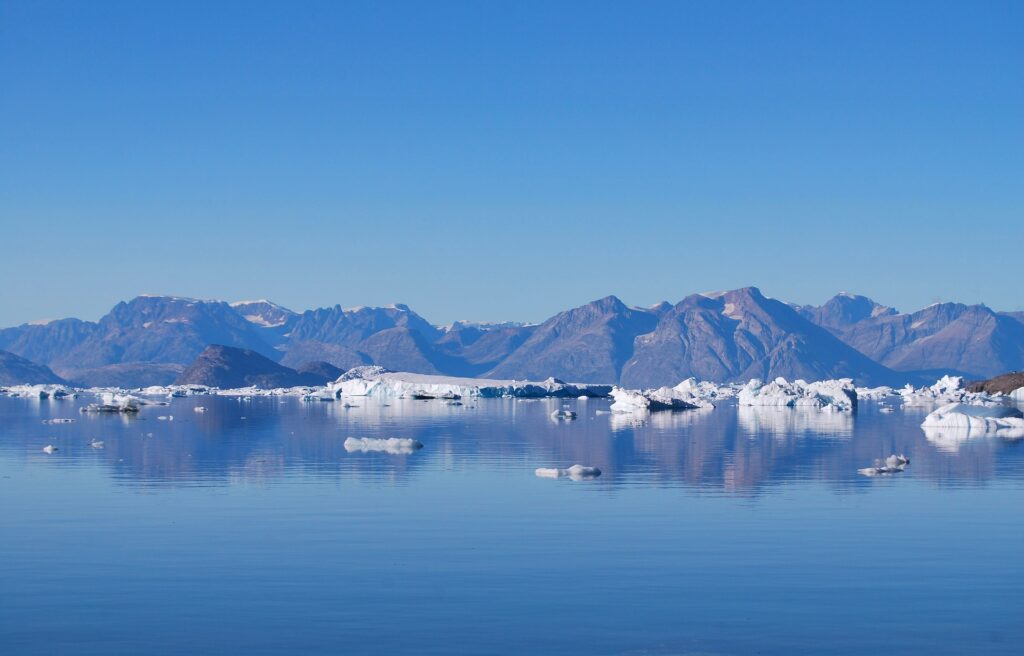
The Arctic is the second-largest concentration of ice in the world after Antarctica. Previous research found that the Arctic has been warming twice as fast (at least) as the rest of the world for three decades and will likely lose its ice cover in the summer entirely by 2035. Researchers have also explained how collisions between floating ice floes affect Arctic sea-ice movement, adding another tool for forecasting the changing pack.
Also, this year Antarctica went through a record warm spell and experienced its first-ever recorded heatwave. The Antarctic Peninsula is one of Earth’s fastest-warming regions.


