
Picture this: you pull up to a crowded entrance. Instead of circling for a spot, a friendly attendant greets you, takes the keys, and handles the rest. In seconds, a stressful arrival becomes a seamless welcome. This moment does more than save time; it sets a tone of genuine hospitality.
Beyond the immediate comfort for guests, professional valet operations unlock hidden value for property owners. By stacking vehicles efficiently and managing traffic flow with precision, businesses can reclaim valuable square footage and significantly boost parking capacity.
This guide explores how integrating a top-tier valet service with a company like FC Parking Valet Services can elevate your brand, streamline your operations, and turn a simple parking lot into a revenue-generating asset.

Core Advantages of Managed Valet Services
A professionally managed valet program solves four critical challenges that self-parking simply cannot address:
- Space reclaimed: Maryland’s automated-valet pilots, reported by the U.S. DOT Intelligent Transportation Systems program, increased capacity by up to 20 percent by parking cars bumper to bumper. You earn more without new construction.
- Reduced Congestion: San Francisco’s managed-parking trial recorded a 43 percent drop in search time. Drivers hand off vehicles at a designated curb point rather than circling the lot, keeping lanes clear.
- Door-to-door access: HCAHPS surveys show patients rate hospitals higher when they can step straight from the drop-off zone to the entrance with luggage or mobility devices in hand.
- Safer, shorter walks: A single, monitored drop-off keeps visitors out of dim garages and cross-traffic, reducing slip-and-fall exposure and wait times in bad weather.
When space is tight or navigation is tricky, these four gains give your guests smoother arrivals and your operation faster turnover.

High-Impact Sectors for Valet Integration
Different industries face unique parking challenges. Here is how specialized valet services drive value across specific sectors.
Hospitality and Resorts
For hotels, the arrival experience is the brand. A staffed valet stand captures revenue while offering the stress-free drop-off travelers expect. HospitalityNet reports that parking revenue across 1,178 U.S. hotels rose 23 percent from 2019 to 2023, with profit margins above 61 percent.
According to FC Parking’s published valet technology results, properties that use digital tickets, GPS-verified timekeeping, and real-time performance dashboards typically see parking revenue rise by roughly 12 to 30 percent and guest satisfaction scores increase by about 14 percent once managers can match staffing and pricing to actual arrival patterns.
Even if you work with another provider, looking for similar reporting tools lets you track whether your valet lane is truly performing like the high-margin asset those hotel benchmarks suggest.
Restaurants and Nightlife Venues
Diners want to finish their meal and leave without a wait. Case studies on Parking.net show that SMS-enabled valet services shorten curb lines significantly. Guests text for their cars while paying the check, ensuring faster exits and quicker table turns for your staff.
Hospitals and Medical Campuses
Hospitals and medical centers. A peer-reviewed survey in the Journal of Patient Experience links convenient parking to higher overall satisfaction scores on large medical campuses. Valet service removes a known pain point for visitors who may already feel anxious.
Live Event Venues
Event venues. Flash, a cloud-based valet platform, recorded a 455 percent year-over-year jump in transactions as live events resumed, proving that organizers count on managed arrivals to avoid gridlock before and after shows.
Urban Curb Management
Dense urban sites. Arlington County, Virginia, is digitizing more than 4,500 curb spaces to maximize scarce real estate. A coordinated valet zone complements these programs by stacking cars tightly and keeping travel lanes clear.
Across every setting, the pattern stays the same: when space, time, or mobility is limited, valet service turns the arrival moment into a value driver instead of a bottleneck.

Defining Standards of a White-Glove Valet Program
A true white-glove program does more than park cars. It blends people, process, and technology so every hand-off feels seamless.
1. Visible Organization
Top-tier valet lanes operate with the precision of a choreographed performance. Speed and safety rely on clarity, ensuring guests know exactly where to go the moment they arrive.
Bring this principle to your property with three cues guests can read in seconds:
- Directional signage: Large, high-contrast arrows at the driveway tell drivers exactly where to stop.
- Branded touchpoint: A lit podium and matching uniforms—traits linked by hospitality researchers to higher perceived professionalism—signal official service and prevent keys from going to the wrong person.
When each cue is visible from 50 feet away, you eliminate hesitation, keep the queue flowing, and free attendants to focus on greeting the next arrival.
2. Trained Attendants
Rigorous, multi-phase training pays dividends at the curb. Attendants hired through FC Parking Parking Facility Management complete comprehensive classroom instruction, hands-on practice, and field mentoring—a structure refined over 25 years in the industry.
Your valet lane is only as strong as the people sprinting between the curb and the garage. That is why top operators invest in formal certification. In fact, more than 500 parking professionals worldwide have earned the Certified Parking Professional badge after passing a 150-question exam on safety, operations, and customer care.
New hires then shadow senior CPP holders for ride-along drills that cover critical daily scenarios:
- Smooth, low-RPM take-offs and tight mirror-only maneuvers.
- A 30-second greeting script confirming ticket number, special requests, and return channel.
- Property-specific routing, such as which spiral ramp backs up at 5 p.m. and where to stage oversized SUVs.
- Scenarios for EVs needing charge, infants asleep in the back seat, or luxury models that require valet mode.
With that foundation, attendants extend your hospitality experience from the moment you hand over the keys.

3. Secure Key and Vehicle Management
Losing even one key can erase a night’s profit, so modern valet decks track every hand-off like inventory. Operators that switched to RFID key vaults and cloud dashboards cut losses from ten sets per day to fewer than one per month, according to case data from Automated Valet’s AVPM 2.0 roll-outs.
The reliability rests on a three-layer control loop:
- Real-time key custody: Each ring sits in a locked drawer that opens only when an attendant scans the matching ticket.
- Ticket-to-VIN matching: A barcode or text ticket pairs the guest’s phone number with the car’s last six VIN digits, slashing lookup errors.
- Staged parking maps: Cloud software paints a live garage map, so attendants know which stall to hit next, and guests wait less than two minutes for retrieval.
Together, these safeguards protect your guests’ property, speed up departures, and spare you costly claims.
Operational Efficiency and Revenue Drivers
Valet service is not just about pampering guests; it is a quiet engine for efficiency and revenue that you can measure.
- Maximized Capacity: Tandem-parking pilots in Houston and San Diego documented up to a 20 percent gain in capacity. Attendants park vehicles bumper-to-bumper, effectively adding a new row of parking without pouring a single yard of concrete.
- Clean traffic patterns: With a single in-and-out lane, delivery vans, rideshares, and late VIPs follow a script you control. Event venues that adopted ParkHub sensors cleared their lots 15 minutes faster after concerts.
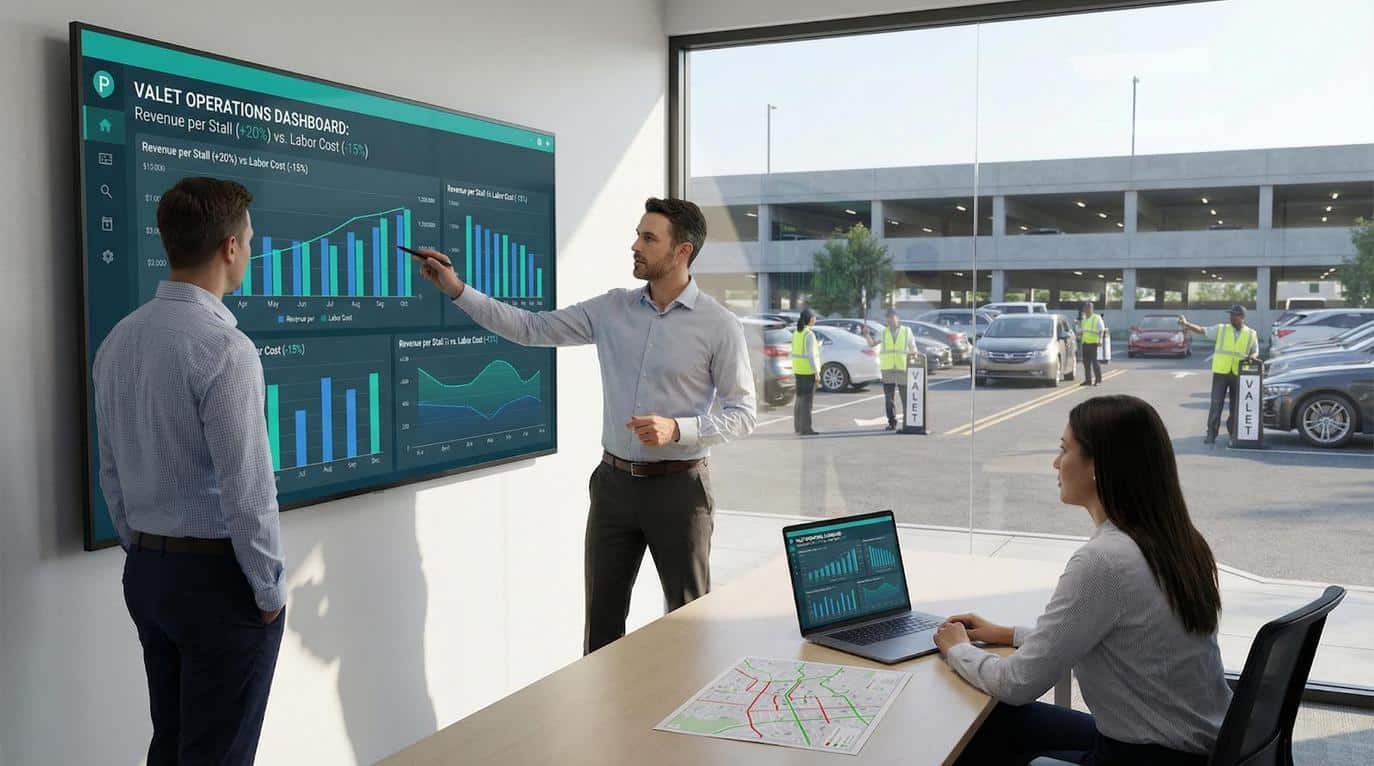
- Data-Driven Insights: Cloud platforms such as CVPS and IDeaS log every scan and retrieval, then surface peaks, dwell time, and revenue per stall. Operators report an average 20 percent lift in parking income and a 15 percent cut in labor cost once they act on the numbers.
Capacity, control, and insight build on one another, giving you a leaner staffing plan, smarter event scheduling, and capital projects anchored in concrete data instead of hunches.
Strategic Considerations for Implementation
Before you price podiums and uniforms, lock in four metrics that dictate staffing, tech, and ROI.
- Peak-hour demand: Cities from Seattle to Austin call 85 percent occupancy “functionally full.” What hour pushes your lot past that point?
- Capacity gap: In structured garages, tandem parking can raise throughput by as much as 40 percent, according to pilots in Houston and San Diego. Decide if that covers your shortfall or only buys time.
- Footprint options: List every stall you control—main deck, remote lot, overflow—to keep retrieval under two minutes.
- Brand promise: Luxury hotels often fund one attendant per 12 cars; hospitals average one per 20. Align ratios with the experience guests expect and the rates you charge.
Answer these four questions with your valet parking services consultant, and you will have a data-driven blueprint instead of a guess.

Elevating the Guest Experience with Professional Valet
Implementing a structured valet service is more than just a logistical upgrade; it is a strategic investment in your property’s reputation and bottom line. When you remove the friction of finding a parking spot, you give every visitor the gift of time and convenience. That positive first impression lingers long after they leave, fostering loyalty and encouraging repeat visits.
Whether you manage a bustling hospital, a luxury resort, or a high-traffic event venue, the right partner makes all the difference. By combining trained professionals with smart technology, you can turn your curbside into a model of efficiency. Reach out to FC Parking Valet Services today to design a custom solution that fits your specific needs and starts delivering measurable results from day one.
Frequently Asked Questions About Valet Services
Does valet parking actually increase revenue?
Yes. By stacking cars efficiently, you can fit 15 to 20 percent more vehicles in the same space, directly increasing your capacity and potential income per square foot.
Is valet service safe for guests’ vehicles?
Professional operators like FC Parking use strict key control protocols, ticket-to-VIN matching, and rigorous attendant training to ensure every vehicle is handled securely and returned without incident.
How does technology improve valet operations?
Modern platforms use digital ticketing and SMS retrieval to speed up wait times. They also provide real-time dashboards so you can track revenue and staffing needs instantly.
Can valet parking work for small lots?
Absolutely. In fact, small lots often benefit most because trained attendants can tandem park vehicles, maximizing every inch of available space in ways self-parking cannot.
What training do professional valet attendants receive?
Top-tier attendants undergo classroom instruction, defensive driving checks, and customer service mentorship. Many also earn certification to ensure they meet high standards of safety and hospitality.


