
Researchers are constantly thinking up new ways to improve solar cell technology. They’re figuring out what’s holding them back from achieving maximum efficiency and incorporating novel materials to enhance their performance. One of the latest in the latter is the use of carbon dots made from human hair waste sourced from a barbershop.
The dots form a kind of ‘armor’ that enhances the performance of perovskites solar cells – a relatively new photovoltaic technology seen as the best candidate to deliver highly efficient solar electricity at a low cost in coming years. The cutting-edge solar technology has proven to be as effective in power conversion efficiency as monocrystalline silicon solar cells (what’s currently commercially available). Plus, they’re made with a compound that’s easily manufactured (unlike silicon cells). Another bonus is that it’s flexible, so it can be used in clothing, tents, backpacks, and any other on-the-go devices. However, it’s still not on par in terms of stability and cost – factors researchers are working hard to change.
Professor Hongxia Wang, working with Associate Professor Prashant Sonar, led the carbon dots with solar cells study at QUT’s Centre for Materials Science. It’s the second piece of research using human hair to make carbon dots. Last year, AP Sonar, together with research fellow Amandeep Singh Pannu, led the team that first turned the hair scraps into nanodots. They broke down the hairs and burned them at 240 degrees Celsius, resulting in the multifunctional material.
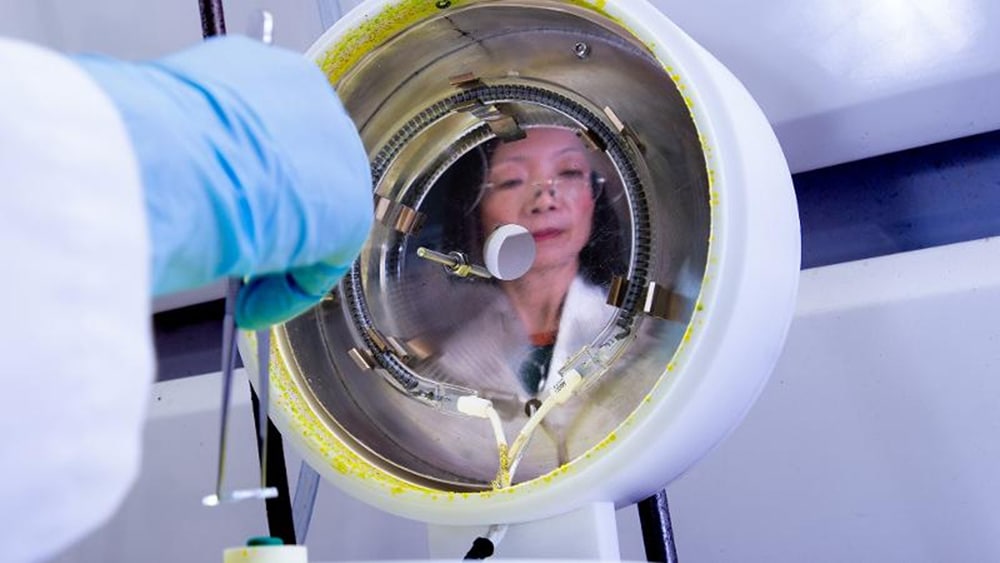
The first time, they made flexible displays for future smart devices with it. This time, they used a solution of nanodots on perovskite solar cells, adding it while making the cells. They found that the dots spur the formation of a wave-like perovskite layer where the dots surround the perovskite crystals.
Professor Wang said:
It creates a kind of protective layer, a kind of armor. It protects the perovskite material from moisture or other environmental factors, which can cause damage to the materials.
Furthermore, the perovskite solar cells coated with the carbon dots had greater stability and a higher power conversion efficiency than perovskite cells without the carbon dots.
Professor Wang continued:
Our final target is to make solar electricity cheaper, easier to access, longer-lasting, and to make PV devices lightweight because current solar cells are hefty. The big challenges in the area of perovskite solar cells are solving stability of the device to be able to operate for 20 years or longer and the development of a manufacturing method that is suitable for large scale production.
Currently, all the reported high-performance perovskite solar cells have been made in a controlled environment with an extremely low level of moisture and oxygen, with a tiny cell area which is practically unfeasible for commercialization. To make the technology commercially viable, challenges for fabrication of efficient large area, stable, flexible, perovskite solar panels at low cost needs to be overcome. This can only be achieved through a deep understanding of the material properties in large-scale production and under industrially compatible conditions.
I’m quite optimistic given how much this technology has improved so far.
If they can make PV materials cheaper and more stable, it would go a long way to help solve the clean energy crisis in the world.


