
Last year, we saw ESC launch the world’s first electric scooter championship. Now, Electric Sea Racing Limited (E1 Series) and Public Investment Fund have joined forces to create the world’s first electric powerboat racing championship.
High-speed hydrofoiling racers will compete in the first E1 series, scheduled to take place in 2023. E1 is like Formula E, but with boats, and it’s described as an electrified version of the F1H20 powerboat racing series. In addition, it’s already fully sanctioned by the UIM (the international powerboat racing authority.)
Despite a rocky inaugural season, Formula E has steadily increased its audience by about 24% per year, mainly among younger viewers. In contrast, the Extreme E electric off-road series attracted 18.7 million viewers in its first race—highlighting the appetite for competitive electric racing.

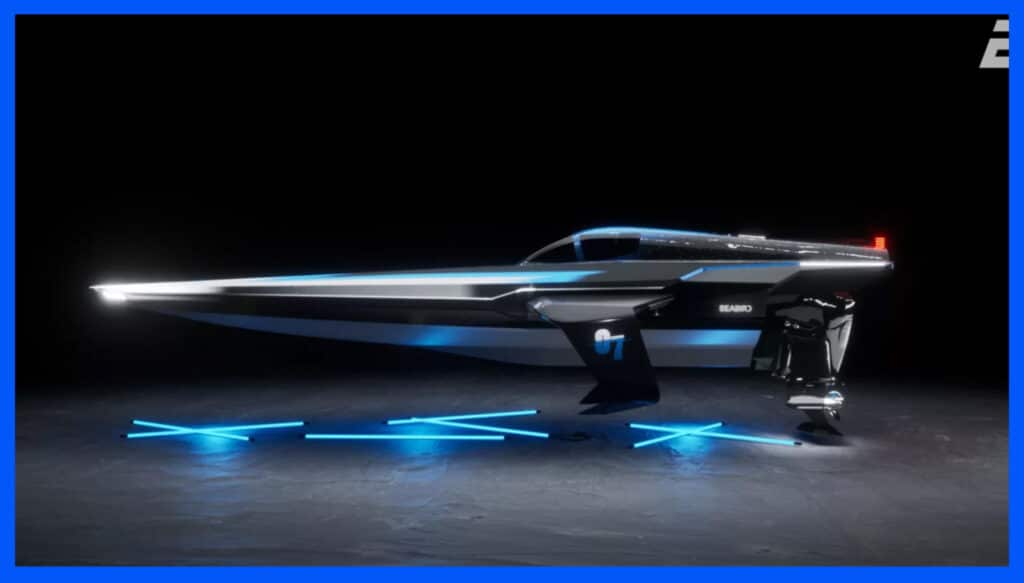
E1 Series organizers revealed the exciting news on June 7th during a virtual launch event, where they also unveiled the new electric RaceBird powerboat design. Since a given amount of energy doesn’t go a long way in the high-drag environment of water, the E1 team decided to use a hydrofoil design that will elevate these boats roughly 40 cm (16 in) over the water’s surface, nearly eliminating drag and looking fantastic in the process.
The Racebird boat, designed by Victory Marine and Seabird Technologies, is inspired by birds flying low over the water. It features entire carbon bodies with wings out the sides that fold under to create the front hydrofoils and an extended wing tail on the outboard motor for the back foil. Like the high-speed gasoline powerboats, the cabin is fully enclosed, making them look like spaceships skimming the water’s surface.


The Racebird specifications:
- 23 ft (7 m) long and 9.8 ft (3 m) wide (including foil wings)
- Weighs around 1,764 lb (800 kg)
- Speeds reach up to 50 knots (93 km/h, 58 mph)
That’s far from the 250-km/h (155-mph) top speeds of the gasoline-powered F1H20 class, and there are many speedboats and cigarette boats capable of going much faster. However, electric boating is challenging, and this is a start. In addition, the foiling design could make head-to-head racing more competitive since there’s little wake to interfere with a following boat.

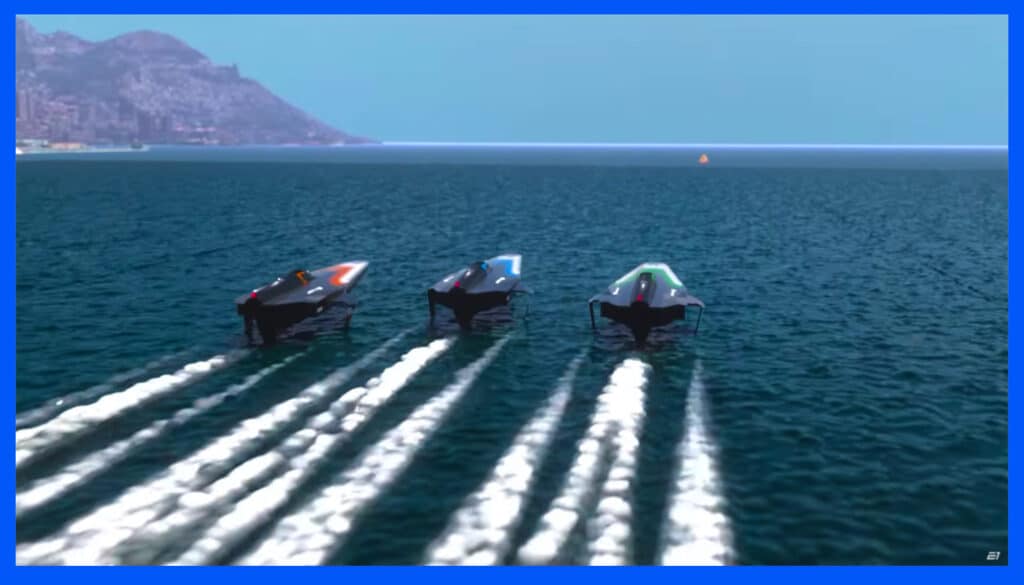
A Racebird prototype will be revealed later this year, and production is expected for 2022. Twelve teams will compete in the first race scheduled for early 2023—with Saudi Arabia as one of the considered race locations. Cities that host racing competitions will benefit from charging facilities, as the E1 series will leave them in place wherever it goes for public use by electric boat owners. Taking hydrofoiling to the next level, REGENT’s Viceroy seaglider uses retractable hydrofoils to lift off and fly at 180 mph in ground effect. For a smaller-scale blend of road and water travel, the WaterCar EV is an amphibious car that also runs as a 35 mph speedboat.


