
Melanoma is the deadliest form of skin cancer. According to data from the Canadian Cancer Society, roughly 7,200 new cases of melanoma were reported in 2017 in Canada – and 1,250 of those cases resulted in death. That’s almost a 20% chance of dying from having melanoma skin cancer.
However, it doesn’t have to be this way. If the cancer is detected earlier, there is a much greater chance of survival. The problem is that most people only realize they have it when they notice something is wrong and by then it is too late. In order to save more people from this fate, there needs to be a way where a normal physician can check their patients every time they come in for their yearly checkup; just like checking their blood pressure and so forth.
With this idea in mind, Canadian researchers developed a laser probe that uses changes in light patterns to detect melanoma. The easy to use device works on the principle that light waves change as they pass through objects. Cancerous cells have a different physical profile to healthy cells, and the system integrated into the device can detect these patterns instantly.
Researcher Daniel Louie, a PhD student who constructed the device as part of his studies in biomedical engineering at the University of British Columbia (UBC), said:
“With skin cancer, there’s a saying that if you can spot it you can stop it – and that’s exactly what this probe is designed to do… Because cancer cells are denser, larger and more irregularly shaped than normal cells, they cause distinctive scattering in the light waves as they pass through. We were able to invent a novel way to interpret these patterns instantaneously.”
All the team had to do was determine the optical polarisation of different skin lesions, then use that data to be able to distinguish cancerous from non-cancerous tissues. To do this they conducted a study on the laser probe where they looked at 69 skin lesions from 47 volunteer patients at the Vancouver General Hospital Skin Care Centre. It was conducted in concert with Vancouver General Hospital, BC Cancer and the Vancouver Coastal Health Research Institute and then published in the Journal of Biomedical Optics. They observed how Louie’s laser passed through skin tissue from the study’s volunteers, as well as the effects this had on the light beam.
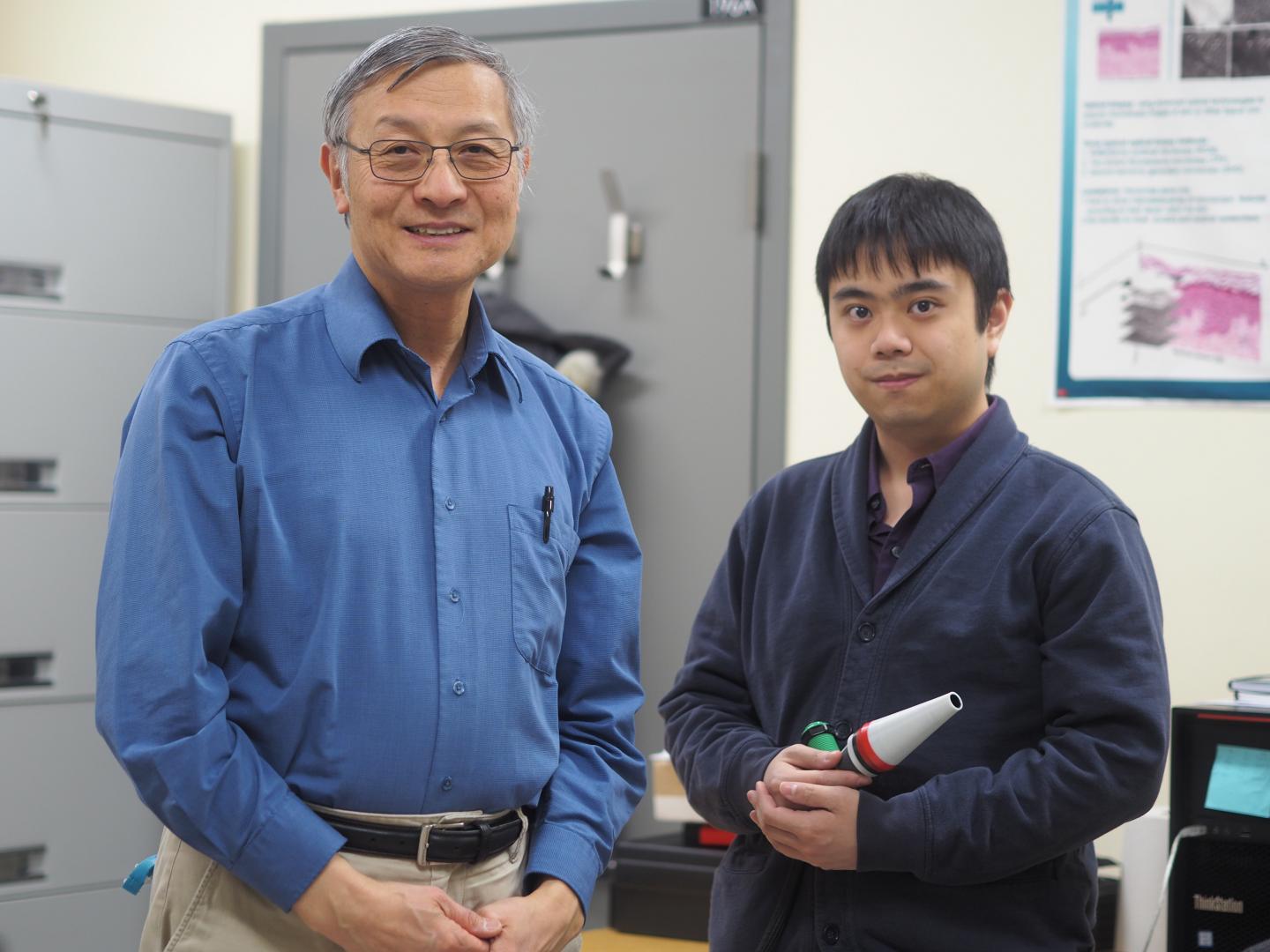
While imaging tools for cancer are nothing new, the UBC team’s device is different because it does not require expensive cameras or lenses and therefore should cost just a few hundred dollars. At such a low price, every medical facility could afford to have one. Their compact, low-cost laser probe could be the perfect aid in early detection. Louie said:
“We set out to develop this technology using inexpensive materials, so the final device would be easy to manufacture and widely used as a preliminary screening tool for skin cancer.”
For now, the probe has yet to be certified or approved by Health Canada. If it does pass inspection, it will be able to help medical professionals almost instantly distinguish between a harmless mole and a cancerous one. It will work by providing an easily understandable numerical result, similar in principle to a thermometer.
Regardless of its low-cost and ease of use, Tim Lee, associate professor of skin science and dermatology at UBC who supervised the study said the device is not intended for use as a consumer product. It also isn’t intended to be a replacement for any current testing methods. He envisions the probe as a future supplement to existing cancer screening technologies and techniques – an enhancement.
Furthermore, given the rise in skin cancers in Canada, the importance of screening methods will only grow. Lee said:
“A cancer screening tool should be administered by a trained health care professional who would know where the patient needs to go afterwards. We have so few dermatologists relative to the growing number of skin cancers that are occurring. If we can develop a device that can be integrated easily into other parts of the health care system, we can simplify the screening process and potentially save hundreds if not thousands of lives.”


