
As of 2019, certain species of bees in Africa, Europe, and North America are now endangered. Beekeepers all across The United States and Europe are regularly reporting hive losses of up to 30% or even higher.
These hive losses don’t only affect humans. Bees are invaluable to the ecosystems; up to 90% of the 369,000 plant species in the world depend on bees’ pollination to reproduce. Many animals only feed on nuts, berries, seeds, and fruits produced by plants that rely on pollination. One bee can pollinate fifty to one thousand flowers in just one trip. Bees’ work sustains countless species.
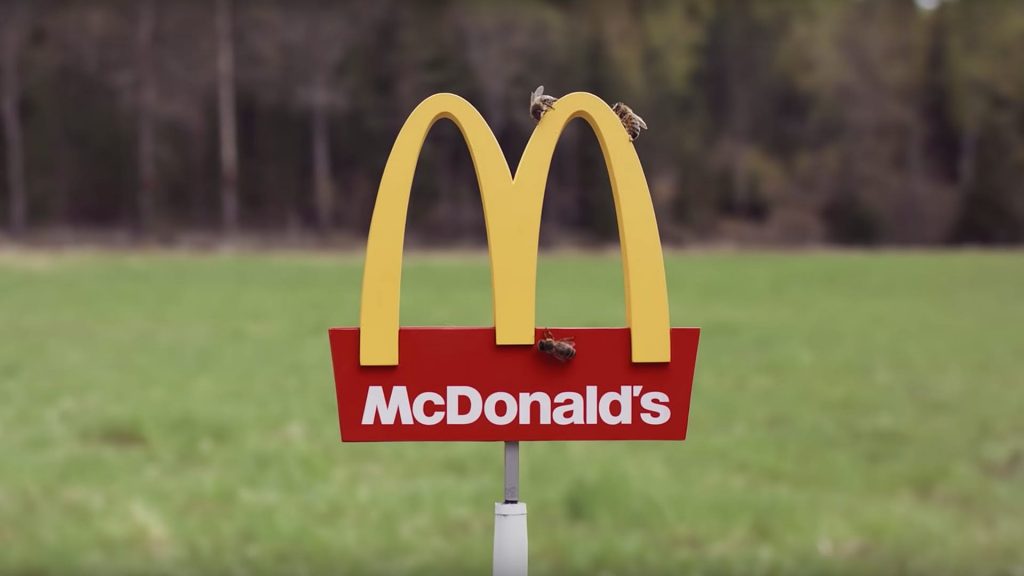 But now, unfortunately, the climate crisis caused by humans has made one species of U.S. bees totally extinct. That’s why Swedish entrepreneurs for the fast-food chain have decided to create McHive, in hopes to bring in new clientele: bees.
 From outside, McHive looks like a typical McDonald’s restaurant but inside it’s a fully functioning beehive. It has the usual drive through with windows, alfresco tables inside, and of course the golden arches logo on the roof. Wooden frames inside are ideal for the bees to create honeycombs to store honey and pollen. The restaurant was specifically designed in a way so the bees could have maximum freedom of movement. The only difference between other McDonald’s and McHive is its miniature size; the reason for it being so tiny is so the bees can feel welcomed.
 The fast-food chain commissioned Nicklaus Nilsson, a Swedish set designer, to design McHive, in order to commemorate World Bee Day on May 20, 2019. This was Nilsson’s first time designing environmental sustainability as his primary objective. The franchise asked him to design a miniature McDonald’s to welcome “thousands of important guests” and that is exactly what he made.
 Across Sweden, several of its restaurants already have beehives on their roofs, which is something McDonald’s says is spreading nationally.
NORD DDB, the Swedish creative agency behind the creation of McHive, said:
McDonald’s is joining a cultural trend. Many restaurant chains are showing a commitment to embracing practices that promote environmental sustainability.
For NORD DDB, creating ad campaigns for humanist issues isn’t just a profitable business model. It’s a personal passion.
NORD DDB said:
The initiative started out locally but is now growing. More franchisees around the country are joining the cause and have also started replacing the grass around their restaurants with flowers and plants that are important for the wellbeing of wild bees.
Christoffer Ronnblad, the director of McDonald’s Sweden, says the franchise is “devoted” to promoting environmental sustainability.
Honey bees are not the only ones that will benefit from NORD DDB’s most recent collaboration with the McDonald’s corporation, but humans will too. All proceeds from the auction of, McHive will be donated to Ronald McDonald House charities.


