
Solar panels don’t capture all the light that hits them. Solar cells are typically only able to harness visible light. The rest of the electromagnetic spectrum goes unnoticed, which includes infrared light.
Scientists have been working diligently to find ways for the solar cells to absorb a variety of wavelengths of light. A team of such scientists from Sweden’s KTH Royal Institute of Technology recently found a way. They developed a film that can be layered over the top of solar cells. It boosts the efficiency of the cells by 10%-25%. The research has been published in the journal Nanoscale.
Their technology is based on a previously discovered method to increase the performance of solar panels in which the panels get supercharged by a specific type of nanoparticles. The nanoparticles are doped up with dyes containing metal ions, such as lanthanide. Like this, they can help the solar panels make use of other types of light – such as infrared – for energy conversion. These particles are known as upconverting nanoparticles (UCNPs).
Using the concept of UCNPs the KTH team made their breakthrough film for solar panels. What they did was create a polymer-based array, which consists of nanocrystals mixed with a series of microlenses. This array shapes the way the light comes in and boosts the performance of the UCNPs.
Hans Ågren, professor in theoretical chemistry and leader of the research team, said:
The ability of the microlenses to concentrate light allows the nanoparticles to convert the weak infrared light radiation to visible light useful for solar cells.
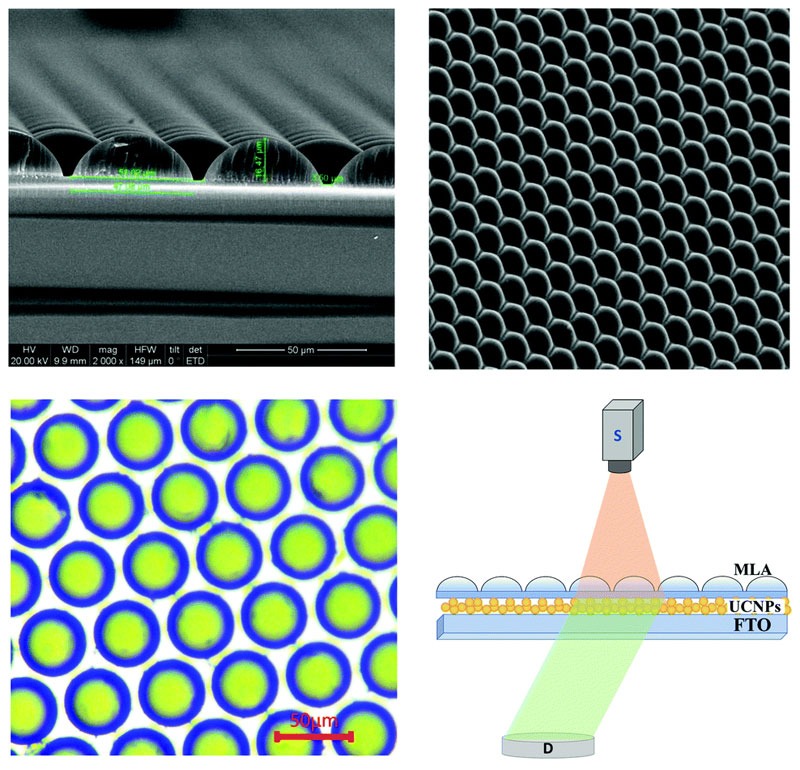
Their thin-film is applied over the top of any regular solar cell. When in place, it has the effect of spatially modulating the infrared light and concentrating it in just the right way to enhance the efficiency of the energy conversion.
Ågren said:
We have achieved a 10% increase in efficiency without yet optimizing the technology. With a little more work, we estimate that a 20 to 25% increase in efficiency could be achieved.
The technology is not yet available and is still in its early phase of development, but the team did patent the invention and is working on improving its efficiency.


