
A brain-machine interface allowed a patient with a spinal cord injury to control his prosthetic arms with only the power of thought.
Researchers have demonstrated for the first time simultaneous control of two of the world’s most advanced prosthetic limbs through the brain-machine interface.

Control Prosthetic Limbs With Thought
The research team from the Johns Hopkins University’s Applied Physics Laboratory (APL) and School of Medicine are also developing strategies for providing sensory feedback for both hands at the same time using neural stimulation. This addition of feedback would make the limbs more “real,” in the sense that the patients could then physically “feel” and not just manipulate their surroundings with their prosthetic limbs.
“We are trying to enable a person with quadriplegia to use a direct neural interface to simultaneously control two assistive devices and, at the same time, feel touch sensation when the devices make contact with objects in the environment,” explained Dr. Brock Wester, a biomedical engineer and APL’s principal investigator for the study.
“It has significant implications for restoring capabilities to patients with high spinal cord injuries and neuro-muscular diseases” Dr. Wester continued. “For everything we envision people needing or wanting to do to become independent – tie their shoes, catch and throw a ball, squeeze toothpaste onto a toothbrush – they really need two hands working together.”
Mind Over Matter
These breakthroughs are the latest developments in Revolutionizing Prosthetics (RP). RP is a program launched by DARPA (Defense Advanced Research Projects Agency) in 2006 to rapidly improve upper extremity prosthetic technologies and provide new means for users to operate prosthetic limbs with their thoughts.

The RP program originally had the vision of creating a neurally integrated prosthetic upper limb with human-like capabilities; the result is the Modular Prosthetic Limb (MPL). “As we integrated new capabilities into the MPL, such as fingertip sensors for force, acceleration, slip, and pressure, we started to ask ourselves, ‘what is the best way to feed this information back to our study participants so that they would be able to interact with the environment just as able-bodied people do?'” said Dr. Francesco Tenore, APL’s project manager for this effort.
Additionally, to develop the MPL, researchers are exploring the use of neural signals to enable “real-time” control of integrated prosthetic and intelligent systems. The program’s initial neural control studies with participants at the University of Pittsburgh and the California Institute of Technology/Rancho Los Amigos focused on the control of a single limb. Three participants were able to do this after months of training. Their success highlighted the possibilities of neural prostheses and laid the foundations for future studies.
APL is now working with two research teams at the Johns Hopkins Hospital. Firstly, Dr. Pablo Celnik’s team in Physical Medicine and Rehabilitation and Secondly, Dr. Nathan Crone’s team in the Department of Neurology.
Discovering A New Frontier
In a first-of-its-kind surgery earlier this year, Dr. Stan Anderson’s team at Johns Hopkins implanted intra-cortical micro-electrode array sensors on both sides of a patient’s brain. Specifically in the regions that control movement and touch sensation. As part of this surgery, the APL researchers and Crone’s team pioneered a method to identify the best location for placing their electrodes by using real-time mapping of brain activity during the surgery.
https://youtu.be/Hw4GWnM2VXY
The team has completed several assessments of the neural signals acquired from the motor and sensory areas of the brain. They have studied what the patient feels when the hand areas of their brain are stimulated. Results from these experiments highlight the potential for patients to sense more information about the prosthetic limb and the environment they are interacting with.
Finally, with these tests and successful surgery, the team has already achieved several “firsts” in the field of brain-machine interfaces.
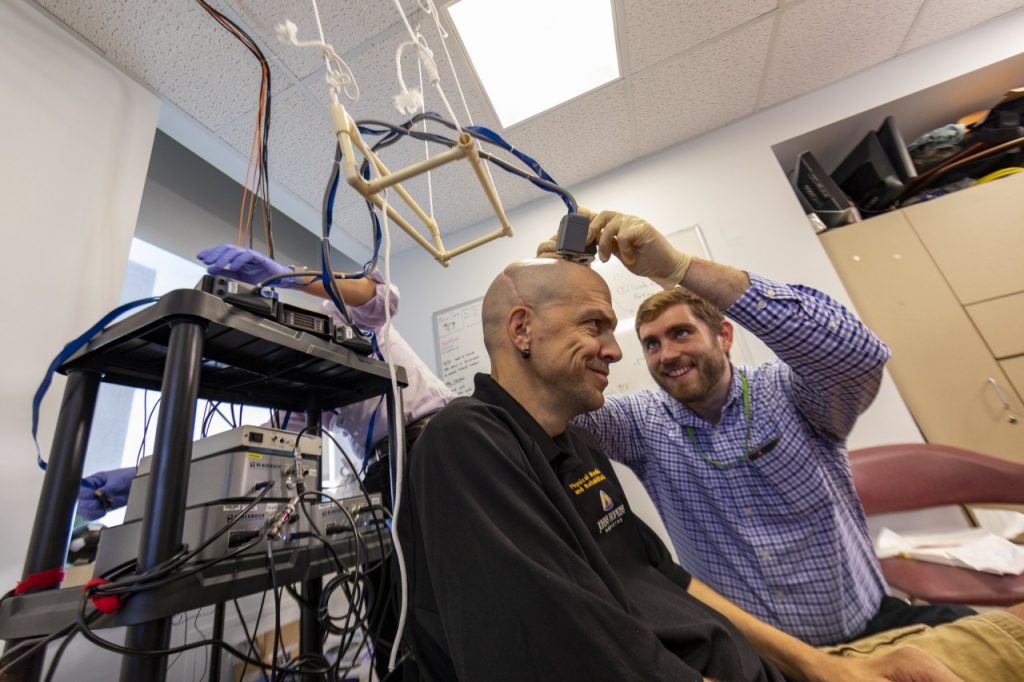
“For the first time, our team has been able to show a person’s ability to ‘feel’ brain stimulation delivered to both sides of the brain at the same time. We showed how stimulation of left and right finger areas in the brain could be successfully controlled by physical touch to the MPL fingers,” explained APL’s Dr. Matthew Fifer, the technical lead on the project. This study benefits from the world’s first human bilateral implant for recoding and stimulation, including 96 electrodes that can be used to deliver very focused neural stimulation to the finger areas of the brain.
The Making Of A Cyborg
“This is the world’s first bilateral implant. We want to be able to execute motions that require both arms and allow the user to perceive interactions with the environment as though they were coming from his own hands.” Tenore said. “Our team will continue training with our participant to develop motor and sensory capabilities, as well as to explore the potential for control of other devices that could be used to expand a user’s personal or professional capabilities.”
“These developments are critical components necessary for future brain-machine interface technologies — relevant to spinal cord injury, stroke, Lou Gehrig’s disease, among others — are all aiming to restore human functions,” said Dr. Adam Cohen, Health Technologies program manager in APL’s National Health Mission Area.
The ability of patients to control prosthetics with their thoughts is a great step towards universal mobility, and also has applications for the control of drones or other equipment using thought. This advance is a clear milestone on the road of integrating many complex signal systems to enable people to turn their thoughts and brainwaves into the control of prosthetic limbs.


