
Officials at the United States Food and Drug Administration recently released draft guidance that could quietly change the future of individualized gene therapy. The document, formally titled “Plausible Mechanism Framework for Individualized Therapies Targeting Ultra-Rare Conditions,” lays out a specific plausible mechanism framework for individualized medicine to establish a regulatory pathway for treatments designed for extremely small patient populations, sometimes even a single individual.
Agency leaders intend this shift toward biological proof over statistical volume to address long-standing barriers for families navigating obscure genetic diagnoses. Clearer evidence thresholds empower the agency to overcome long-standing barriers for families navigating obscure genetic diagnoses.
Families affected by ultra-rare diseases frequently find that the traditional clinical trial model remains out of reach. Large randomized trials require massive patient pools, yet some genetic disorders affect only a handful of people worldwide. In response to that gap, the FDA published its draft in February 2026, outlining how substantial evidence of effectiveness could be demonstrated when conventional trials are not feasible. Prioritizing target engagement and molecular proof ensures that limited patient counts do not stop life-saving innovation.
Regulatory science is evolving alongside gene editing technology as the framework remains open for feedback via the Federal Register draft guidance docket through late April, creating a timeline that will shape how quickly this idea turns into real policy. Gene editing tools like CRISPR moved from lab curiosity to first-in-human safety testing in recent years, including the first U.S. CRISPR human safety trial that helped show feasibility without treating early safety data like a miracle cure.
Establishing a ‘plausible mechanism’ allows reviewers to judge therapies built for tiny patient groups using biological evidence instead of just counting patients. This change gives hope to families who previously had no clear regulatory path forward.

Understanding the FDA Plausible Mechanism Framework and Targeted Patient Populations
Quick Facts: FDA Plausible Mechanism Framework for Ultra-Rare Gene Therapies
Reviewers at the FDA intend the draft guidance to serve as a proposed review playbook for situations where a traditional randomized trial is not realistic.
Specific goals of the framework include:
- Keeping safety and product quality standards high.
- Providing reviewers a structured way to judge therapies built for tiny patient groups.
- Bridging the gap between lab innovation and clinical application.
- Draft guidance released by the FDA in February 2026 and labeled “not for implementation” while it is reviewed.
- Intended for individualized therapies targeting ultra-rare conditions where classic trial enrollment is not feasible.
- Centers on a science-backed “plausible mechanism” showing the therapy addresses the root cause of disease.
- Puts extra weight on direct evidence like target engagement, biomarkers, and well-documented natural history data.
- Open for public comment until April 27, 2026, with revisions possible before any final version appears.
If this becomes final guidance, it would not create instant approvals, but it could shorten the uncertainty around what evidence regulators expect. For families and clinicians, clarity can matter almost as much as speed when time is measured in symptoms, not paperwork.

Regulatory Scope of the FDA Framework for Rare Disease Solutions
Defining Patient Eligibility for Individualized Rare Disease Therapies
Designers of the draft guidance at the agency established a regulatory pathway for individualized therapies targeting ultra-rare diseases. In the agency’s effort to accelerate individualized therapy development, the goal is to make review possible when classic randomized trials cannot happen, while still demanding a clear scientific case for why a therapy should work.
In practical terms, the framework targets disorders where a single hospital system might never see two patients with the same mutation. A genetics clinic could spend years collecting records on one family, only to learn that the next comparable case lives on another continent. Because of this, traditional statistical comparisons often collapse under the weight of such small numbers.
Establishing Clinical Evidence Thresholds for Small Patient Populations
Under this draft approach, sponsors may rely on detailed natural history data, deep molecular understanding of disease biology, and direct evidence that the therapy modifies the underlying cause, incorporating flexible rare disease evidence standards that prioritize scientific clarity when patient counts are extremely limited.
Instead of asking if a treatment beat a placebo in a large group, the core question changes. Reviewers now ask if the therapy hit the known biological target and moved the disease in a direction that rarely happens on its own. When clinicians track lab results week by week, those shifts are not abstract. These biological shifts manifest as measurable changes that can separate a stable month from a sudden emergency.
Maintaining Regulatory Standards for Product Quality and Manufacturing Consistency
The framework does not eliminate safety or manufacturing standards. Instead, it shifts the evidentiary focus toward mechanistic clarity when patient numbers are extremely limited, while keeping expectations around product quality, consistency, and monitoring in place.

Defining Plausible Mechanism in the Context of Individualized Gene Therapy
Interpreting Plausible Mechanisms for Personalized Clinical Development
Prioritizing Biological Mechanisms Over Traditional Clinical Outcomes
The idea of a ‘plausible mechanism’ translates to real-world scientific requirements for individualized medicine. Regulators simply want clear proof that a therapy interacts with the specific biological problem causing the disease.
According to the FDA’s draft document, developers must identify the disease-causing molecular abnormality, show that the therapy targets that root cause, and demonstrate evidence of target engagement. Target engagement means measurable proof that the treatment actually hits the intended gene, protein, or pathway, rather than drifting into guesswork.
The Role of Molecular Target Engagement in Regulatory Review
If a gene editing therapy is designed to repair a mutation in a liver enzyme, reviewers may look for molecular data confirming that the mutation was corrected and that enzyme function improved. This cause-and-effect focus highlights why precision genome editing tools matter, as they aim to rewrite DNA with fewer disruptive breaks.
Routine clinical care mirrors this logic; post-medication lab results serve as direct evidence of biological impact. When a specialist adjusts a medication, the next labs are not a formality. The numbers are evidence of whether the biology moved the way the plan predicted.
The technical backbone of prime editing traces to the architecture of search-and-replace DNA editing, which utilizes a modified Cas protein and a reverse transcriptase to copy edited sequences directly into a target site.
Because editing the wrong stretch of DNA can create new risks, accuracy has become a recurring theme. Advances in high-fidelity CRISPR enzymes reflect the ongoing industry effort to reduce off-target edits and improve clinical safety.
Utilizing Natural History Data as a Comparative Clinical Tool
The framework also highlights the importance of utilizing rare disease natural history data, which allows clinicians to document how a condition progresses without intervention, providing a critical comparison tool. When patient numbers are tiny, knowing what would have happened without treatment becomes a critical comparison tool.
Clinical Precedents and the Evolution of Individualized Editing
Analyzing the Impact of Patient-Specific In Vivo Base-Editing Treatments
The urgency behind the FDA’s draft guidance did not emerge in a vacuum. In 2025, a customized in vivo base-editing therapy was administered to an infant with severe CPS1 deficiency. Successful personalized base-editing intervention helped set a modern precedent for how individualized editing can function within a clinical setting.
Early follow-up data suggested meaningful biochemical change, while also underscoring the reality that long-term monitoring remains essential. That balance is crucial. A strong early signal is not the same thing as a lifetime guarantee.
Engineering Precision Cargo: The Importance of Gene Therapy Delivery Systems
The therapy was delivered using lipid nanoparticles and designed specifically for that child’s mutation. Delivery details matter because getting an editor to the right organ is often the make-or-break step. Sophisticated tissue-specific lipid nanoparticle engineering ensures that gene editors reach the specific organs required to drive therapeutic change.
Modern gene editors operate more like precision cargo than standard pill-based medications. Temperature, timing, and tissue targeting can decide whether the payload reaches the cells that actually drive disease.

Prime Editing Platforms and the Future of Scalable Individualized Therapies
Advancements in Prime Editing for Standardized Genomic Repair
Urea Cycle Disorders as a Proving Ground for Liver-Targeted Editing
Beyond one-off treatments, researchers are now exploring whether personalized editing can be standardized through adaptable platforms. Recent developments in standardized in vivo editing platforms suggest that multiple urea cycle disorders could eventually be addressed under a single development strategy.
In everyday terms, because metabolic ammonia detoxification failures can have outsized effects on brain chemistry, these disorders serve as a compelling proving ground for liver-targeted edits. Even small changes in liver enzyme function can have outsized effects on brain and body chemistry.
Comparing Prime Editing and Base Editing for Precision DNA Repair
Prime editing differs from base editing by using a programmable guide RNA and a reverse transcriptase enzyme fused to a modified Cas protein. The architecture of prime editing enables a wider menu of genetic changes without creating full double-strand DNA breaks, which is one reason the field is paying close attention to precision tools that can make targeted swaps, insertions, or repairs.
Leveraging Platform Reuse to Streamline Individualized Medicine Development
If delivery systems and manufacturing processes can be reused across multiple mutations, development may become more scalable. It helps to imagine a toolkit where only the genetic “address label” changes while the delivery vehicle stays consistent, the kind of repeatability biotech teams chase when they want individualized therapies to feel less like emergency improvisation.
The in-body approach has been explored outside rare disease platforms too, including research where gene editing reached stem cells inside the body rather than being limited to cells edited in a lab dish.
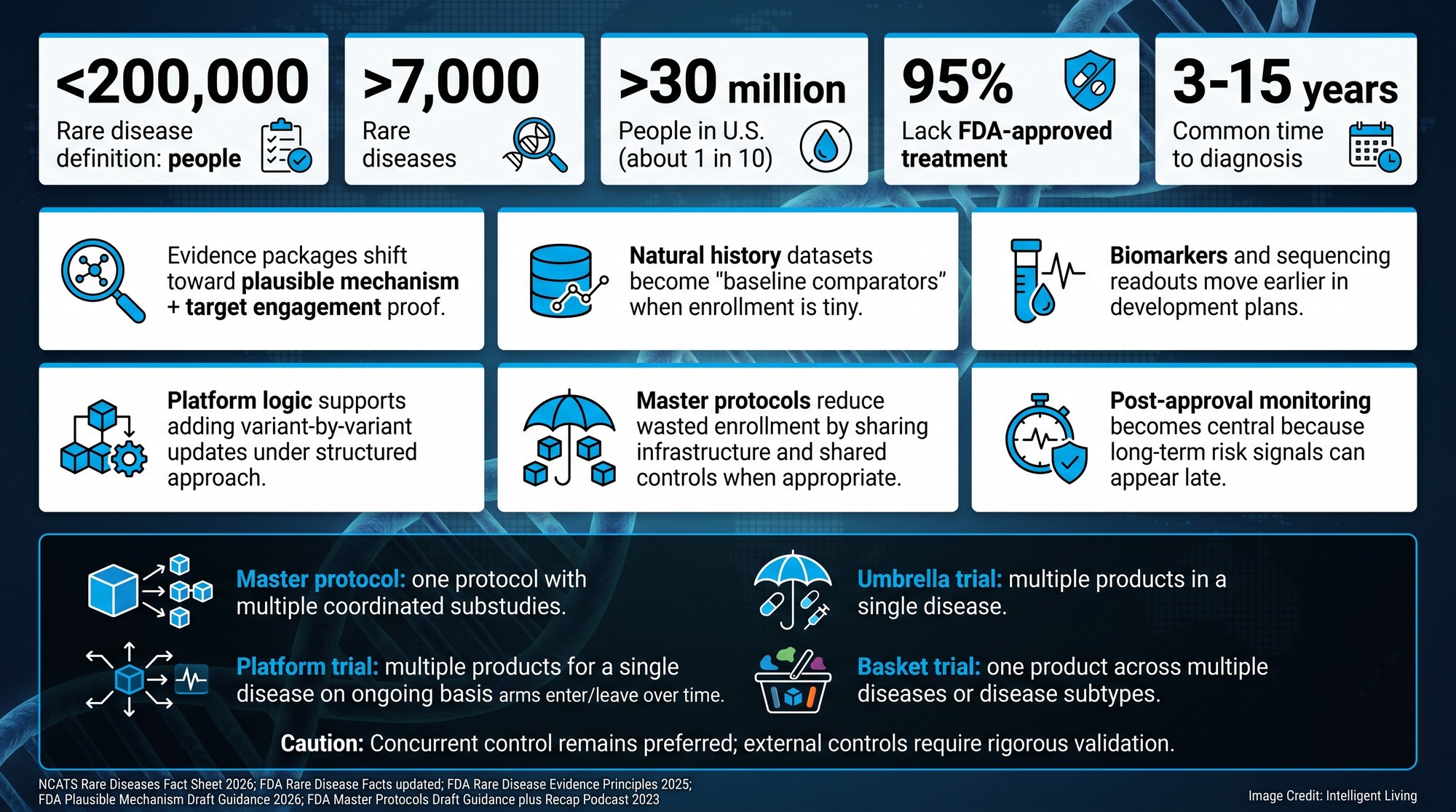
6 Strategic Implications for Individualized Regulatory Pathways
If the proposed framework becomes final guidance, it could change how companies and academic teams plan their evidence packages from day one. It also sets expectations that can shape what families hear when a clinician says a therapy is “in development,” because development plans often follow the pathway regulators are most likely to accept. Clearer rules help researchers focus on the data that matters most for safety and speed.
- A growing number of individualized therapies may enter formal regulatory review rather than staying limited to the compassionate use expanded access pathway when no other clinical options remain available.
- Researchers increasingly align with drug development considerations for rare diseases to emphasize the necessity of understanding untreated disease progression.
- Platform technologies may reduce the need to reinvent manufacturing processes for each mutation, especially when the delivery method and core editor remain stable.
- Regulators may demand earlier demonstration of molecular target engagement, which can push teams to prioritize high-quality biomarker and sequencing evidence.
- Post-approval monitoring could become more standard when patient pools are small, because long-term safety signals may only appear over time.
- Biotech companies may invest more aggressively in ultra-rare disease research now that a clearer pathway exists, while still weighing cost, manufacturing capacity, and follow-up obligations.
Even in the best-case scenario, this approach does not erase uncertainty. It reorganizes it, turning scattered expectations into a checklist that can be debated, improved, and eventually applied. These shifts ensure that even the rarest diseases receive a fair chance at a developed treatment.

Long-Term Impact of the FDA Framework on Global Rare Disease Innovation
Moving the conversation from whether individualized gene therapy is possible to how it can be responsibly evaluated represents meaningful progress. Regulatory evolution offers more than just a paperwork change—it is a signal that the system is finally catching up to the speed of genetic engineering. Prioritizing molecular target engagement and natural history data allows the FDA to open doors for treatments that were previously stuck in the ‘experimental’ phase indefinitely.
The framework aligns regulatory science with emerging research to match policy to what science can now attempt. Modern medicine already reflects this shift toward individualized decision-making across various specialties. Clinicians now have a clearer regulatory blueprint to follow, ensuring that search engine optimization and real-world health outcomes align for the benefit of patients.
Developments in xenotransplantation and gene-edited organ trials force hard questions about safety, monitoring, and long-term outcomes. Careful progress requires this exact blend of clinical caution and scientific ambition to ensure the person in front of you receives the safest, most effective care possible. Success in the ultra-rare space will likely set the tone for the broader future of personalized medicine.
Regulatory Blueprint for Personalized Gene Editing: What this Means for Patients and Families
The draft framework does not guarantee approvals. It does not bypass safety standards. It does not promise cures. It also does not remove the reality that individualized therapies can be expensive, slow to manufacture, and difficult to evaluate without long follow-up.
Standardizing regulatory science and evidence thresholds suggests that regulatory science is evolving alongside gene editing technology. The FDA’s comprehensive regulatory guidance for rare disease drugs demonstrates that progress depends on matching trial design and biomarkers to small patient pools.
Evidence requirements must adapt when diseases affect only a handful of people, as success depends on mechanistic clarity, molecular proof, and consistent manufacturing quality. These deployment challenges persist across various sectors of modern medicine, highlighting the need for a more flexible regulatory mindset. The mindset driving personalized chronic condition management emphasizes adjusting medical plans to the individual rather than forcing every patient into a single template. Regulators must align policy with current scientific capabilities to implement next-generation genetic medicine tools like AAV and mRNA for individualized care. Ensuring that the law keeps pace with the lab is the final step in bringing these treatments to the patients who need them most.

FAQ: Common Questions About the Plausible Mechanism Framework
What is the FDA’s new rule for ultra-rare diseases?
The FDA’s Plausible Mechanism Framework establishes a review pathway for individualized gene therapies when traditional clinical trials are impossible due to tiny patient populations.
How does the FDA test drugs for only one person?
Regulators prioritize strong biological proof that a therapy hits its intended target and corrects the root cause of the specific disease mutation.
Why is a ‘plausible mechanism’ important in gene therapy?
A plausible mechanism provides the scientific evidence that a medicine interacts correctly with a patient’s unique genetic code to produce a specific clinical effect.
Does this guidance cover CRISPR and prime editing?
Yes, the framework addresses various genome editing and RNA-based therapies designed to treat individualized genetic conditions.
Where can the public comment on the new FDA draft?
Public feedback on the draft guidance is being accepted through late April 2026 to help shape the final version of the policy.


