
A team of research chemists at Nanyang Technological University, Singapore (NTU Singapore), has been working on a way to turn plastic waste into reusable chemicals without generating new pollutants in the process.
The team was led by Soo Han Sen; an Assistant Professor at NTU from the School of Physical and Mathematical Sciences. Their work has recently been published in Advanced Science, where they developed a way to degrade plastic using artificial sunlight.
They were able to turn polyethylene into formic acid, which is a naturally occurring antibacterial agent and preservative. Possibly even more important, this material can be used by power plants to generate energy and in hydrogen fuel cell vehicles.
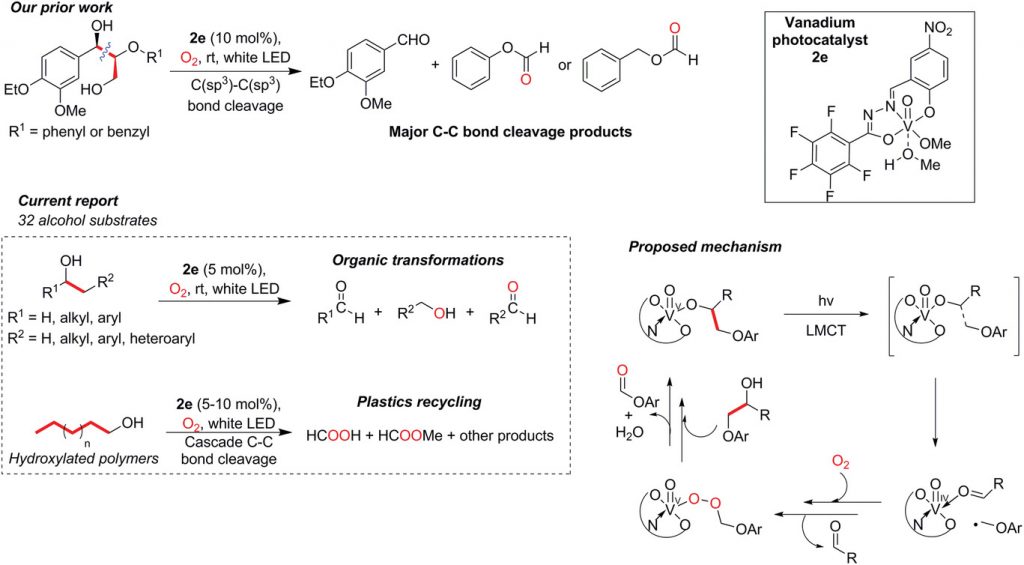
How They Did It
The team performed different lab experiments mixing plastics with a catalyst in a solvent. They made their catalyst from an affordable material called biocompatible metal vanadium, which is commonly used in aluminum alloys for aircraft and steel alloys for vehicles.
This allowed their solution to harness light energy, converting dissolved plastics into formic acid, which is a chemical used by fuel cells to produce electricity.
We aimed to develop sustainable and cost-effective methods to harness sunlight to manufacture fuels and other chemical products,” said Asst Prof Soo. “This new chemical treatment is the first reported process that can completely break down a non-biodegradable plastic such as polyethylene using visible light and a catalyst that does not contain heavy metals.
The team’s vanadium-based catalyst LV(O), uses light energy to produce a chemical reaction known as a photocatalyst. These photocatalysts allowed a chemical reaction to be powered by sunlight, where most current reactions that require heat are usually performed through the burning of harmful fossil fuels.
They said other advantages of the new photocatalyst are that it’s environmentally-friendly, low cost, and abundant.

Something that separates this vanadium-based photocatalyst is, it can break through what are called carbon-carbon bonds. These bonds are what make the majority of plastics non-biodegradable. The team at NTU purposefully designed this new photocatalyst to break these bonds and “does so by latching onto a nearby chemical group known as an alcohol group and using energy absorbed from sunlight to unravel the molecule like a zipper.”
The team’s results proved successful in more than 30 different compounds, as an environmentally-friendly low-cost way to turn plastics into useful materials. The plastics were conducted at a small scale, reaching a heat of 85°C in a solvent, before dissolving the catalyst in a powder form. It was then exposed to artificial sunlight for a few days.
Currently, in Singapore, most of the plastic waste is incinerated, which produces harmful pollutants. As the team points out, an important part of the research at the NTU Smart Campus is to develop innovative zero-waste solutions. Next, they plan to improve on the method and hope to create a process to break down plastic into other useful chemicals, like hydrogen gas.


