
Shooting Cameras
In 2011, the Israeli military came up with a camera that could be launched from a grenade launcher called the Firefly. The country’s defense contractor Rafael Armament, from the Development Authority, called it a “revolutionary concept in tactical intelligence.” And as incredible as it seemed then, the Firefly was just a wireless camera shot 500 feet into the air that gave soldiers eight glorious seconds of a bird’s-eye view around them before crashing back to Earth.
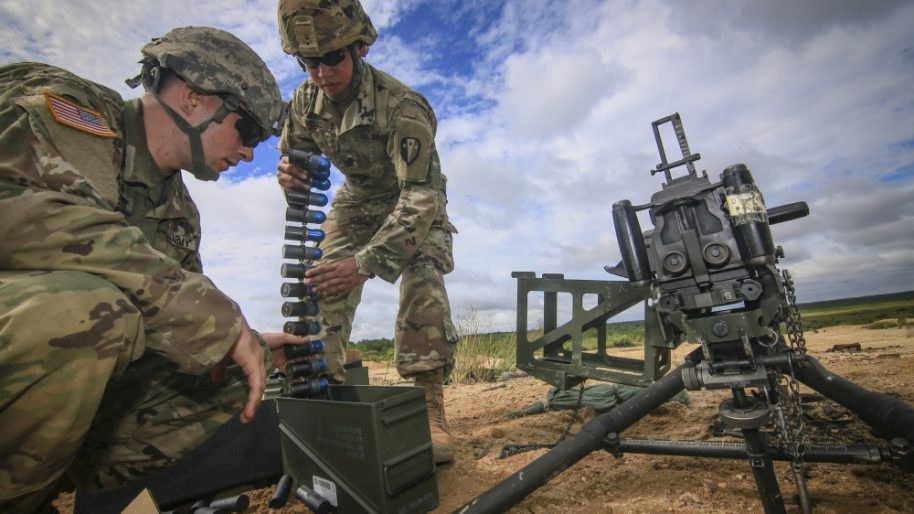
Granted, it could still make the difference between life and death on the battlefield – but fast-forward ahead almost a decade to 2020, and the Army has a new mini camera and GPS equipped projectile drone that can remain airborne for an hour and a half after being fired from a standard launcher.
John Gerdes, an Army Research Laboratory mechanical engineer, said:
“Things like GPS receivers and flight controllers are very feasible to install [onto the GLUAS], which makes it easy to maintain a position or follow a ground unit. Basically, if there is something you want to look at, but you have no idea where it is yet, that’s where the drone comes in.”
The new drone, called Grenade Launched Unmanned Aerial System (GLAUS), being developed by the U.S. Army, can be launched from an existing grenade launcher, thus sparing troops the hassle of having to lug yet another item along with them. It has a two-kilometer range, is capable of operating up to 2,000 feet in the air, and can loiter over the battlefield for up to an hour and a half.


There are two versions under development, the Army says:
One is a small, paragliding system with folding blade propellers and Mylar paragliding wings to help it stay in the air, and the other is a helicopter-style that hovers on a gimbaling set of coaxial rotors.
And although these spy gadgets were intentionally made as weapons of war, they could be handy in disaster situations as well – for example, to locate survivors after an earthquake.
Grenade-Launchers In The Sky

With a body shaped like a crossbow, this tricopter drone developed by Skyborne technologies is a frame for a weapon – a platform for a grenade launcher or shotgun. The drone, called Cerberus GL, can carry three grenades to be fired remotely by troops on land. It launches the bombs while flying and returns to the user for reloading.
Drones Away!
The Drone-40 is a grenade that can be piloted remotely into enemy territory and then detonated. The 40mm munition drone is fired from a grenade launcher. Once it’s in the sky, it deploys its helicopter-style rotors to stay airborne. It can hover for 20 minutes or fly for 12 at a cruising speed of 20 meters per second, giving it a range of 10 kilometers.

Multiple Drone-40s can be shot out simultaneously and left to hover, ready for action. Soldier Systems, the company developing the drone, explains:
“With these mixed of payload types, Drone-40 can be used individually, paired, or as a swarm, to a variety of effects. For example, a team could launch one or more ISR configured munitions along with a swarm of anti-armor payloads and loiter over an ambush spot, waiting for a vehicle column. ‘With Multi-Round Simultaneous Impact mode, multiple effects can be achieved at once, depending on the types of payloads delivered.”
The launcher can even shoot a camera drone after the Drone-40 to follow it. That way, the soldier flying it can use the camera drone to see precisely where the Drone-40 needs to be directed and detonated.
Drone Catcher
Another U.S. Army invention is the grenade-sized drone that shoots out a net to capture and take down enemy drones. It also can be fired out of a standard grenade launcher.
The system relies on compact drone servo mechanisms to precisely time the release of the net, ensuring the capture sequence fires only when the target is within range.

The patent reads:
“As the round nears the target, a signal from a control board activates a servo. The servo pulls on a central lock plunger to release a ball mechanism. This releases the ogive section, which in turn allows the ejection spring means to eject the petals and weights along with the net stowed there within.”

This is different than drones with nets on them trying to scoop another drone out of the sky. Instead, it flies up to another drone and then fires out the net to catch it.


