
The field of lunar agriculture has advanced significantly, with scientists reporting the first plants grown in lunar soil. While the method did not produce an edible meal, the team’s achievement is a big step forward in the endeavor to sustain a lunar colony and conduct long space missions. It also provides valuable information about the composition and viability of foreign soil.
It should not surprise you that lunar soil is in low supply on Earth, making this kind of research difficult. However, scientists have successfully produced crops in artificial lunar soils derived from the Arizona desert. And in 2019, China’s Chang’e-4 spacecraft planted the first seedlings on the moon’s surface, albeit they died less than 24 hours later.
The latest accomplishment in this field was spearheaded by University of Florida researchers Anna-Lisa Paul and Rob Ferl. They applied three times over 11 years to conduct tests on lunar soil, or regolith. The soil in question was taken during the Apollo 11, 12, and 17 missions, so it has a lot of historical value, but the scientists borrowed 12 g (0.4 oz) of it from NASA to cultivate their own miniature garden.

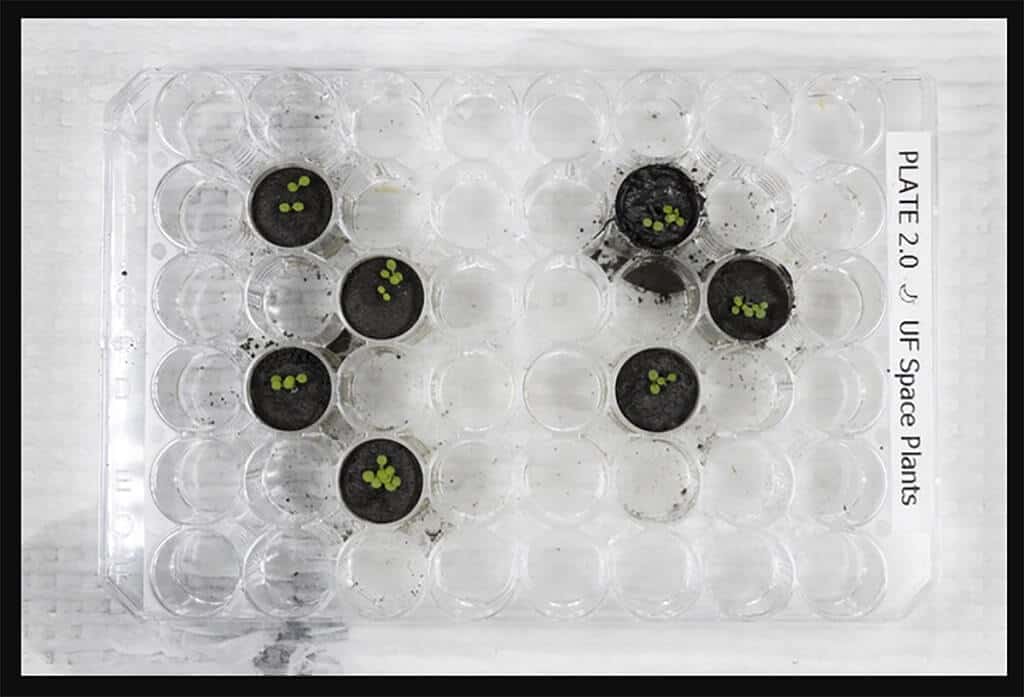
The scientists filled thimble-sized pots with a gram of lunar soil, hydrated them with a nutritional solution, and sowed seeds from the Arabidopsis plant. Next, the researchers planted the same seeds in soils from harsh regions on Earth, simulated lunar soil, and simulated Martian soil as control experiments. Despite their initial skepticism, the scientists were delightfully surprised to discover that almost all lunar soils sprouted plants. “We were amazed. We did not predict that. That told us that the lunar soils didn’t interrupt the hormones and signals involved in plant germination,” Paul said.
However, things didn’t stay so smooth for long. Plants planted on lunar soil took longer to mature, and many of them showed signs of stress, with gene expressions similar to those seen in plants exposed to salt, metals, and reactive oxygen species.
Paul explained:
“At the genetic level, the plants were pulling out the tools typically used to cope with stressors, such as salt and metals or oxidative stress, so we can infer that the plants perceive the lunar soil environment as stressful.
Ultimately, we would like to use the gene expression data to help address how we can ameliorate the stress responses to the level where plants – particularly crops – are able to grow in lunar soil with very little impact on their health.”
Plants cultivated on more mature lunar soil – soil exposed to more cosmic wind – exhibited more signs of stress, whereas plants planted in less mature soil had a more pleasant ride. As part of their follow-up investigations, the UF scientists can now continue to investigate the relationship between plant health and soil composition and the effects that plants may have on the soil itself.
Stephen Elardo, a study author, questioned:
“The Moon is a very, very dry place. How will minerals in the lunar soil respond to having a plant grown in them, with the added water and nutrients? Will adding water make the mineralogy more hospitable to plants?”
The UF team published their findings in the journal Communications Biology. For more information, watch an overview of the breakthrough below.


