
There has been a growing number of discoveries of Earth-like planets around nearby stars. Clearly, long-distance space travel has never seemed more exciting! Not to mention, colonizing Mars. Yes, space agencies and private companies already have elaborate plans to send humans to Mars in the next few years.
There are a few complications standing in the way, however. The truth is, it isn’t easy for humans to survive in space for sustained periods of time. Primarily because of one very important element – oxygen. There is only a little oxygen available in space and the great distances make it hard to do quick refills. That is why one of the biggest challenges with long-distance space flight is transporting enough oxygen for astronauts to breathe. Another one is transporting enough fuel to power complex electronics.
Well, scientists have yet again done an unbelievable thing. There is a new study which shows that it is possible to produce hydrogen (for fuel) and oxygen (for life) from water alone. How? By using a semiconductor material and sunlight (or starlight) in zero gravity. This makes sustained space travel a real possibility. The research has been published in Nature Communications.
The idea first came to light when scientists were looking for a way to use hydrogen as fuel in order to move away from oil towards renewable sources of energy. They found the best way to do this would be by splitting water (H2O) into its constituents: hydrogen and oxygen.
This is possible using a process known as electrolysis. It involves running a current through a water sample containing some soluble electrolyte. This breaks down the water into oxygen and hydrogen, which are released separately at the two electrodes.
Technically, this method of using water to produce hydrogen and oxygen could also be used to fuel a spacecraft. Once in space, special technology could split the water into hydrogen and oxygen which in turn could be used to sustain life or to power electronics via fuel cells. And as a bonus, it would be safer to launch a rocket with water than launching it with additional rocket fuel and oxygen on board, which can be explosive.
There are two possible options for onboard technology:
- Electrolysis as we do on Earth – using electrolytes and solar cells to capture sunlight and convert this into a current.
- Photocatalysts – which work by absorbing light particles – photons – into a semiconductor material inserted into the water. The energy of a photon gets absorbed by an electron in the material which then jumps, leaving behind a hole. The free electron can react with protons (which make up the atomic nucleus along with neutrons) in water to form hydrogen. Meanwhile, the hole can absorb electrons from water to form protons and oxygen.
Option 2 can also be reversed. Hydrogen and oxygen can be brought together or “recombined” using a fuel cell returning the solar energy taken in by the “photocatalysis” – energy which can be used to power electronics. The best part about this is how recombination forms only water as a product – meaning the water can also be recycled – which is key to long-distance space travel.
Overall, the process of using photocatalysts is the best option for space travel. The equipment weighs much less than the one needed for electrolysis. Theoretically, it should work easily because the intensity of the sunlight is far higher without the Earth’s atmosphere (it absorbs large amounts of it on its way through to the surface).
Drop Tower Testing
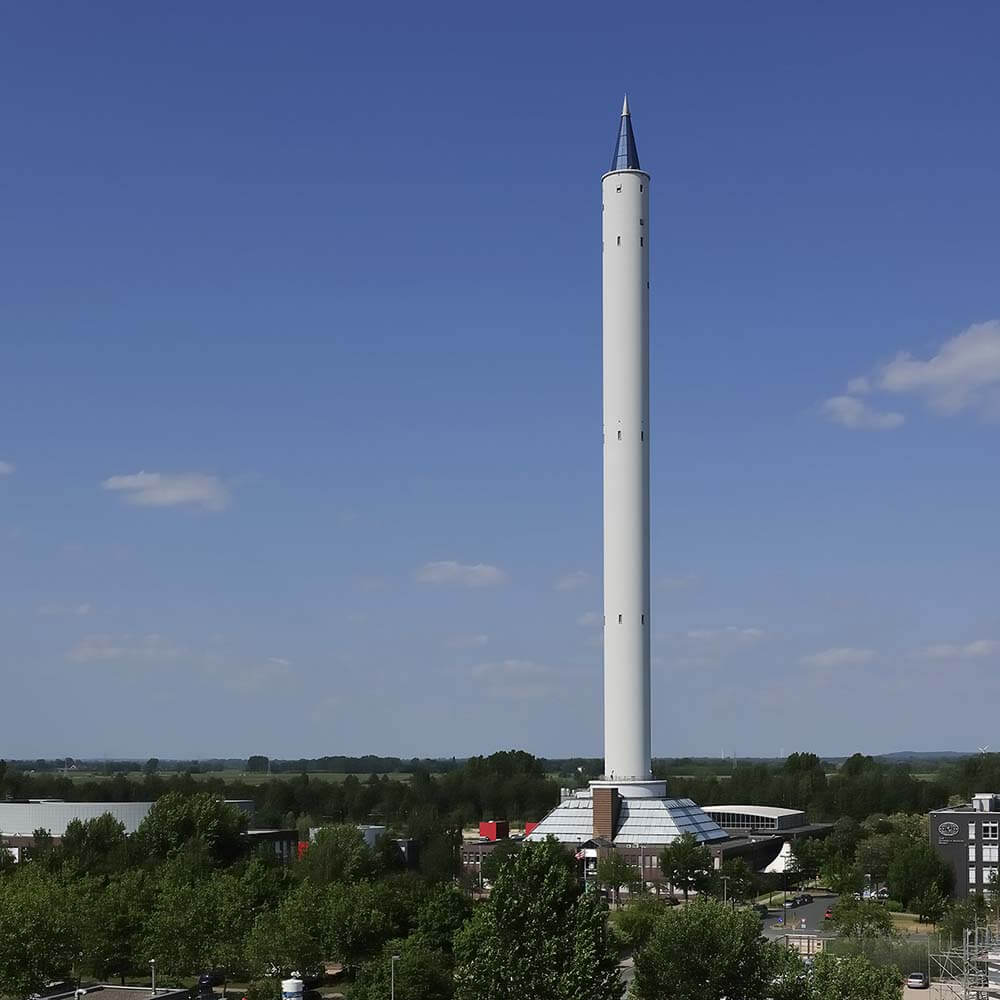
The researchers even tested a full experimental set up for photocatalysis. They dropped it down a 120-meter drop tower, creating an environment similar to microgravity. How this works: As objects accelerate towards Earth in free fall, the effect of gravity diminishes as forces exerted by gravity are canceled out by equal and opposite forces due to the acceleration. This is opposite to the G forces experienced by fighter pilots and astronauts as they accelerate in their aircraft.
Bubbles
What this experiment showed was that it is indeed possible to split water in this environment. They also discovered something else, however – bubbles form as water is split to create gas. This is not good because bubbles hinder the process of creating gas. Therefore, getting rid of bubbles from the catalyst material once formed is crucial.
The thing is, on Earth, gravity makes the bubbles automatically float to the surface (the water near the surface is denser than the bubbles, which makes them buoyant) – freeing the space on the catalyst for the next bubble to be produced. Unfortunately, in zero gravity this is not possible and the bubble will remain on or near the catalyst. However, the scientists did figure out a solution! They adjusted the shape of nanoscale features in the catalyst by creating pyramid-shaped zones where the bubble could easily disengage from the tip and float off into the medium.
Now, one problem remains. In the absence of gravity, the bubbles will remain in the liquid – even though they have been forced away from the catalyst itself. Gravity allows for the gases to easily escape from the liquid but without the presence of gravity, no gas bubbles float to the surface and separate from the mixture – instead, all the gas remains to create a foam. This reduces the efficiency of the process dramatically by blocking the catalysts or electrodes.
The key to successfully implementing this technology in space is to engineer solutions around this problem. One possibility could be to use centrifugal forces from rotation of a spacecraft to separate the gases from the solution. Anyways, at least we are a step closer to long-duration human spaceflight thanks to this study!


