
Researchers from the Graphene Flagship are paving the way for a novel class of high-performance bionic composites by finding a way to boost the strength of spider’s silk using graphene-based materials. Naturally, spider silk has excellent mechanical properties, superior to most existing materials in the world. Yet, this enhanced version is several times stronger making it one of the strongest materials on the planet!
These researchers have demonstrated how spider’s silk – produced naturally by the spiders, incorporating graphene and carbon nanotubes (rolled up graphene sheets) introduced in their environment – had enhanced mechanical properties of up to three times the strength and ten times the toughness of the unmodified silks. They published the study in 2D Materials. The research was performed within the Graphene Flagship’s Polymer Composites Work Package but it was a collaboration between the University of Trento, Italy, leading the project, and other research centers and universities in Italy and the UK, including the Cambridge Graphene Centre at the University of Cambridge.
Nicola Pugno (University of Trento, Italy) said:
“Humans have used silkworm silks widely for thousands of years, but recently research has focused on spider silk, as it has promising mechanical properties. It is among the best spun polymer fibers in terms of tensile strength, ultimate strain, and especially toughness, even when compared to synthetic fibers such as Kevlar.”
Artificially Modified Bionic Materials
Artificially modified biological materials are an expanding area of research because of their enormous potential. Taking inspiration from nature is an effective research tool since natural materials can have properties that cannot be achieved with lab-produced materials.
Pugno said:
“We already know that there are biominerals present in the protein matrices and hard tissues of insects, which gives them high strength and hardness in their jaws, mandibles and teeth, for example. So our study looked at whether spider silk’s properties could be ‘enhanced’ by artificially incorporating various different nanomaterials into the silk’s biological protein structures.”
Enhancing The Spider Silk
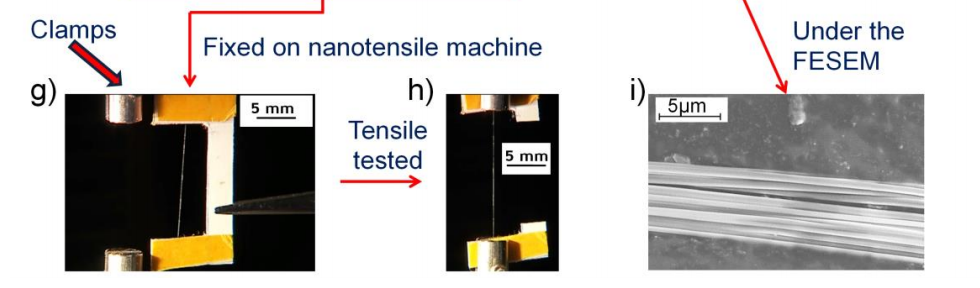
How They Did It
- They prepared solutions of graphene and carbon nanotubes (CNTs).
- These solutions were sprayed within the enclosure the spiders were kept in.
- They waited for the spiders to ingest the graphene and CNT dispersions from their environment.
- Then, their silk was collected from the spiders and tested for graphene/CNT content and mechanical properties.
The Results
- The silks showed enhanced mechanical properties compared to reference silks collected from the same spiders.
- There were significant increases in the strength, toughness, and elasticity of the biocomposite silk threads.
- The strongest silk threads had a fracture strength of up to 5.4 GPa, over 3 times as strong as the unmodified silks, as well as a tenfold increase of toughness modulus up to 2.1 GPa.
Pugno said:
“This is the highest fiber toughness reported to date, and a strength comparable to that of the strongest carbon fibers or limpet teeth. These are still early days, but our results are a proof of concept that paves the way to exploiting the naturally efficient spider spinning process to produce reinforced bionic silk fibers, thus further improving one of the most promising strong materials.”
Tailoring Threads Theory
Further boosts could be possible using graphene flakes specifically tailored for interaction with the silks. Why? Because normally in graphene composites, the lateral size of the graphene flakes determines the interaction between the flake and the composite material. This influences the strain that can be transferred to the graphene below a threshold size. The researchers plan to experiment with this next.
How is this useful in a real-world application? These artificially modified silks could find use in high-performance or biodegradable textiles such as parachutes or medical dressings.
Costas Galiotis, leader of the Graphene Flagship work package on Polymer Composites said:
“While conventional composites, which are now used in so many applications still suffer from inherent weaknesses that prevent a more widespread use, natural or biologically-inspired composites, however, even those encountered in living species, are far superior in many respects because nature itself has worked out ingenious solutions for specific needs. Indeed, graphene and related materials present an excellent opportunity to design new composites at the nanoscale and hence surpassing the deficiencies of conventional man-made materials.”
Andrea Ferrari, director of the Cambridge Graphene Centre, Science and Technology Officer of the Graphene Flagship and Chair of its management panel added:
“The interaction between graphene and related materials and bio-materials is key to broaden their possible applications. This is one of many examples showing potential in this area. This work can help us to design novel composites with enhanced properties, taking inspiration from nature.”


