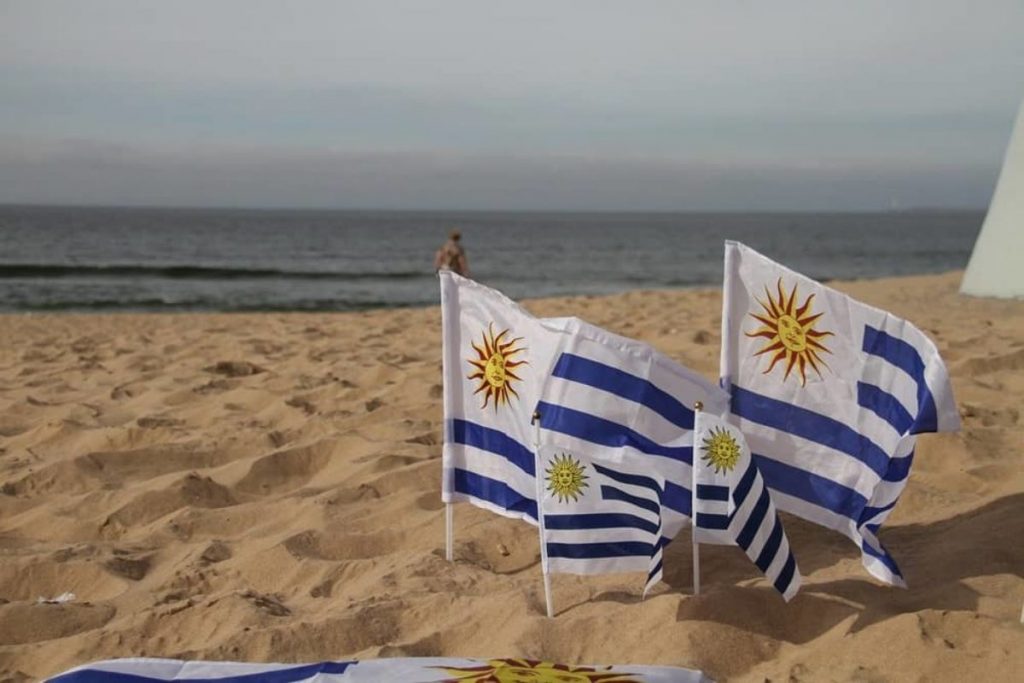
In Southern Uruguay, people weigh their plastic waste before dropping it in a designated “Plasticoin” container by the beach. In return, they receive virtual money on their phone that can be used for discounts on purchases at partnered shops or restaurants. This scheme is part of a pilot environmental project called “Plasticoin” which has recently launched. The project’s goal is to encourage plastic recycling throughout the South American country.
Juan Rivero, who launched the project with Nicole Wyaux, said:
Our mission is to take care of the beach.

A popular seaside resort called Piriapolis is the location of their test site. In 1893, plastic didn’t exist when the Piriapolis resort was built. Now the same cannot be said, the United Nations stated that 13 million tons of the material are discarded in the world’s oceans every year.
How does it work? Participants register online and then they can deposit their plastic waste at any one of the three collection points. The minimum weight for deposit is two pounds (one kilogram), for which participants are compensated with 100-400 Plasticoins. The amount of Plasticoins the depositor receives depends on the type of waste: 400 coins for microplastics of less than a quarter-inch, 200 for beach waste, and 100 for household waste.

One of the participants, Graciela Martinez, said:
It’s good to recycle for yourself, for your children and your grandchildren.
Plasticoins are sent electronically to a mobile phone and can then be used to get a variety of coupons and discounts at the stores and eateries who are involved in the project.
The creators of the Plasticoin project didn’t expect it to be such a great success like it turned out to be. When the project began in January, with a $5,000 grant from a government agency, they had hoped to attain 100 users within the first four months but in less than three weeks they had nearly a thousand.
Another participant, 43-year-old Gustavo Abiega, said the compensation is nothing but a bonus. What’s most important is having a clean beach, “the beach is part of my life”, he added.
With 3.4 million people living in Uruguay, the country faces recycling barriers beyond a lack of awareness and opportunity. According to Cempre’s director, Federico Baraibar, 35% of plastic waste collected is intended for recycling, of which only 12% ends up in the recycling plants.
However, attitudes are slowly adapting the need to take more exceptional care of plastic waste. Hopefully, others get inspired by the Plasticoin project and do similar projects of their own.