
A new superconducting material was synthesized by a group of researchers led by Artem Oganov of Skoltech and the Moscow Institute of Physics and Technology, in collaboration with Ivan Troyan of the Institute of Crystallography of RAS. The material, called Thorium Decahydride (ThH10), has a very high critical temperature of 161°Kelvin (-112.15°C / -169.87°F). The study was supported by a Russian Science Foundation grant and published in the journal Materials.
What is superconductivity? It’s the total loss of electrical resistance under exact and sometimes extremely harsh conditions. It’s a remarkable property inherent in quantum materials. Unfortunately, even though such a quality holds immense potential for high-sensitivity detectors and quantum computers, they are too difficult to use because their valuable properties typically manifest themselves at extremely high pressures or very low temperatures.
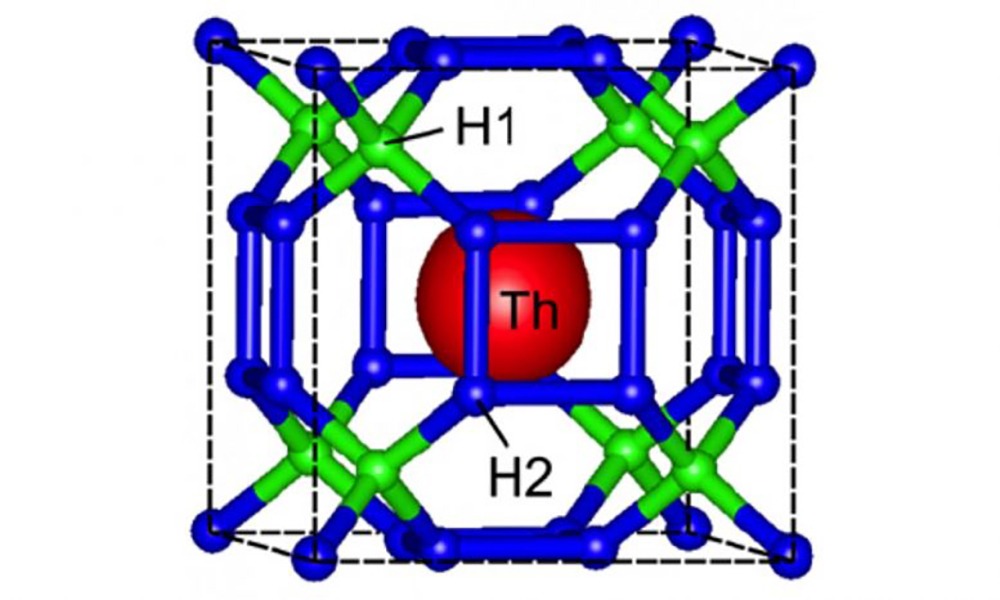
Until ThH10 was synthesized, a mercury-containing cuprate was the 2nd top superconducting material following lanthanum decahydride (LaH10). LaH10 would have been ideal as it becomes superconducting at −13°C (which is very close to room temperature), but it requires pressures close to 2 million atmospheres. Such conditions can’t be maintained for real-life applications. Hence why scientists continued with their hunt for a superconductor that could retain its properties at standard conditions, leading to the finding of ThH10.
ThH10 becomes superconducting at a critical temperature of −32°C and is stable under 1 million atmospheres. It was Alexander Kvashnin, a researcher at Oganov’s lab, who first predicted in 2018 that the material could do this. Then, this study proved Kvashnin’s theoretical predictions to be accurate.
As reported by SciTechDaily:
The team’s findings corroborated the theoretical predictions, proving that ThH10 exists at pressures above 0.85 million atmospheres and exhibits amazing high-temperature superconductivity. The scientists could only determine the critical temperature at 0.7 million atmospheres and found it to be −112 C, which is consistent with the theoretical prediction for that pressure value. This makes ThH10 one of the record-breaking high-temperature superconductors.

Oganov, Skoltech and MIPT Professor who co-directed the study, said:
Modern theory, and in particular, the USPEX method developed by myself and my students, yet again displayed their amazing predictive power. ThH10 pushes the boundaries of classical chemistry and possesses unique properties that were predicted theoretically and recently confirmed by the experiment. Most notably, the experimental results obtained by Ivan Troyan’s lab are of very high quality.
Troyan, study co-director added:
We discovered that superconductivity predicted in theory does exist at −112 C and 0.7 million atmospheres. Given the strong consistency between theory and experiment, it would be interesting to check whether ThH10 will show superconductivity at up to −30 C…−40 C and lower pressures as predicted.
Dmitry Semenok, Skoltech Ph.D. student and first author of the study, said:
Thorium hydride is just one of the elements in a large and rapidly growing class of hydride superconductors. I believe that in the coming years, hydride superconductivity will expand beyond the cryogenic range to find application in the design of electronic devices.
It’s discoveries such as this that are going to pave the way for the electronics of the future.


