
University of Nottingham scientists have developed a revolutionary and incredibly accurate technique for measuring the microscopic elasticity of materials for the first time. The technology, called SRAS++, works by measuring the speed of sound as they bounce across individual crystals from the material’s surface.
The technology could have significant implications for the progression of next-generation materials. For example, SRAS is already starting to be used in aerospace engineering to understand the performance of new materials and manufacturing processes, such as electric discharge machining.
Eventually, this will launch a new research field since it is an entirely new way to assess materials for improving safety in systems like jet engine turbine blades or develop innovative, high-quality alloys with customized stiffness. In addition, medical implants would greatly benefit from this technology. For example, it is vital to match the stiffness of prosthetic devices to the properties of the human body to guarantee harmonious operation.
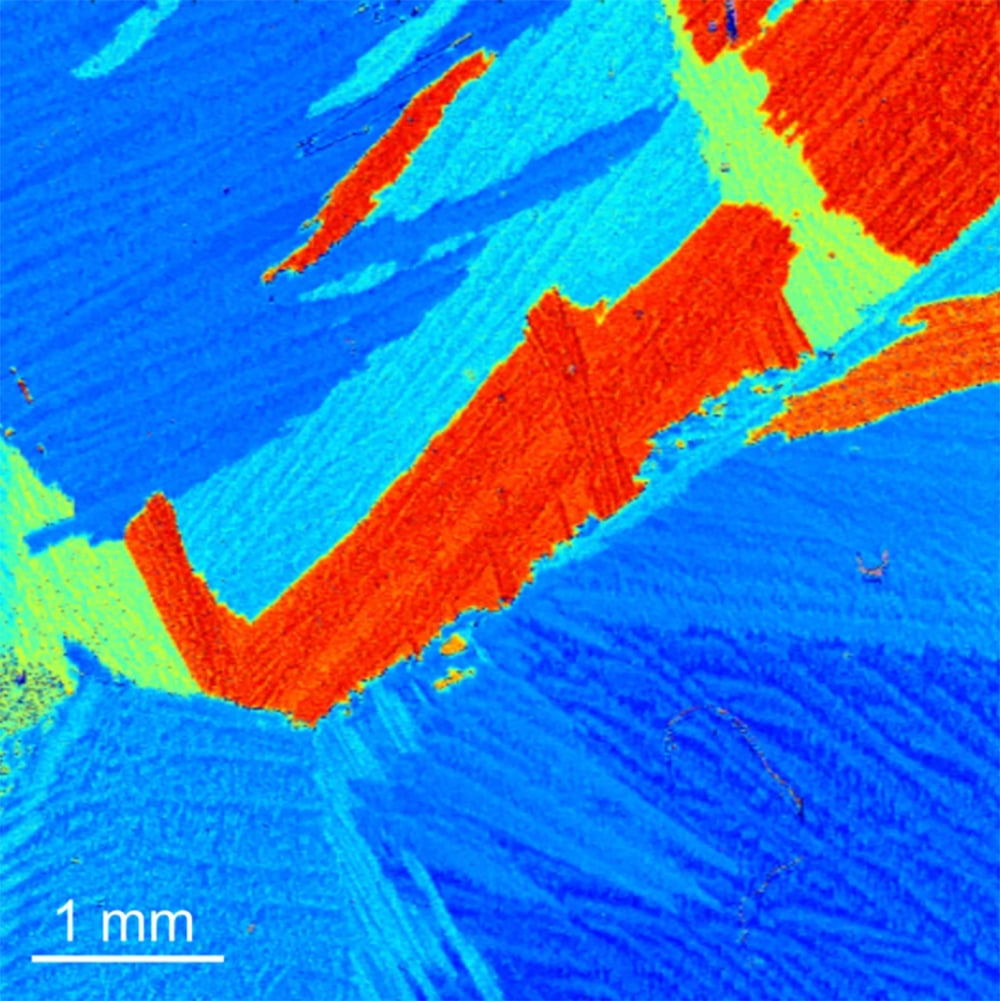
SARS uses high-frequency ultrasound to create microscopic resolution images of the material’s microstructure and measures their relationship between stresses and strains (the elasticity matrix). These crystals are invisible to the naked eye. Still, the alignment and the inherent elasticity of the material can be revealed by precisely measuring the speed of sound from the surface of these crystals.
Traditionally, the only way to measure the elasticity matrix of these materials involved cutting them up or attempting to grow a single crystal. However, this process cannot be applied to many materials, including the titanium alloys used in jet engines.
As a result, a small percentage of materials have had their elasticity measured, which leaves the elasticity of most industrial materials unknown. This means that there is significant (and potentially hazardous) uncertainty in the actual performance of the material put to use. For example, estimates show that fewer than 200 materials (out of thousands) have measured their elasticity.
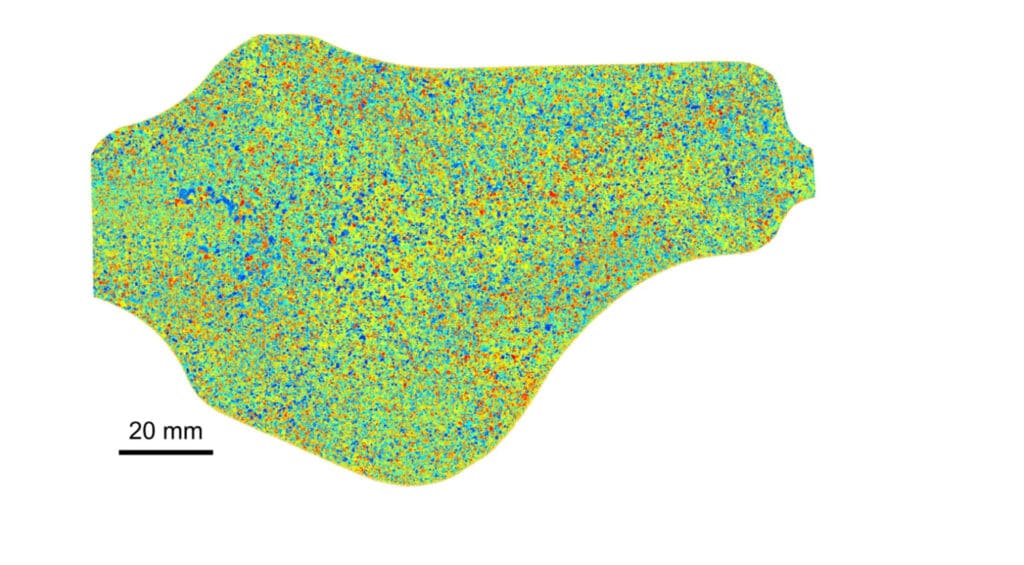
Paul Dryburgh, who co-led the study, explained, “Many materials (such as metals) are made up of small crystals. The shape and stiffness of these crystals are essential to the material’s performance. This means that if we tried to pull on the material, as we would a spring, the stretchiness depends on the size, shape, and orientation of each of these hundreds, thousands, or even millions of crystals. Unfortunately, this complex behavior makes it impossible to determine the inherent microscopic stiffness. This has been an issue for over 100 years, as we’ve lacked an adequate means to measure this property.”
A few years ago, MIT scientists developed a new laser ultrasound technique to make images of the human body without any skin contact, an impossible undertaking with traditional ultrasound. This new study, published in the journal Acta Materialia, builds on this novel method to open up exciting possibilities in material science.
Traditional ultrasound delivers high-frequency sound waves into a sample, like human tissue, and then measures the sounds that bounce back to produce an image of that sample. Instead, laser ultrasound uses light to create these sound waves.
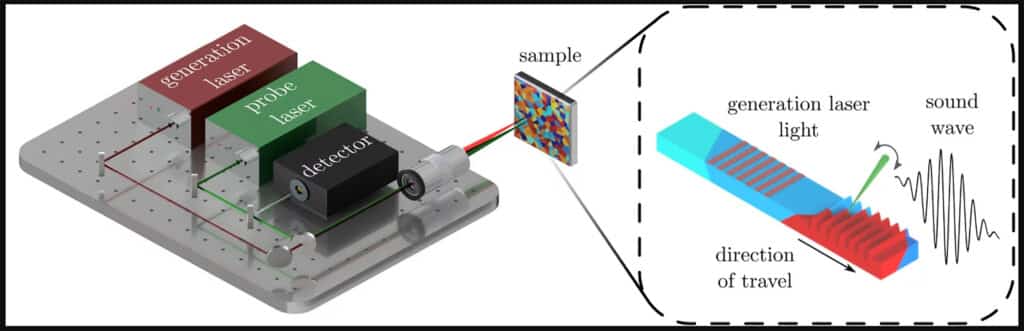
SARS can generate high-frequency waves in a confined space of roughly 200 micrometers (the exact width of two or three human hairs). The laser is designed to shoot a high-energy pulse of light at the sample material, which subsequently creates a sound wave that travels along its surface and is tracked by a built-in detector to reveal the positioning of single crystals and their inherent elasticity. Additionally, SRAS can conduct these measurements at impressive speeds.
The team validated the device’s accuracy via experiments on pure nickel, a nickel-CMSX-4 alloy, and titanium. These samples were chosen due to their favorability among aerospace engineers.
Professor Matt Clark, a co-lead on the study, said, “The development of SRAS++ is a notable breakthrough because it provides the first method to measure the elasticity matrix without knowing the distribution of crystals in the material. Furthermore, SRAS doesn’t require the exacting preparation of a single crystal; it is fast (thousands of measurements can be made every second) and offers unparalleled measurement accuracy. The speed of the technique is such that we estimate that we could repeat all the historical elasticity measurements of the past 100 years within the next six months.”
Besides determining a material’s stiffness, the elasticity matrix also provides insight into various significant material properties that are difficult to measure, like how the material reacts to temperature changes. Thus, the rapid measurement of the elasticity matrix can be used as a guide to finding cutting-edge materials with superior properties, making SRAS++ a vital tool in the development of next-generation materials.
For a complementary development on the control side, a 2026 acoustic tractor beam study showed that sound can also be used to actively retune a material’s stiffness from the outside, rather than just measuring it.


