
The most powerful tidal-powered turbine in the world, made by the Scottish engineering firm Orbital Marine Power, has started to generate electricity through the grid in Orkney, an archipelago located north of mainland Scotland. The 74-meter-long, 680-tonne, 2-megawatt (MW) offshore unit named Orbital O2 is the company’s first commercial turbine and a culmination of over 15 years of work.
The developer sailed the turbine out of Dundee in May. Then, it took over 18 months to finish assembling it and anchor it in the Fall of Warness, where a subsea cable connects it to the local onshore electricity network (through the European Marine Energy Centre).
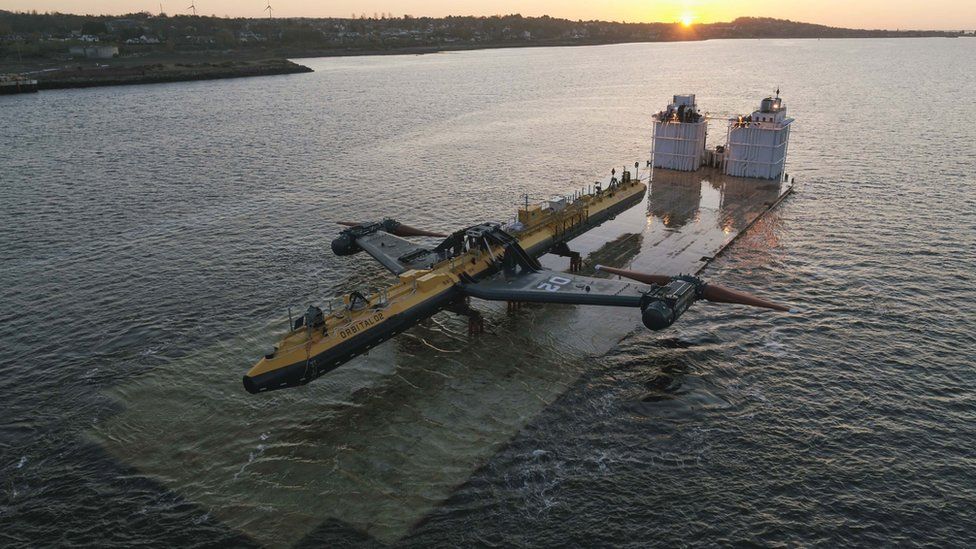
Orbital O2 can meet the annual electricity demand of approximately 2,000 homes for the next decade and a half. However, it’s also set up to send power to a land-based electrolyzer to produce green hydrogen.
Michael Matheson, the Cabinet Secretary for Net Zero and Energy, said:
“With our abundant natural resources, expertise, and ambition, Scotland is ideally placed to harness the enormous global market for marine energy while helping deliver a net-zero economy. The deployment of Orbital Marine Power’s O2, the world’s most powerful tidal turbine, is a proud moment for Scotland and a significant milestone in our journey to net zero.”
Andrew Scott, Orbital Marine Power’s CEO, agrees this is a significant milestone for the UK’s nascent marine energy sector. He also praised the supply chain and his team for their success.
He said:
“This is a major milestone for the O2, and I would like to commend the whole team at Orbital and our supply chain for delivering this pioneering renewable energy project safely and successfully. Our vision is that this project is the trigger to the harnessing of tidal stream resources around the world to play a role in tackling climate change while creating a new, low-carbon industrial sector.”
The turbine consists of a superstructure floating on the surface with legs that have rotors attached to them, extracting energy from the fast-passing tidal flow. It’s held in place by a four-point mooring system made of chains strong enough to lift over 50 double-decker buses. A dynamic cable transfers the electricity from the turbine to the seabed, then through a static line to the onshore electricity network.
The company’s next goal is to commercialize the technology to deliver a significant job boost to coastal communities.
Mr. Scott said:
“We believe pioneering our vision in the UK can deliver on a broad spectrum of political initiatives across net-zero, leveling up and building back better at the same time as demonstrating global leadership in the area of low-carbon innovation that is essential to creating a more sustainable future for the generations to come.”
However, the current footprint of the marine-based energy industry remains small, albeit with apparent growing interest. It also spans more technologies than tidal stream alone, from wave devices to OTEC, which installed its first purpose-built offshore platform off the Canary Islands in 2026. For example, Ocean Energy Europe figures indicate that Europe added only 260 kilowatts of tidal stream capacity and 200 kW of wave energy in 2020. Meanwhile, the continents saw a 14.7 gigawatt increase in wind energy capacity that year. Nevertheless, Orbital Marine Power expects costs for marine-based technology to fall as systems are more widely deployed—as seen in the wind and solar sector.


