
Researchers from Southwest Jiaotong University unveiled the world’s first high-temp superconducting (HTS) maglev (magnetic levitation) train prototype capable of reaching top speeds of 620km/h (385mph). The HTS technology was demonstrated during a ceremony where the 21-meter-long train was seen floating along the tracks in Chengdu, China.
When the presentation was almost complete, deputy director Deng Zigang of the university’s research center for super-high-speed maglev transport in low-pressure tubes pointed out that “although the theory sounds good, everyone saw the HTS maglev technology as a lab toy in the past, without tests in a real situation.”

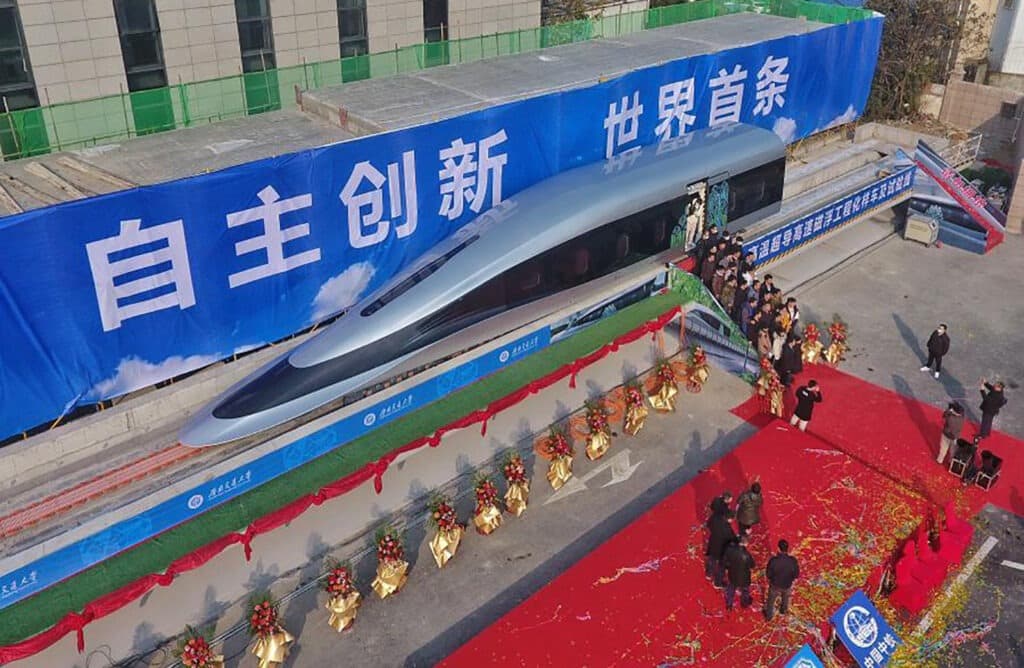
Various technologies that enhance speed are incorporated into the new train, including:
- A low resistance train shape
- A full carbon-fiber lightweight body
- A HTS maglev with a large load capacity
With a top speed of 620 km/h (385 mph), the Chinese maglev train is expected to break a new land transportation speed record in an atmospheric environment. In the future, it could deliver changes to the rail transit industry with the application of low vacuum tube technology. The developers aim to eventually boost the speed to 800 km/h (497 mph). “The HTS technology can make the train float without electricity, and it can be moved with just one hand,” added Zigang.
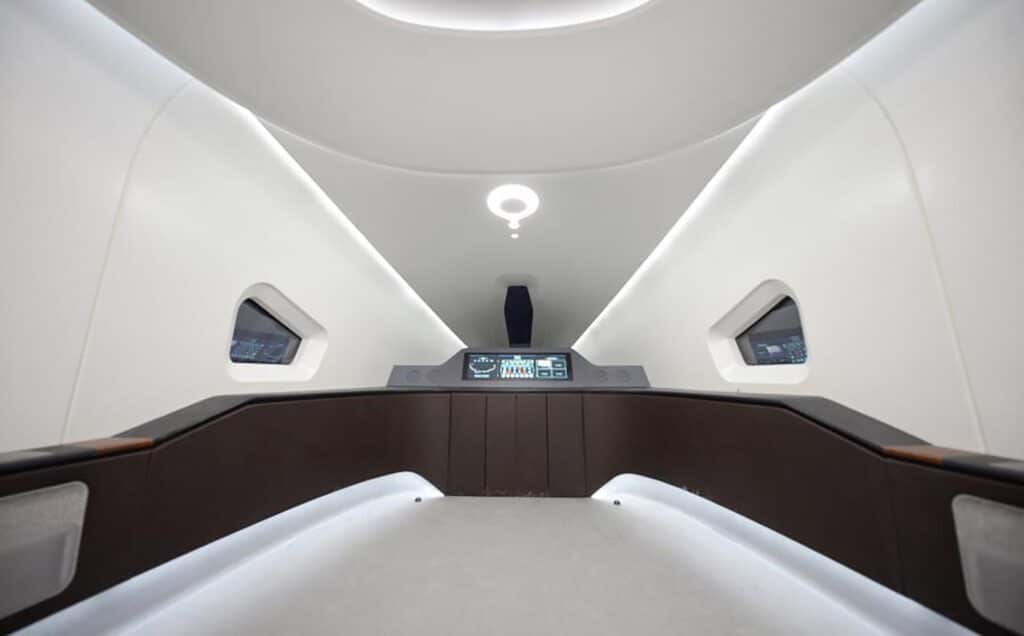


China is a world leader in high-speed railways, with more than 37,900 km of rail lines throughout the country. Their first maglev system – the ‘Shanghai maglev train’ – has operated since 2003 with German technology. It’s the third commercially used maglev line in history (after the British Birmingham Maglev and the German M-Bahn). However, the Chinese HTS maglev technology is more suited for futuristic superfast transportation in vacuum tubes than these other technologies.
A hyperloop train in South Korea reached a top speed of 1,019 km/h (633 mph) in November, 2020. Hyperloop trains can reach a higher speed by creating a vacuum environment, significantly reducing air resistance.


