
Out of nearly 100,000 fungal species, around 80 are known to be bioluminescent. A 2015 study found that the mushrooms emit a bluish-green light from within to attract flies, ants, wasps, and beetles, which in turn helps disperse the mushrooms’ spores and spread the fungi across the forest. Fungi can also sustain unusual non-green plants: the newly described Thismia daemona depends on a fungal partner for its carbon and nutrients.
Bioluminescent mushrooms are beautiful, but if growers want to plant them in their garden, they will find it can be challenging. Thankfully, a new study published in Nature Biotechnology shows it could soon be possible to buy glowing versions of easily grown plants.
The research was achieved in collaboration with Moscow-based biotech start-up Planta, the Institute of Science and Technology Austria, MRC (Medical Research Council) London Institute of Medical Sciences, and the Institute of Bioorganic Chemistry of the Russian Academy of Sciences.

In the study, scientists started by extracting DNA from bioluminescent mushrooms and inserting them into tobacco plants. The process could work on a wide range of plants, but the team chose tobacco because it is genetically simple and grows rapidly. The results were successful, with the genetically manipulated tobacco plants continuously emitting green light from their roots, stems, flowers, and leaves throughout all stages of their growth.
In 2017, MIT scientists discovered how to make watercress plants temporarily glow by incorporating enzymes obtained from fireflies. While the glow was considerably dim, their long-term plan was to develop plants that produce light for at-home use or to transform trees into self-powered streetlights to reduce the need for electrical lighting. However, the mushroom-DNA plants are apparently ten times brighter, and they glow consistently.
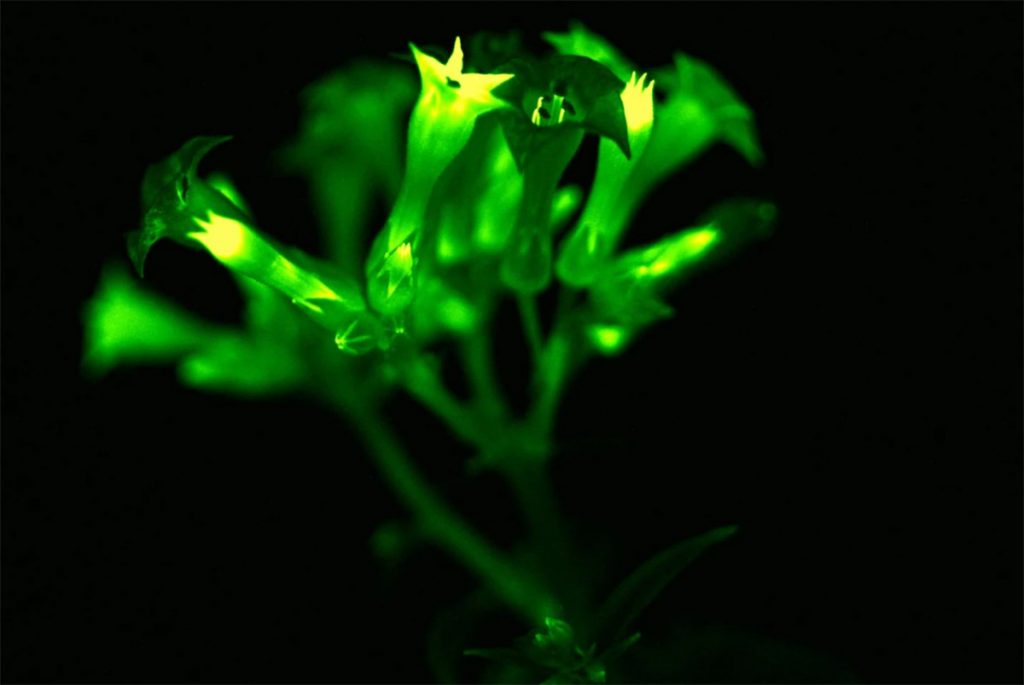
How does the mushroom glow? It glows from a molecule known as caffeic acid, which is found in both the lignin that makes up much of the cell walls of plants and in bioluminescent mushrooms. Even though plants contain caffeic acid, it’s not enough to make them glow. In these mushrooms, a pair of enzymes convert the acid into a luminescent molecule named luciferin, which is oxidized by a third enzyme to produce a light particle (photon). Then, a fourth enzyme turns the oxidized molecule back to caffeic acid so that the entire process can start all over again.
The biotech company, Light Bio, has partnered with Planta to commercialize the technology, with plans to offer a wide range of glowing houseplants eventually.
Recently, a team of researchers led by Robert Grass and Yaniv Erlich embedded a 3D-printed plastic white rabbit with DNA that contains instructions for printing new bunnies. If a piece of the bunny’s ear chips off, the 3D printer can identify the DNA from the ear and can print an identical bunny.


