
A small town in Colorado called Basalt with a population of 4,170 people is testing a different type of energy grid than everywhere else.
The U.S. Department of Energy’s (DOE’s) National Renewable Energy Laboratory (NREL) is working together with local Colorado power company Holy Cross Energy to bring a new grid solution, with a “think big, start small” approach that may help other cities around the world.
They began small with one home and have now scaled the system to 27 homes. NREL’s Energy Systems Integration Facility (ESIF) is described by the Holy Cross Energy CEO Bryan Hannegan as a “distribution grid in a box.” Hannegan worked closely on the development of the ESIF facility from 2013-2017, so he knew exactly how everything worked when he joined Holy Cross Energy.
Together they have set up an autonomous energy grid that shares electricity between solar panels, batteries, heaters, and vehicles. This system uses Ethernet connections that communicate to determine when and where to optimally send power throughout the town.
This pilot project was made possible thanks to the Advanced Research Projects Agency-Energy (ARPA-E) whose role is to fund early-stage technology development before the private sector is willing to get involved. They look at new solutions and new approaches to solving problems that have never been tried.

Andrey Bernstein, a senior scientist at NREL and lead on the Network Optimized Distributed Energy Systems (NODES) program, explains how this got started: “This project came together because of ARPA-E’s support for high-risk, high-gain projects from start to finish, all the way from brainstorming at the blackboard to actual implementations in our homes.”
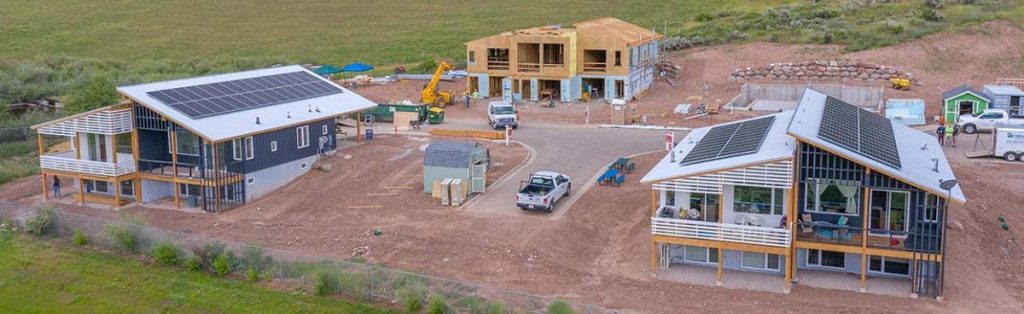
This cutting-edge technology is a virtual power plant of field-advancing algorithms where the equipped Basalt Vista homes exchange energy and services with their neighbors. There are controls located both indoors and outdoors in weather-protected casings that run the NODES algorithms directing the controllers where to send the energy through residential distributed energy resources (DERs).
This technology has been a success. Energy costs are down for local residents and Holy Cross is learning valuable information about the home’s energy use. This provides a great blueprint to implement such an energy sharing grid on a large scale.
Credit: Dennis Schroeder, NREL
Fei Ding, an engineer at NREL and project lead on the Holy Cross partnership, said this technology is ready for large scaling, but they have questions they would like to answer first:
Technically, the NODES algorithms are ready for large systems. We’re now looking to other related use cases, such as dynamic DER aggregation: How can we aggregate these controllable devices dynamically and flexibly to address different needs and time-varying system conditions? And how can DER management be optimized to further increase the resilience and security of the Holy Cross distribution grid?
Basalt offered the perfect testing ground for this type of project. The small Colorado town is surrounded by mountains that have many challenges including very long cables stretching far distances, unusual load patterns from ski seasons, along with forest fires and other natural disasters that could leave the town without power. The location is also just a few hundred miles from NREL’s ESIF facility.
Now, this information gathered from Basalt will be broadcast and shared with the National Rural Electric Cooperative Association that covers more than half of America’s land and services more than 40 million people. As Hannegan points out, this can help everyone:
This is work that any electric utility can apply anywhere in the country. By using interoperable standards and commercially available components, we have worked hard to ensure that this work can scale and provide benefits in a way that will be meaningful on a national level.
For more information please visit the NREL and ARPA-E links provided.


