
Land use and land cover changes, or LULCC, is a subject that scientists have been studying more closely due to the global climate crisis. The data they’ve compiled shows the world’s tropical forests are now removing less carbon dioxide (CO2) from the atmosphere than boreal forest growth, which has increased the carbon sink globally.
This information is an amalgamation of combined data from remote-sensors and modeling to show carbon losses and gain across all of Earth’s biomes from 1992-2015.
Researchers determined that deforestation is the main driving factor of tropical rainforests’ reduced ability to capture CO2. The lead author of the study, Dr. Torben Tagesson, a researcher at Lund University in Sweden, pointed out the main areas affected by this are the Amazon, Indonesia, and Southeast Asia. He goes on to say:
This study gives us an insight into how this CO2 uptake is distributed across the world – and we show that the contribution of the tropical forests is substantially decreasing. At the same time, the contribution of boreal forests is increasing.
This has caused an increase in the growth of the carbon sink, which are natural systems that suck up and store carbon dioxide from the atmosphere.
Nearly 30% of all greenhouse gas emissions from human activity are absorbed by our land, therefore it is important to discuss forests when speaking about carbon sinks. Assessing the data from 1992-2015, the scientists found an increased carbon sink of 1 billion tons!
The first map shows a breakdown of the world’s terrestrial biomes.
The second compares the original size of our forests compared with their modern size.
The third displays the growth of carbon sinks across the globe.
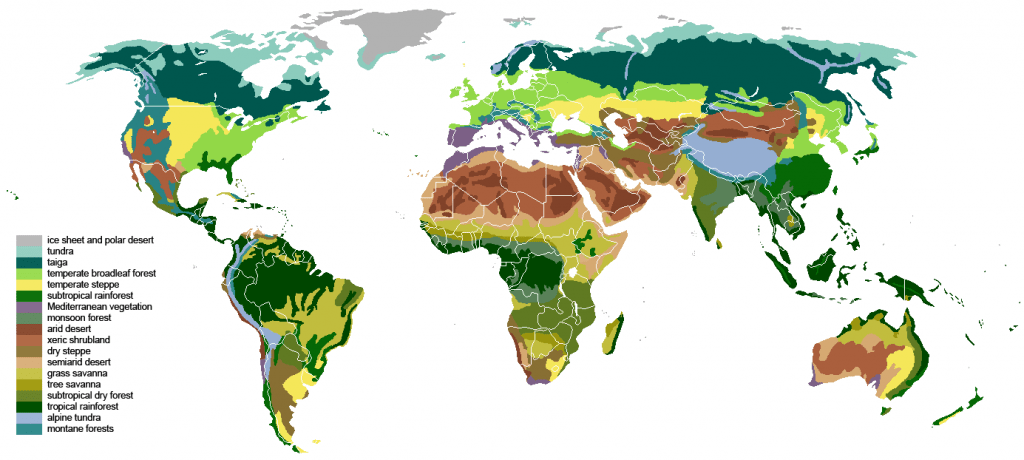

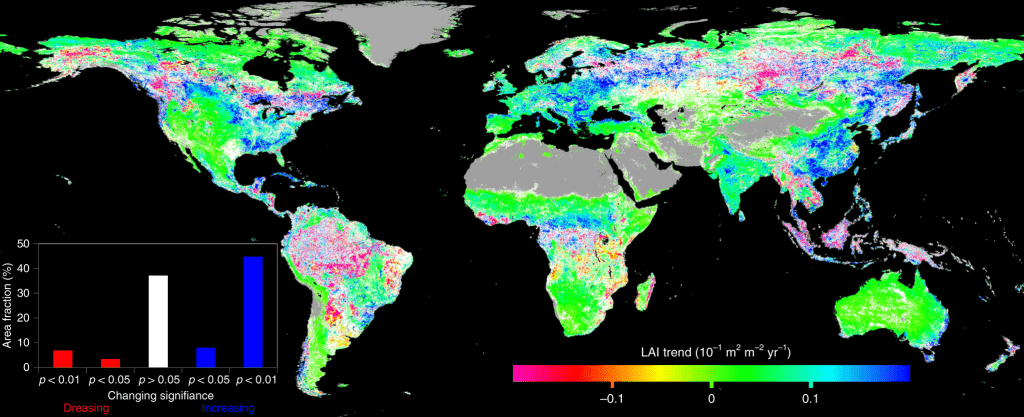
When looking at previous research, the new study finds that tropical and boreal forests are the most important biomes when it comes to the ability to store carbon. These two biomes account for 53% of the carbon held by land.
Tagesson said, that these two regions are now showing divergence in their ability to store carbon.
We can clearly see that the anthropogenic land use and land cover change have a big impact for the contribution of tropical forests.
He also pointed out that there has been a large increase in the amount of deforestation from 2015 until now. Meaning the numbers now are most likely much worse.
Tagesson and his team said it’s more difficult to figure out why the boreal forests are absorbing more CO2. However, he said that it’s likely the “CO2 fertilization effect” is playing a role. When plants use CO2 for photosynthesis, when humans cause more emissions, the plants grow faster and store more carbon.
This may sound like a good thing that the plants are storing more. However, Professor Anja Rammig from the Technical University of Munich, who was not involved in the study, warns that this could slow down or possibly even have a reverse effect. She recently told Carbon Brief:
The question is: How long will this carbon stay in forests? It could be that this carbon gets lost earlier because if trees are growing faster, they could die younger. If trees are dying younger, we could expect to see a completely reversed picture in 10 or 20 years.
She goes on to say that this new study is “very solid” and creates a “comprehensive picture” of how the carbon sink is changing. “A real strength is the author’s look at above-ground biomass, rather than just ‘greening’, which is often used in forestry studies.”


