
Most people prefer to spend their time surrounded by nature, and it is good for your health after all. That’s why we see more and more buildings covered in greenery. Foster + Partners’ Marina Tower and Guangming Hub are among them. The tower is Greece’s first green high-rise building and its tallest, reaching 200 meters (656 ft) in height. The hub will include greenery-filled towers, autonomous vehicle technologies, and even virtual reality (VR).
Indeed, the greenery brings nature into cities while offering insulation and shade to the buildings, reducing air-conditioning requirements—but what if they could also provide food? That is precisely what Italy’s Carlo Ratti Associati (CRA) has in mind for the “Farmscraper,” which the firm claims could feed up to 40,000 people annually.
The Farmscraper, officially called Jian Mu Tower, would rise to 715 ft (218 m) in Shenzhen, China. The tower would have 51 floors, with most of the floor space used for offices, though it would also feature a food court, supermarket, and a rooftop terrace. However, the most exciting detail is the hydroponic farm, expected to produce an ambitious yield per year.


CRA explained, “Jian Mu Tower occupies the last plot available in Shenzhen’s Central Business District, therefore completes the skyline of the area’s central axis. The 218-meter-high tower dedicates 10,000 sq m [roughly 107,00 sq ft] of space on its facade to cultivate crops. The vertical hydroponic farm will produce an estimated 270,000 kilograms [almost 300 tons] of food per year, enough to cover the needs of roughly 40,000 people. Jian Mu Tower establishes a self-sustained food supply chain, encompassing the cultivation, harvest, sale, and consumption of crops, all inside the same building. In addition, the tower will house offices, a supermarket, and a food court.”
Urban agriculture is taking another form on rooftops, where researchers are combining solar panels with high-value crops. A Colorado State University study demonstrated that saffron grown under solar panels can double its yield while the rooftop simultaneously generates electricity, creating dual-income urban infrastructure.”
Other features include:
- A series of landscaped terraces hosting lychee, fern, and water lilies.
- Greenery-filled gardens for office workers to relax.
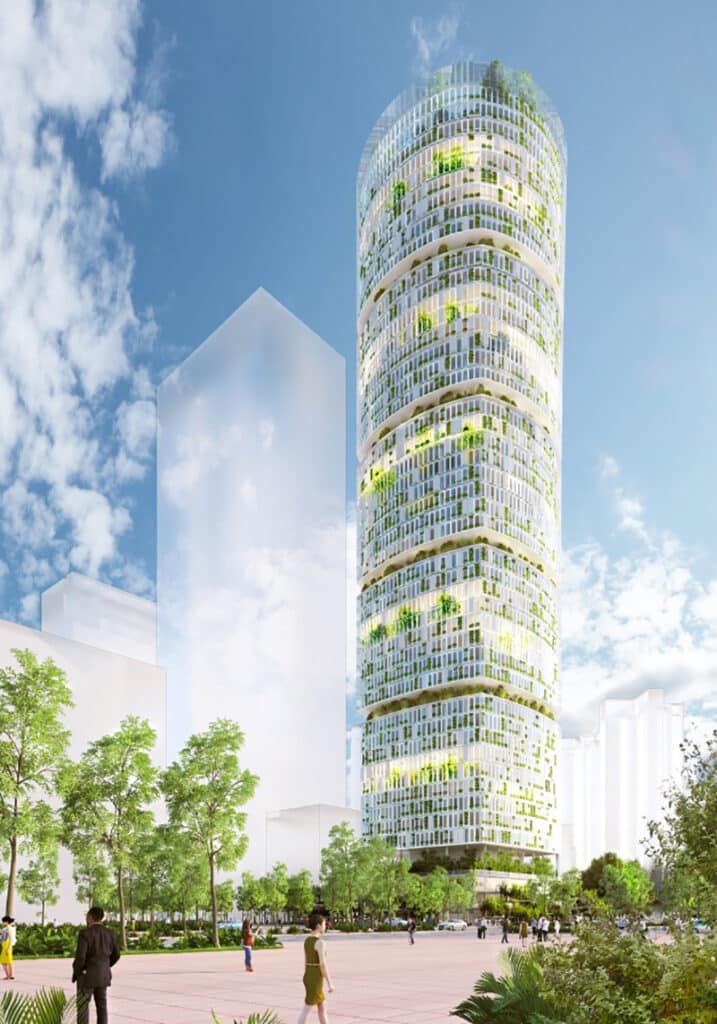

The Jian Mu Tower, commissioned by Chinese supermarket company Wumart for an international competition, would involve engineering firm Arup and Italian specialist agriculture firm Zero. But, unfortunately, there is no confirmation on whether the Jian Mu Tower is going ahead with construction. So, for now, like CRA’s ‘Playscraper,’ it’s best taken as food for thought.
However, not everything from CRA is just food for thought. In 2019, CRA developed an incredible orange juice bar that turns the fruit peel waste into 3-D printed bioplastic cups on the spot! Freshly-squeezed orange juice is served in freshly printed cups as a prime example of a zero-waste circular economy. The juicer is 10-feet tall and topped with a massive dome comprised of many helical racks holding up to 1,500 oranges. In addition, a 3-D printer is installed at the machine’s base.
In the summer of 2019, the Circular Juice Bar made its debut in Rimini, Italy then was installed at Milan’s Singularity University Summit on the 8th and 9th of October that same year. In 2020, it toured around Italy to demonstrate a new approach to environmental circularity and inspire others to incorporate zero-waste in their daily lives.


