
When the COVID-19 pandemic forced bars and restaurants across the UK to close in 2020, millions of pints of beer faced an undignified fate: disposal down the drain. The British Beer and Pub Association (BBPA) estimated that approximately 87 million pints of beer would be discarded as a result of lockdown closures. But Heineken’s Manchester brewery found an inspired alternative—turning that surplus beer into green energy.
At Heineken’s Manchester brewery, the team devised a method to convert excess beer into energy, preventing their stock from going to waste. The surplus stock destined for pubs around the country was recycled using new equipment that reversed the keg-filling mechanism—extracting the beer and storing it in empty vessels.
This beer was then drip-fed into an onsite wastewater treatment plant and placed into an anaerobic digester that converted the beer into biogas—a 100% sustainable and renewable energy source. A combined heat and power (CHP) unit, housed inside a shipping container, then converted the biogas into electricity and heat, which was fed back into the brewery’s operations to power brewing kettles and canning pasteurisers.

Matt Callan, Heineken’s brewery and operations director, explained the drive behind the initiative: “After all the care, attention, and passion that went into brewing the beer in the first place, it would have been a great shame to pour it down the drain – no brewer wants to see their beer not be enjoyed.”
Since May 2020, the Heineken team converted approximately 83,210 fifty-litre kegs — the equivalent of more than 7 million pints that would otherwise have been wasted — into energy, producing enough power to heat roughly 28,000 average UK homes for one day. The wastewater treatment plant operated at full capacity, processing the equivalent of 70,000 litres of beer daily.
The Science Behind Brewery Waste-to-Energy: How Anaerobic Digestion Works
The process Heineken used in Manchester is called anaerobic digestion—a technology that has been powering breweries for decades. Brewery waste—whether surplus beer, spent grain, wastewater, or yeast—is rich in organic matter. When placed in an oxygen-free environment, naturally occurring microbes break down this organic material in a four-stage process: hydrolysis, acidogenesis, acetogenesis, and methanogenesis. The end product is biogas—a mixture of roughly 60% methane and 40% carbon dioxide.
Once captured, the biogas can be used in several ways:
How Biogas Is Captured and Used
- Combined Heat and Power (CHP): Biogas fuels an engine-generator that produces both electricity and heat simultaneously. This is the approach Heineken Manchester employed, and it can cover 50–60% of a typical brewery’s electricity demand.
- Direct Boiler Fuel: Cleaned biogas can be fed directly into boilers to produce steam for the brewing process, replacing fossil natural gas.
- Biomethane Upgrading: Biogas can be purified to pipeline-quality biomethane—chemically identical to natural gas—and injected into the gas grid or used as vehicle fuel.
The solid byproduct, called digestate, is rich in nitrogen and phosphorus and can be used as an agricultural fertiliser—creating a closed-loop system where brewing byproducts nourish the barley fields that supply the next batch of beer.

Göss Brewery: Heineken’s Carbon-Neutral Pioneer in Austria
While the Manchester story made headlines during the pandemic, Heineken’s most impressive waste-to-energy achievement sits in the small Austrian town of Göss. The Göss Brewery, which produces 1.4 million bottles of beer daily, became the world’s first large-scale carbon-neutral brewery—powered largely by its own waste.
In partnership with Austrian engineering firm BDI–BioEnergy International, Göss installed a spent-grain fermentation plant that processes 18,000 tonnes of brewery residues annually. The anaerobic digestion system produces enough biogas to cover roughly 50% of the brewery’s total energy needs, with the remainder supplied by solar panels, hydropower from a nearby river, and waste heat recovery from the brewing process itself.
The model is truly circular. After anaerobic digestion, the nutrient-rich digestate is spread on local barley fields as organic fertiliser. The barley grown on those fields is harvested and returned to the brewery—grain to glass to grain again. The brewery avoids approximately 3,000 tonnes of CO2 emissions annually, and in 2016, it became the first major brewery on the planet to achieve complete carbon neutrality—a milestone that predated Heineken’s company-wide climate targets by years.
Heineken’s “Brew a Better World” 2030 Sustainability Strategy
The Manchester and Göss projects are not isolated experiments. They form part of Heineken’s ambitious Brew a Better World strategy, which sets firm targets for 2030 and commits to net zero across the entire value chain by 2040.
Recent progress highlights include:
- 38% reduction in Scope 1 and 2 emissions since the 2022 baseline—on track for net zero production by 2030
- 88% of electricity sourced from renewables across global operations in 2025
- 33% reduction in Scope 3 emissions, including agricultural supply chains, packaging, and logistics
- Spain becomes the first Heineken market worldwide to brew with 100% renewable energy—electricity and thermal—across all four breweries (Seville, Madrid, Valencia, and Jaén) as of December 2025, following an €80 million investment in solar photovoltaic, concentrated solar thermal, biomass, and biogas
- 99% of production waste is diverted from landfill—spent grain becomes animal feed; wastewater yields biogas and fertilizer; yeast and alcohol are repurposed
- Water stewardship: average water usage of just 2.9 hectoliters per hectoliter of beer, with 43% water balancing achieved in water-stressed regions
Beyond Heineken: How Breweries Worldwide Are Turning Waste Into Resources
Heineken is far from alone in the brewery waste-to-energy movement.
Industry Leaders: Anheuser-Busch and the Craft Brewery Movement
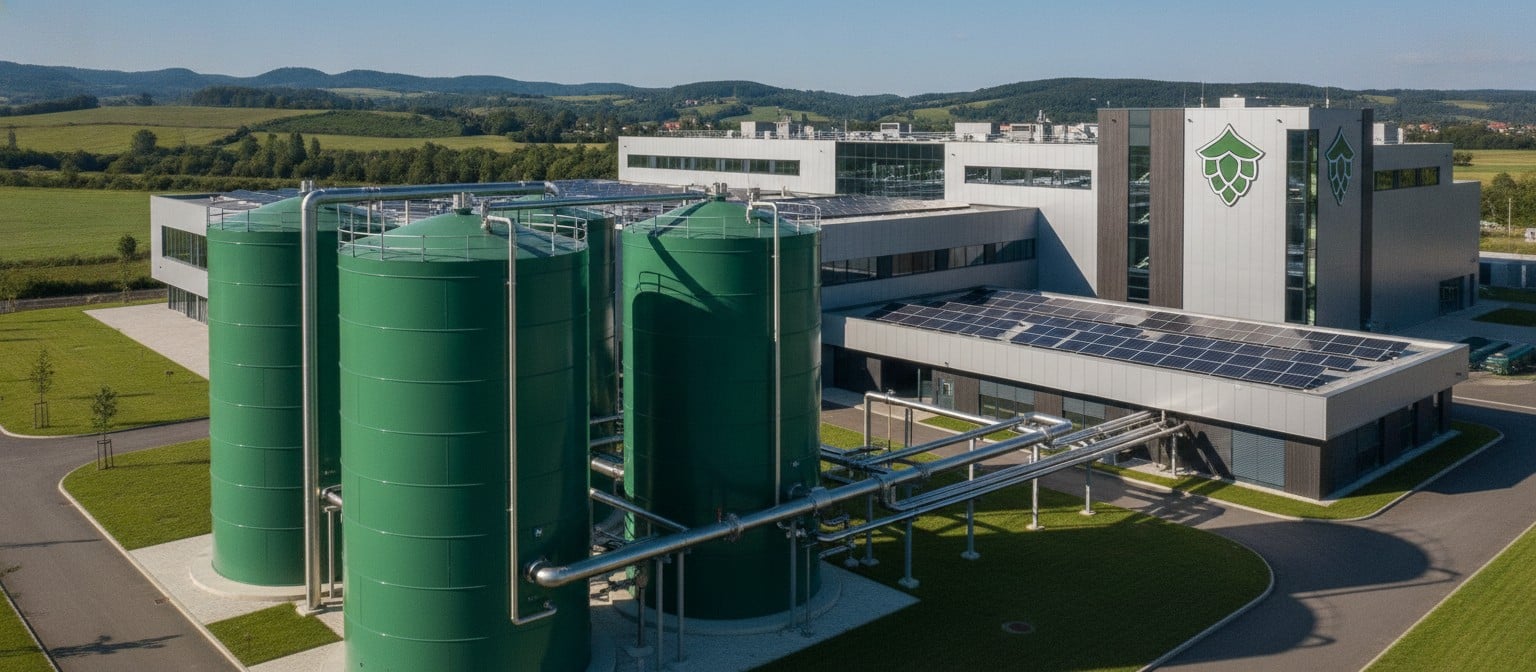
Anheuser-Busch, the world’s largest brewer, began installing anaerobic digestion systems in the late 1980s and now operates them at 10 of its 12 US breweries. Their Bio-Energy Recovery System (BERS) supplies 10–15% of each brewery’s fuel needs, and the company has achieved over 99% biogas utilisation—one of the highest rates in the industry—meaning almost none is flared or wasted.
Craft breweries are joining too. At the Dickinson College Farm in Pennsylvania, spent grain from Molly Pitcher Brewing Company—over 1,000 pounds weekly—feeds an anaerobic digester alongside livestock manure and food waste. The resulting methane powers the farm and a neighbouring dairy and produces surplus energy sold back to the grid. In the UK, Hepworth Brewery has partnered with technology firm WASE to treat 17 cubic metres of wastewater daily through electro-methanogenesis, generating 362 MWh of renewable energy and saving over 100 tonnes of CO2 annually.
Researchers are also developing methods to turn beer waste into activated carbon for water filtration and extracting valuable protein and fibre from spent grain for food products—showing that brewery waste has value far beyond energy alone.
The Circular Economy of Beer: From Grain to Glass and Back Again
What makes brewery waste-to-energy so compelling is that it completes a natural circular loop. The same barley fields that supply the grain for brewing can receive the fertiliser created from brewing leftovers—a cycle Heineken’s Göss brewery has perfected:
Barley → Malt → Brewing → Spent Grain & Wastewater → Anaerobic Digestion → Biogas → Heat & Electricity → Brewery Operations
And simultaneously: Digestate → Fertiliser → Barley Fields → New Barley Crop
This closed-loop model demonstrates that the brewing industry need not be a net drain on environmental resources. When waste becomes fuel, every pint can help power the next one. With forward-thinking initiatives like those at Heineken’s Manchester and Göss breweries—and innovations in sustainable packaging and plastic waste reduction—one of the world’s oldest industries is proving it can be among the most sustainable. In Portugal, Heineken’s Vialonga brewery has taken a different approach, pairing a 6 MW heat pump with a 100 MWh brick battery to cut thermal carbon emissions by half.


