
Every year, industries spend enormous resources stripping rust, paint, and corrosion from metal surfaces, and the methods used to do it carry costs most people never see. Sandblasting generates hazardous abrasive waste and airborne dust. Chemical stripping relies on solvents and acids that demand careful handling and disposal. Laser cleaning, a technology once confined to specialized labs, is emerging as a chemical-free alternative that removes contamination using nothing more than a focused beam of light.
Companies such as Virmer CNC, the official European and UK supplier of Wattsan laser equipment, have supplied this kind of technology for over a decade—a sign of how far it has moved from niche research tool into everyday industrial use.
Why Traditional Metal Cleaning Methods Are a Problem
Sandblasting works by firing abrasive particles—typically sand, grit, or glass beads—at a metal surface under high pressure. The impact strips rust and old coatings, but it also creates a byproduct rarely discussed outside industrial circles: spent abrasive mixed with the removed contaminants. Once that material contains lead paint residue, heavy metals, or other pollutants, it is classified as hazardous waste and must be disposed of through specialized channels.
The process also releases fine silica dust into the air. Prolonged exposure to airborne silica is linked to serious respiratory conditions, which is why operators are typically required to wear protective equipment and work in ventilated environments. OSHA’s respirable crystalline silica standard sets a permissible exposure limit of 50 micrograms per cubic meter as an eight-hour time-weighted average to address these risks. Beyond the health considerations, the abrasive action itself can erode or roughen the base metal, altering surface tolerances that matter in precision applications.
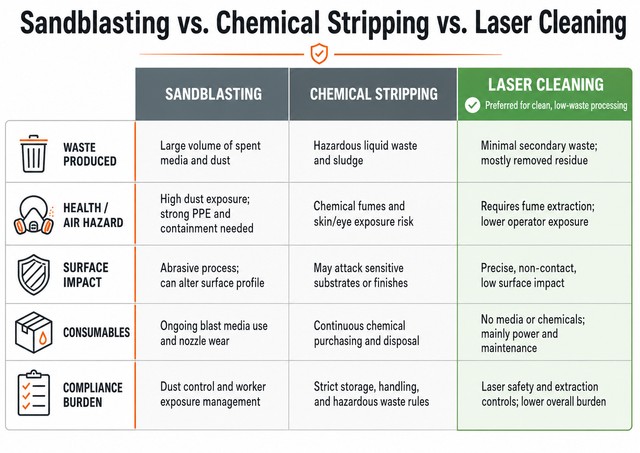
Chemical stripping avoids the dust problem but introduces a different one. Acids and solvents used to dissolve rust, paint, or oxidation are effective, yet they generate hazardous liquid waste that requires controlled treatment before disposal. Mishandling—through spills, improper storage, or inadequate ventilation—can expose workers to toxic fumes or, in worse cases, allow contaminants to reach local water systems. Certain industrial solvents have drawn particular concern; trichloroethylene (TCE), a common degreaser, has been linked to a higher risk of Parkinson’s disease.
Regulatory pressure around both methods has increased in the EU, the UK, and the US, as environmental agencies tighten rules on hazardous waste handling and disposal. For manufacturers, that translates into rising compliance costs: documenting waste streams, contracting licensed disposal services, and, in some cases, retrofitting facilities to meet updated ventilation or containment standards. These are ongoing operating costs, not one-time expenses, which is part of what has pushed the industry to look for cleaner alternatives.
There is also a labor dimension worth noting. Sandblasting and chemical stripping both require personal protective equipment, controlled work zones, and trained handling procedures. Facilities running these processes at scale often need dedicated ventilation systems, containment booths, and staff trained specifically in hazardous-material handling—infrastructure that adds cost and complexity well beyond the cleaning task itself.
How Laser Cleaning Actually Works
Laser cleaning removes contamination through a process that sounds more complex than it is. A focused laser beam is directed at the metal surface, and the energy is absorbed by the layer of rust, paint, oil, or oxidation sitting on top of it. That absorbed energy heats the contaminant rapidly, causing it to vaporize or detach without ever bringing an abrasive or chemical into direct contact with the material underneath.

The physics behind this relies on a difference in how surfaces interact with light. Clean, bare metal tends to reflect the laser beam, while the contaminant layer absorbs it. As the top layer clears away, the exposed metal reflects more of the energy, which naturally limits how deep the process goes. This self-limiting effect is part of why laser cleaning generally leaves the base material undamaged, unlike sandblasting, which erodes surface material indiscriminately.

Because there is no mechanical contact, there is also no tool wear on the surface being cleaned—no grit embedding itself into the metal, no abrasive residue to rinse away afterward. Laser cleaning machines are built around this principle: a beam replaces the abrasive or the solvent, and the cleaning happens without touching the surface at all.
Why Laser Cleaning Is the Greener Option
The environmental case for laser cleaning starts with what it does not produce. There is no abrasive media to source, use, and dispose of, and no chemical solvents that require hazardous-waste handling. The vaporized contaminant is typically captured through a filtration system rather than left behind as a waste stream that needs separate treatment.
Operators also benefit from a safer working environment. Without abrasive blasting, there is no airborne silica dust to guard against, which reduces the respiratory risks associated with traditional methods. The equipment tends to run more quietly than sandblasting systems as well, which matters in facilities where noise exposure is a workplace consideration.
Over the lifetime of the equipment, consumable use is far lower than methods that require a constant supply of fresh sand, grit, or chemical solution. That reduction in ongoing material use is one of the more understated ways laser cleaning lowers a facility’s overall resource footprint, even before accounting for the avoided waste-disposal costs.
Where This Technology Is Already Being Used
Laser cleaning has moved well beyond experimental use and into several established industries, each drawn to it for slightly different reasons.
- Automotive and aerospace maintenance: Removing rust, coatings, and corrosion from parts during restoration or routine servicing, often without disassembling the surrounding components. Precision matters here, since abrasive methods risk altering tight tolerances on engine or structural parts.
- Heritage and artifact restoration: Cleaning delicate historical surfaces—statues, monuments, and metal artifacts—where abrasive or chemical methods risk damaging irreplaceable material. Conservators favor non-contact methods precisely because centuries-old surfaces cannot tolerate trial and error.
- Mold and tooling maintenance: Clearing residue and buildup from manufacturing molds without the wear that abrasive cleaning introduces over repeated cycles, which helps extend the working life of expensive tooling.
- On-site industrial equipment cleaning: Treating rust and corrosion on large machinery in place, avoiding the cost and downtime of dismantling equipment for off-site cleaning. Portable laser systems make it possible to clean structural steel, pipelines, or heavy machinery without shutting down an entire production line.
Each of these applications shares a common thread: precision surfaces, sensitive materials, or situations where introducing chemicals and abrasive dust is impractical or too risky.
What This Means for the Future of Industrial Cleaning
As environmental regulations continue to tighten and companies face rising costs tied to hazardous-waste disposal, the incentive to adopt cleaner methods will likely grow. Laser cleaning fits that shift well: it eliminates two of the most regulated waste streams in industrial cleaning—spent abrasive and chemical byproducts—while reducing the health risks tied to dust and fumes.
That said, laser cleaning is not a universal replacement for every situation. The right method still depends on the material being treated, the type and thickness of contamination, and the scale of the job. Heavy, large-area rust removal on rough structural steel, for instance, may still favor traditional blasting in some cases. What laser cleaning offers is a genuine alternative for the many applications where precision, safety, and waste reduction matter more than raw processing speed.
As the technology becomes more accessible, expect it to keep expanding into manufacturing, restoration, and heavy industry—sectors that have spent decades managing the fallout of abrasive and chemical cleaning and are now looking for a way to clean metal without the waste that traditionally came with it.
Metal will always need cleaning. What is changing is the price the environment and the people doing the work have to pay for it—and laser cleaning is one of the clearest signs yet that the industry is looking for a better trade-off.


