
Water on a window attracts attention because it is easy to see. Its explanation is less immediate. Moisture on the room-side glass, a wet frame, and an apparently cloudy space within the glazing should not all be treated as the same symptom with the same solution.
Window condensation is worth understanding before a household starts comparing replacement products. Wet frames and misted glass are observations, not diagnoses. This distinction also applies to double glazing: its construction needs to be understood alongside the observed conditions. Knowing how moisture, surface temperature, and window construction relate can make a later inspection more informative without pretending that a photograph reveals the complete cause.
Notice when the moisture appears and where it sits
Begin with the visible pattern. Note whether the moisture is on an accessible surface, around the edge of the glass, on the frame or apparently within the glazing assembly. Record when it is noticed and whether it changes as the room is used.
A photograph showing the affected area together with the surrounding window can be more useful than a tightly cropped image of droplets, especially when someone inspecting the problem later needs to understand whether the water was concentrated at a corner, spread across the glass, or associated with a nearby wall junction. Location gives the observation context.
This record has limits. It does not show concealed construction, establish the condition of a seal, or measure the moisture in the room. Its value is in describing the symptom consistently, so an explanation can be tested against what actually happens rather than against a general impression that the window is faulty.
Separate surface moisture from apparent moisture within glazing
Ask which surface can be reached. Condensation on the room-facing surface is different from moisture that appears to lie between panes, although reflections and lighting can make an initial impression uncertain.
Describe the uncertainty directly. If misted glass cannot be clearly located from ordinary observation, tell the inspector which part appears cloudy and when it becomes visible, rather than deciding that the entire frame has failed or that a particular glazing repair is required before the location and condition have been properly assessed.
Double glazing includes a glazing assembly whose condition needs to be considered separately from the surrounding frame and installation. A symptom that seems confined to the glass does not establish the condition of the wall junction. Likewise, water near a frame should not automatically be attributed to the glazing unit.
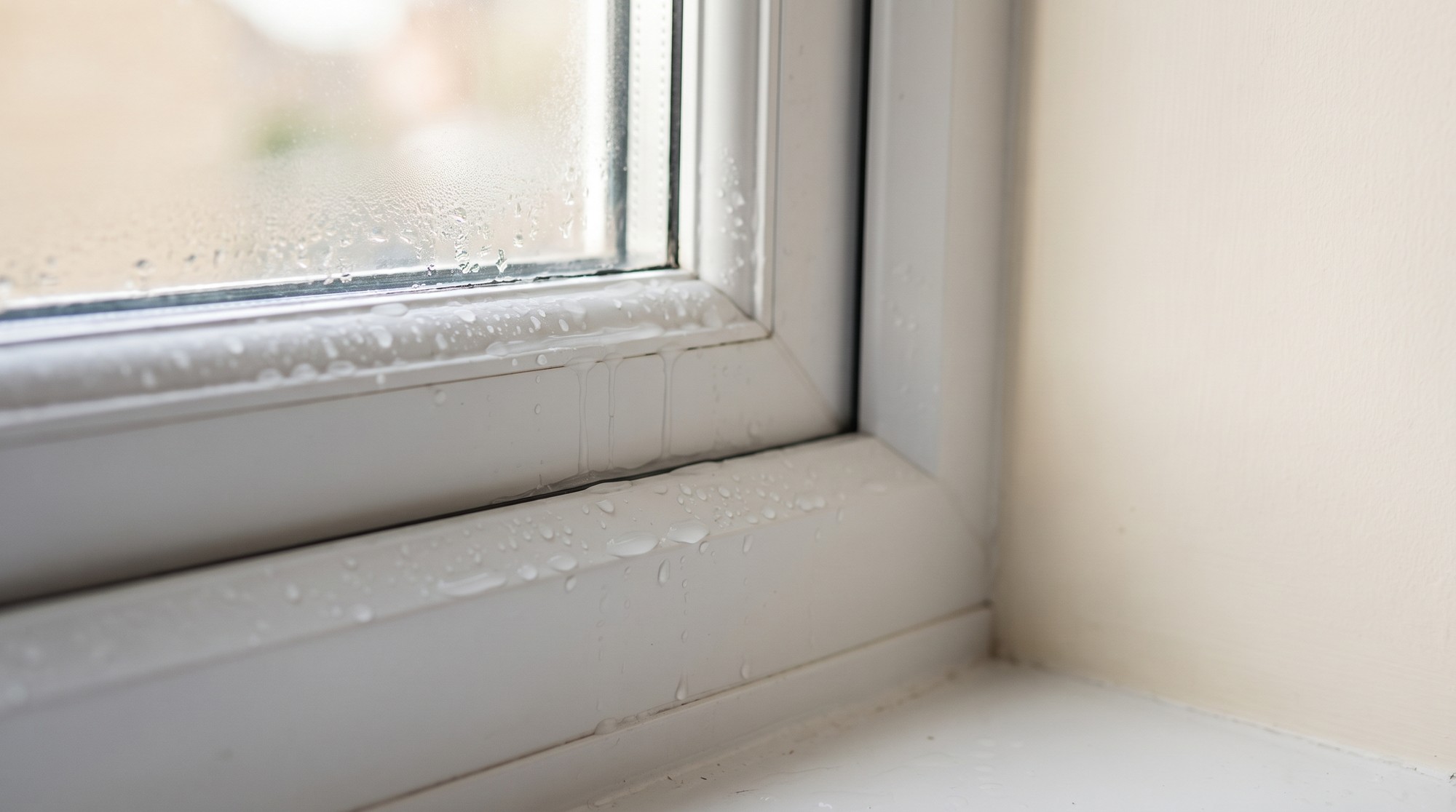
Understand the meeting of moist air and a cool surface
Condensation forms when a surface is sufficiently cool for moisture in the surrounding air to become liquid on it. That explanation connects the air conditions and the surface temperature. Looking at only the frame material leaves part of the question unanswered.
Consider the room as well. Changes in occupancy, moisture-producing activities, or ventilation may be relevant observations for the person investigating the problem, particularly when window condensation appears after a room begins to be used differently even though the visible window assembly has not changed. A wider approach to humidity-resistant home design treats those conditions as part of the same question.
A dry pane at one moment does not prove that the conditions never occur, and droplets at another moment do not prove that every part of the product is defective. The useful investigation asks what conditions coincide with the moisture and which part of the assembly becomes affected.
See what a thermal bridge means for the frame
A thermal bridge is a path through the building enclosure that transfers heat more readily than the surrounding construction. At a window, conductive paths can matter to the temperature of the inner surface. The frame and its connections therefore deserve attention alongside the center of the glass.
Thermally broken aluminum windows place an insulating barrier between internal and external aluminum profiles. The barrier restricts a conductive path through the frame. This explains the purpose of the construction without establishing the temperature of a particular frame in a particular home.
Those limits matter. A thermal break does not control the moisture conditions in a room, and it says nothing about every connection around the window. Wet frames therefore cannot be diagnosed by checking whether a catalogue uses that phrase, because its presence does not rule out condensation in the installed assembly. The whole setting remains relevant.
Keep glazing construction separate from a condensation guarantee
Double glazing, spacers, and Low-E coatings address different aspects of the glazed assembly. A spacer maintains the separation between panes; a coating can influence radiant heat transfer. These features help explain construction, but their names do not amount to a guarantee that visible moisture can never occur.
The Department of Energy’s window guide describes glazing, spacers, coatings, and installation as relevant to window performance. Its explanation is useful background for understanding why the pane, its edge, and the surrounding assembly should not be treated as an undifferentiated sheet of glass.
Request information that matches the question. If an inspection suggests that the glazing construction deserves closer examination, the relevant description is the actual assembly installed in the opening, not a generic claim about what double glazing usually achieves or an unrelated product example whose components may differ from those in the home.
Recognize what catalogue dimensions leave unknown
uPVC windows provide another example of how a product description can look more conclusive than it is. A profile-system dimension may be clearly stated while the complete window’s thermal behavior and installation remain separate matters. The dimension should not be read as a condensation rating.
For example, Durable’s uPVC specification table lists 60 mm, 65 mm, 70 mm, 80 mm, 88 mm, 94 mm, 112 mm and 166 mm profile options. Those are catalogue dimensions. They do not establish an order of resistance to condensation or prove how an installed window will perform under the conditions inside a specific room.
The distinction is useful beyond this example. A larger profile number, a familiar material, or a more elaborate glass description should not be used to explain away a visible moisture problem without understanding the assembly and the environment in which it is used.
Read thermal figures for the property they describe
Window performance terms are easy to mix together. Information about incoming solar heat answers a different question from information about insulation. Neither, by itself, diagnoses why a surface became wet at a particular time.
The Department of Energy defines solar heat gain coefficient between 0 and 1, with a lower value indicating less solar heat entering through the window. U-factor concerns insulation. These definitions help identify the property being discussed; they do not provide a condensation diagnosis.
Supplier descriptions, such as the frame and glass options published by Durable, can help identify what a product contains, but the reader still needs to distinguish a component description from supporting information about a complete window and from evidence about the actual conditions around an installed unit.

Prepare a useful account for inspection
If window condensation persists or its location is unclear, organize the observations before seeking an assessment. The purpose is to help the responsible person inspect the right parts of the assembly and consider the room conditions, rather than asking them to confirm a conclusion already drawn from a catalogue.
- Record where moisture appears and whether that surface is accessible.
- Note the timing and any changes in room use or ventilation.
- Keep available product and installation information together.
- Describe nearby wet areas without assuming they share the same cause.
An informed description leaves room for the evidence to change the explanation. It helps separate what has been observed from what remains to be established, which is more useful than replacing every window feature with a promise that a different frame or pane will make moisture impossible.


