
According to a novel study led by University College London (UCL) researchers, using a robotic “third thumb” can alter the way your hand is represented in your brain. The team taught people to use a mechanical extra thumb and train for five days, bringing the device home each evening to test out using it with everyday tasks.
As a result, the participants effectively carried out dexterous functions in the lab, like building a tower with blocks using only that one hand with two thumbs. And the more the participant practiced utilizing the thumb, the more they felt like it was part of their body.

Designer Dani Clode developed the device as a student at the Royal College of Art. It was her graduate project, and she won an award for it. Her initiative was to reframe the way people view prosthetics – to break away from them just being seen as a way to replace a lost function. Instead, she wanted to show how they could also be applied as an extra extension of the body, thus human capabilities.

Subsequently, Professor Tamar Makin invited her to join his team of neuroscientists at UCL who were exploring how the brain adapts to body augmentation.
Lead author Professor Makin said, “Body augmentation is a growing field aimed at extending our physical abilities, yet we lack a clear understanding of how our brains can adapt to it. By studying people using Dani’s cleverly-designed Third Thumb, we sought to answer key questions around whether the human brain can support an extra body part and how the technology might impact our brain.”
The Third Thumb is easy to customize because it’s entirely 3D printed.
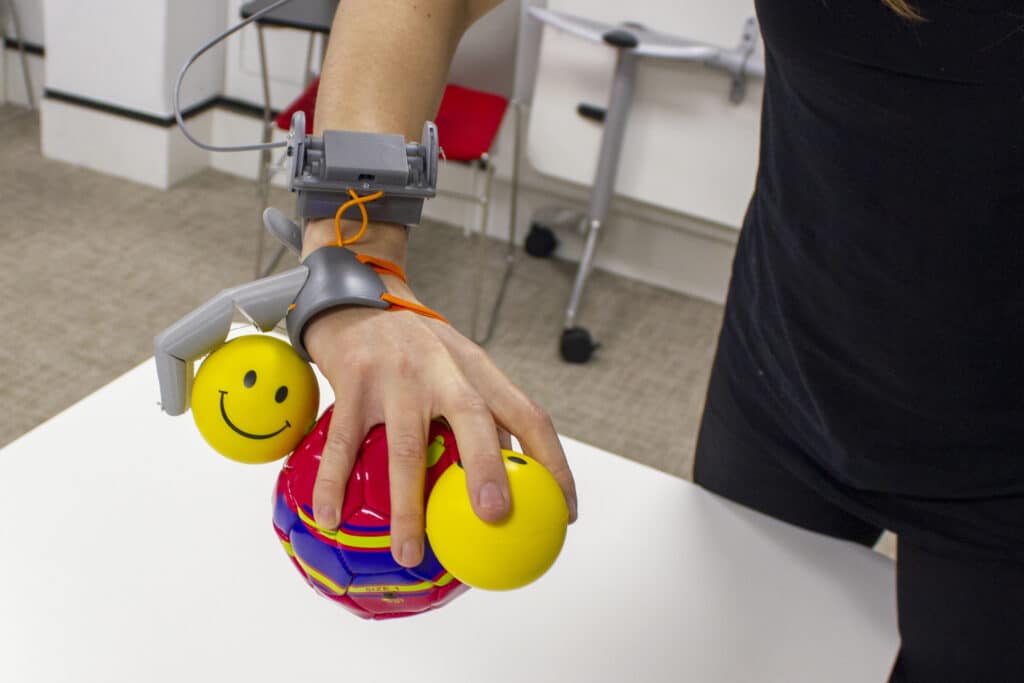
It’s worn outside the hand below the little (pinky) finger, opposite the user’s actual thumb. The wearer controls it via wireless pressure sensors attached to their feet, below both big toes. The sensors control different movements of the Third Thumb by reacting in real-time to subtle changes of pressure from the wearer pushing down their toe.
The Study Part One
- The scientists trained 20 participants to use the device over five days.
- Each day, the participants also took the thumb home to test it out on everyday tasks.
- In all, the participants wore the Third Thumb for approximately two to six hours daily.
- The control group (consisting of ten participants) wore a static, unmoving robotic thumb while executing identical training tasks.
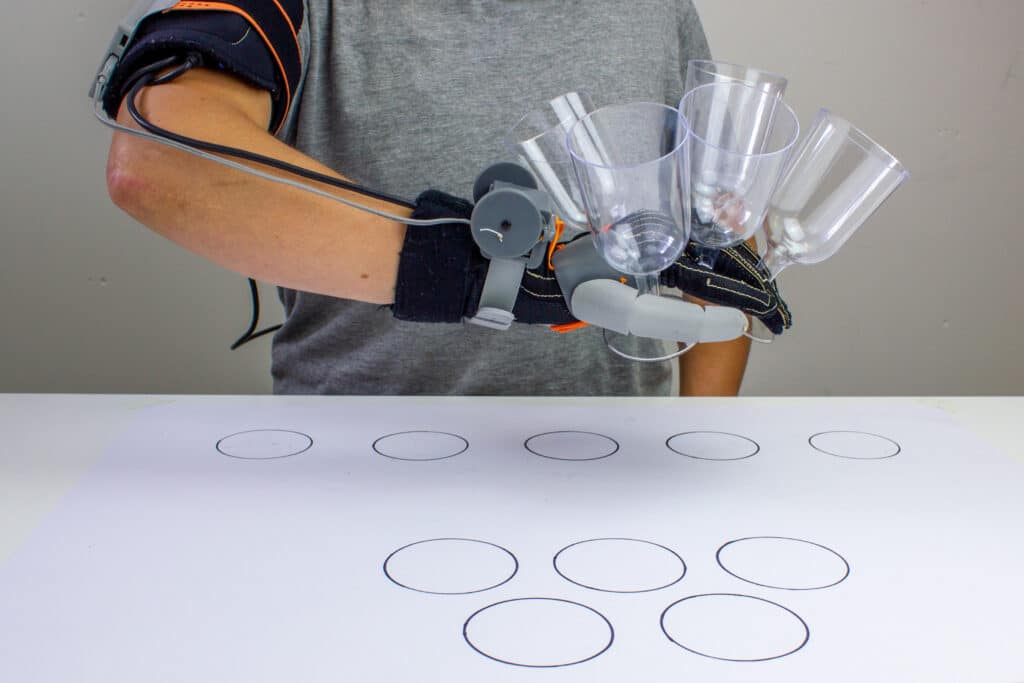
- During the daily lab sessions, participants were trained to use the Third Thumb through tasks designed to enhance their hand and device coordination – like picking up multiple wine glasses or balls with one hand.
- All participants learned the basic gestures of using the Third Thumb very quickly. Then, the continued training helped the wearers improve their agility, motor control, and hand-thumb coordination.
- Eventually, they could use the device even when distracted or blindfolded.
Clode said, “Our study shows that people can quickly learn to control an augmentation device and use it for their benefit, without overthinking. For example, we saw that while using the Third Thumb, people changed their natural hand movements, and they also reported that the robotic thumb felt like part of their own body.”
The Study Part Two
- The researchers scanned the participants’ brains using fMRI before and after training while moving each finger individually, with no Third Thumb attached.
- The fMRI detected subtle but significant changes to how the robotic-thumb-augmented hand was represented in the brain’s sensorimotor cortex.
- Our brains represent each finger uniquely. But after the robotic finger training, the activity pattern corresponding to each finger changed. As a result, they became more similar to one another.
- Some of the participants were scanned again a week later, and the changes in their brain activity had subsided. This suggests that changes are short-term, but more research is needed to confirm this.
First author Paulina Kieliba said, “Our study is the first one investigating the use of an augmentation device outside of a lab. In addition, it is the first augmentation study carried over multiple days of prolonged training and the first to have an untrained comparison group. The success of our study shows the value of neuroscientists working closely together with designers and engineers to ensure that augmentation devices make the most of our brains’ ability to learn and adapt while also ensuring that augmentation devices can be used safely.
Body augmentation could one day be valuable to society in numerous ways, such as enabling a surgeon to get by without an assistant or a factory worker to work more efficiently. In addition, this line of work could revolutionize the concept of prosthetics, and it could help someone who permanently or temporarily can only use one hand to do everything with that hand. But to get there, we need to continue researching the complicated, interdisciplinary questions of how these devices interact with our brains.”

Professor Makin added, “Evolution hasn’t prepared us to use an extra body part, and we have found that to extend our abilities in new and unexpected ways, the brain will need to adapt the representation of the biological body.”
Our brain is more than capable of adapting and taking on the requirements of a cybernetic future – even though it hasn’t evolved to use more than what a typical baby is born with. So, it’s highly likely that the future of human motion will see extensive augmentation with robotic extensions and limbs. The brain’s capacity for adaptation also helps explain long-standing evolutionary puzzles; recent research on handedness suggests that hemispheric specialization, shaped by bipedalism and brain expansion, is why 90% of humans favor their right hand.


