
Our eyes provide us with a field of view as wide as 160° and can adapt to different lighting and visibility conditions instantly to resolve details as small as 30cm from 1km away. Our retinas concave hemispheres – which contain 10 million photoreceptor cells per sq cm – are to thank for such impressive abilities. They are the reason that our eyes are one of the most complex organs of the body, equipping us with about 80% of the information we perceive from our surroundings.
However, the sphere is a challenging shape for technology to work with, hence why the eye is not easy to copy. Today’s most advanced image sensors are flat, making them next to impossible to integrate into hemispherical structures to create artificial retinas.
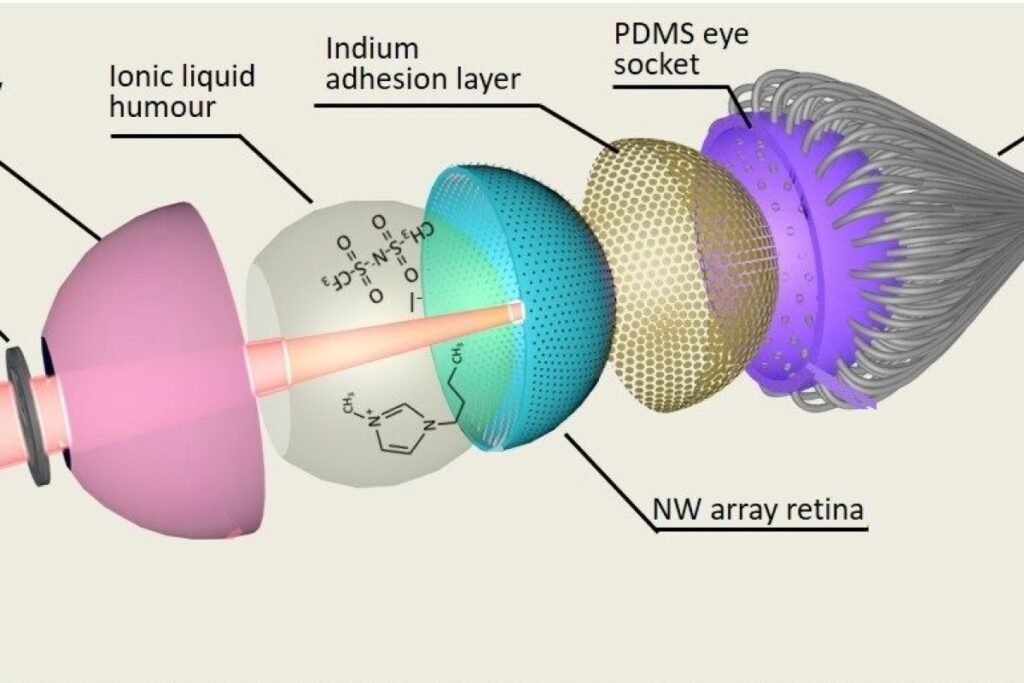
But now a team of Hong Kong University of Science and Technology (HKUST) researchers led by Leilei Gu found a way around this issue. They designed a device called the Electrochemical Eye (EC-Eye) made up of a hemispherical arrangement of light-sensitive perovskite nanowires, which mimic photoreceptor cells in the human retina. Their biomimetic eye is as near the real thing as anyone has come up with yet. It even has the potential to produce images at higher resolutions than the human eye!
The researchers believe it could pave the way for significant new advances in robotics. A fully functional artificial eye could be used in human-like robots that need to function autonomously or interact with humans more naturally.

And while the development has been technologically focused, the design could potentially be modified for use as prosthetic eyes as well. At the moment, the most advanced versions of bionic eyes have only restored the ability to see streaky flashes of light. That’s far from adequate for navigating the world. Perhaps the EC-Eye could herald a considerable improvement.

The team built a prototype of the EC-Eye, and it was able to capture images relatively clearly. There’s still much work to be done, but the concept works, and that’s very exciting!
They are even looking into making an upgraded version with night vision ability. There’s a prosthetics company called Second Sight Medical Products playing with such an idea as well. However, their bionic eye is of the current design, which involves a camera mounted on glasses and a brain implant.
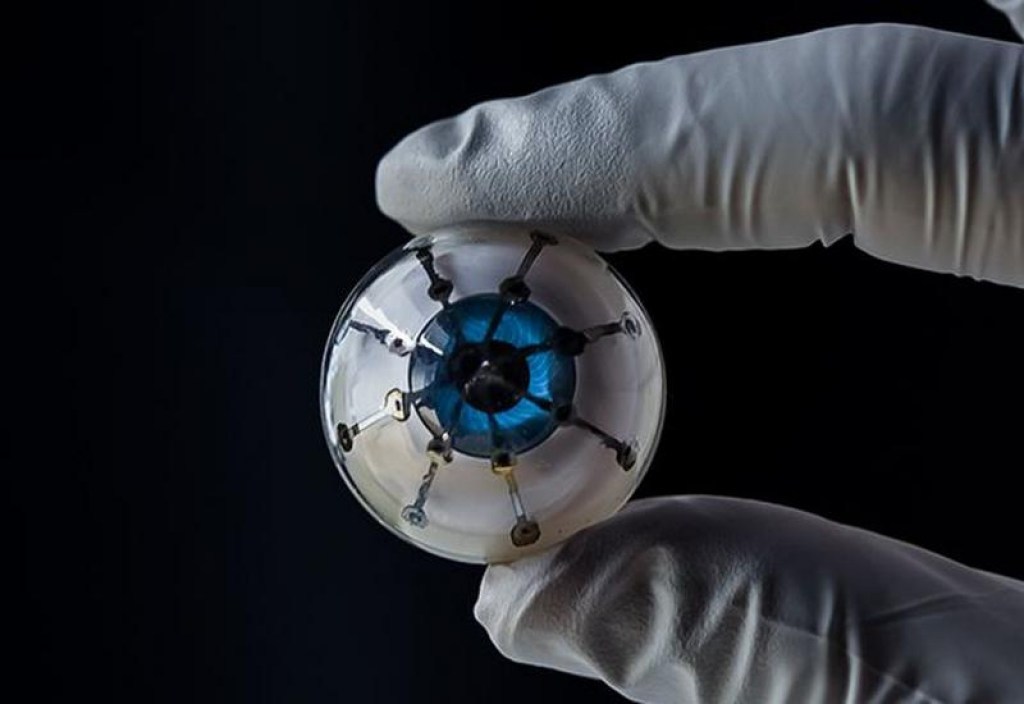
Meanwhile, another team of researchers at the University of Minnesota is tackling the issue of fitting light receptors on a concave surface by using 3D printing. They made a 3D-printed bionic eye by printing an image sensing array onto a glass hemisphere. Now they are working out how to make the device with a softer material that can be implanted and feel like the real thing.
Soon enough there will be artificial eyes that can give blind people their sight back and all sorts of extra abilities too!


