
The initial week of a phone-free school policy introduces a palpable shift in campus atmosphere. Instructors no longer pause mid-lecture to address the muffled vibration of a pocket buzz or surreptitious glances at screens. Instead of silent hallways filled with students staring at glass, teenagers find themselves filling the quiet with actual eye contact and spontaneous conversation.
While school cell phone bans are trending globally, the data suggests this transition is rarely a simple victory lap. Success depends on moving beyond reactive rules toward intentional digital learning design. Early indicators reveal that academic performance gains often trail behind an initial surge in discipline incidents, creating a complex ‘enforcement shockwave’ that administrators must navigate carefully.
The core challenge involves balancing restrictive policies with educational equity. When districts replace unmanaged smartphone access with teacher-led digital instruction and structured tools, the focus shifts back to instructional time. Real progress emerges only when policies are paired with consistent enforcement and robust safeguards for student wellbeing.

Quick Facts: What We Know So Far About Phone-Free Policies
- Recent data highlights that national mobile phone bans currently exist across 114 education systems, according to the latest UNESCO monitoring of global policy shifts reported in March 2026.
- In the United States, Education Week’s state policy tally shows most students now live under some form of restriction, ranging from class-time limits to bell-to-bell rules.
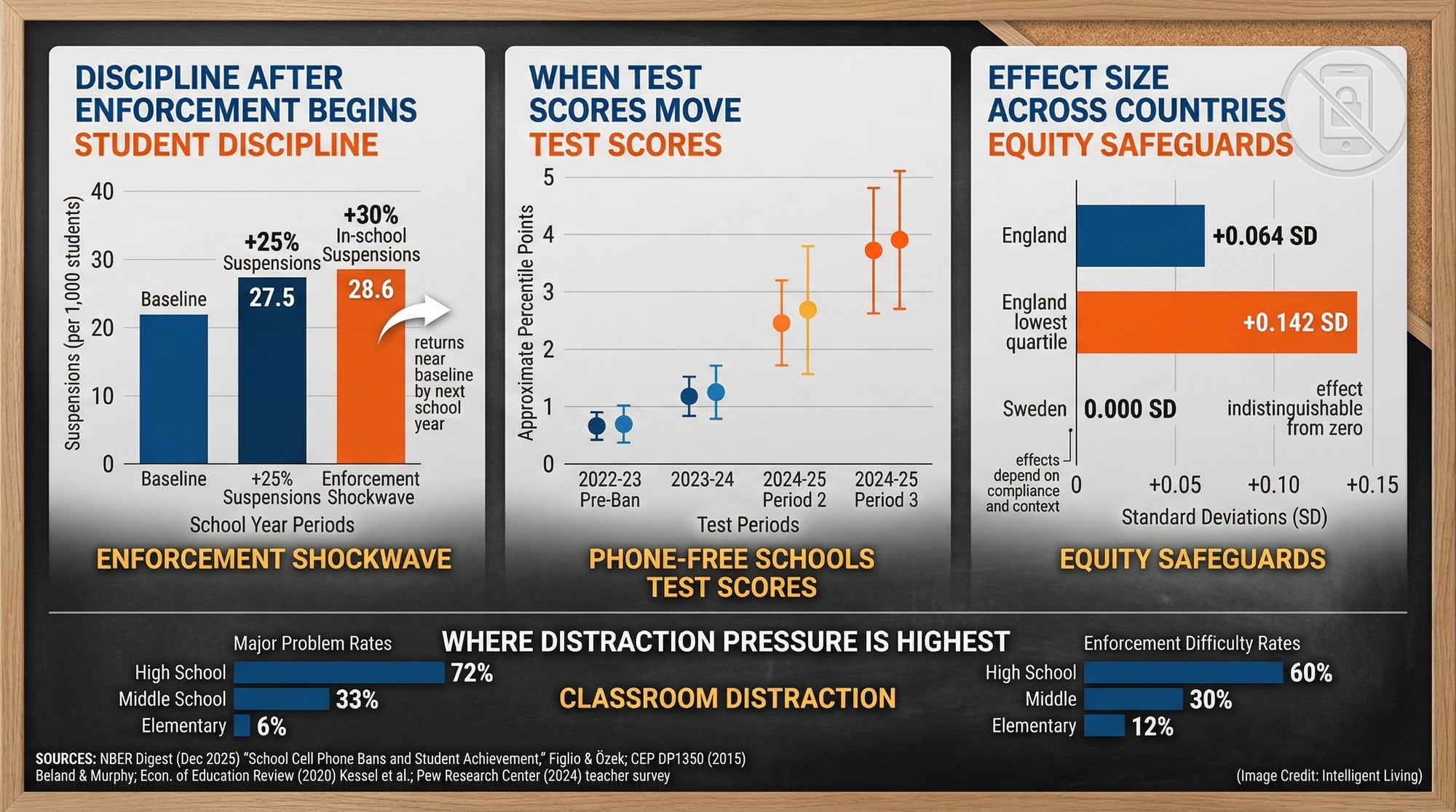
- A Pew analysis reports that 72% of U.S. high school teachers call cellphone distraction a major classroom problem, and many teachers say enforcement is hard.
- Rigorous U.S. evidence of discipline spikes after enforcement reveals a predictable pattern. Discipline incidents often surge immediately after enforcement begins, while academic gains emerge slowly and frequently appear incremental.
- International research outcomes fluctuate significantly. Certain studies show academic gains isolated among lower-achieving groups, while separate longitudinal data reveals negligible test-score impacts, indicating that localized classroom norms remain the primary driver of success.
- Reducing in-school device engagement does not necessarily lower total daily phone usage. Consequently, phone-free designations do not provide a guaranteed pathway to improved adolescent mental health.
- Device policy intersects with equity: NCES warns that bring-your-own-device approaches can leave students behind if phones are restricted without school-provided alternatives.
Discipline and Test Scores: What the Best Studies Show So Far
The Enforcement Shockwave: Why Discipline Moves Before Test Scores
Implementing a phone-free policy redefines daily power dynamics and instructional pacing while shifting the boundaries of punishable interruptions. Such structural transitions explain why discipline metrics typically serve as the earliest indicator of policy impact.
Florida District Findings and the Enforcement Timing Effect
A Florida district analysis in the Florida cellphone-ban outcomes analysis uses administrative data to compare schools that differed in baseline phone activity before and after a policy shift.
The resulting pattern remains blunt. Formalized enforcement often triggers a sharp rise in short-term discipline incidents, followed by incremental improvements in specific academic metrics over time.
Daily behavioral shifts manifest in subtle interactions. In a typical classroom, a student might reach for a device the moment independent work begins—driven by ingrained habit rather than active rebellion.
Educators seeking to maintain instructional momentum face the dilemma of overlooking subtle distractions or pausing the lesson to intervene. Scaling these individual decisions across a facility forces the policy to evolve into a comprehensive schoolwide behavior system instantly. A working alternative is on display at one Bogotá public school, where replacing punishment with structured peer mediation helped cut reported bullying to zero and serious incidents by 85 percent, suggesting that relationship-first models can move the enforcement conversation in a more productive direction.
Why Enforcement Can Amplify Inequities
Discipline risk rises when enforcement depends on individual style. When one instructor confiscates devices instantly while another provides multiple warnings, the resulting inconsistency creates an unpredictable environment for the student body. That unevenness can map onto existing inequities, especially when families have different capacities to contest a referral or push for exemptions.
Sustainable solutions prioritize policy clarity over punitive severity. Districts utilizing standardized escalation ladders, documented exemptions, and subgroup-specific discipline tracking successfully mitigate the risk of policies becoming equity barriers.
Bans Don’t Travel: Why Outcomes Differ Across Schools and Countries
Phone bans are often described as low-cost and universal, but results vary across systems for reasons that are easy to miss. Baseline norms, enforcement culture, and the role phones play in students’ learning lives all change the outcome.
United Kingdom Research: Academic Gains for Lower-Achieving Students
A widely cited English study, England exam-score gains after bans, employed administrative data and a difference-in-differences design to estimate post-ban changes in exam performance.
Academic benefits rarely distribute equitably across student populations. Strongest gains typically emerge among lower-achieving cohorts, validating concerns that unregulated smartphone access exacerbates existing attention disparities.
Sweden: A Replication that Found No Test-Score Impact
A Sweden-focused analysis from the Research Institute of Industrial Economics, Sweden’s null test-score findings, used a similar empirical setup and found no measurable impact on student performance. One plausible interpretation is that the marginal benefit of a ban is smaller where baseline classroom norms already limit phone use.
Norway Analysis: Gender-Specific Improvements in Mental Health
A Norway working paper combining administrative and survey data reports significant improvements following policy implementation, specifically:
- Psychological Wellbeing: Reductions in healthcare consultations for psychological symptoms among female students.
- Classroom Climate: Measurable decreases in bullying incidents.
- Academic Success: Improved learning outcomes concentrated among girls.
Findings suggest that policy effects remain highly specific to local usage patterns.
The Displacement Problem: Less in School Does Not Always Mean Less Overall
A large English cross-sectional study, in-school phone time fell without lower total use, suggests that restrictive policies successfully reduce in-school device engagement.
Weekday and weekend social media use remained largely unchanged across various policy types. Such displacement remains critical because standard mental health hypotheses assume a significant reduction in total screen exposure.

Well-being and Digital Design: Mental Health Signals and Structured Tech Use
Deciphering Mental Health Signals in Phone-Free Environments
Psychological well-being represents a high-stakes component of the device-policy debate, yet definitive conclusions remain elusive. Objective analysis requires treating current findings as preliminary and evolving.
Evidence-Based Insights into Adolescent Psychological Distress
An Australian natural experiment using an emulated-trial approach, small distress reductions after bans, reports small reductions in psychological distress and negative emotion after bans were introduced. The key word is small. For many students, school-day phone access is one piece of a larger attention and well-being puzzle.
Analyzing Variable Outcomes in Diverse School Environments
Varied enforcement styles and individual device attachments cause school-day restrictions to elicit conflicting emotional responses, often leaving students feeling either tranquil or isolated. While certain teenagers view phones as essential social lifelines, others fall into stressful coping loops that exacerbate anxiety. Consequently, establishing healthy screen-time boundaries at home remains just as vital as managing the hours between the first and last bell.
Phone-Free Doesn’t Mean Tech-Free: Structured Digital Use vs. Decentralized Digital Use
The evidence does not support a simple “digital is harmful” conclusion. A clearer takeaway is that unmanaged smartphone use is a poor default learning environment, while structured digital tools can be valuable when they are curriculum-aligned and teacher-directed.
Why Unmanaged Phones Disrupt Learning
A national teacher survey analysis from RAND, RAND teacher data on digital materials, underscores the widespread use of digital content and its frequent misalignment with specific classroom needs. Policy failure often stems from a lack of institutional alternatives; restricted access must be replaced by school-provided digital structures to maintain academic integrity.
Where AI Fits Under Teacher Direction
The better model is structured digital use. Structured approaches align with guidance advocating for technology primarily when it enhances learning rather than simply adding screens to a classroom, and it means tools chosen for learning outcomes, deployed inside lessons, and governed by clear privacy and equity rules. It can include carefully scoped AI with ethical safeguards to address privacy and bias built into teacher-led routines. A concrete example is the way personalized learning tools and generative AI support inclusivity when teachers use them to tailor practice and feedback, not to outsource judgment.
A classroom moment makes the difference vivid. During guided practice, a teacher might use an adaptive math platform to spot common errors and shift instruction in real time. That is very different from a student toggling between homework and a social feed. The same logic shows up in research-driven experimentation, such as when an AI tutor at Harvard was tested for learning retention under structured conditions.

Implementation Reality: Costs, Compliance, and a Practical Playbook
The Hidden Budget Line: Enforcement Takes People, Time, and Trust
Administrators often pitch phone bans as cost-free interventions, yet the practical implementation requires significant institutional investment. Schools frequently allocate extensive resources toward:
- Staff Time Allocation: Navigating the friction caused by vague or permissive rules.
- Conflict Resolution: Managing student resistance and maintaining classroom momentum.
- Logistics and Storage: Overseeing the physical security of confiscated or stored devices.
- Family Communication: Explaining policy nuances and emergency protocols to parents.
Strategic planning must account for these hidden budget lines to prevent staff burnout and ensure policy longevity.
Districts frequently struggle with enforcement fatigue even when initial policy intentions receive broad community support. An economic evaluation tied to SMART Schools estimated that policy enforcement time requires significant staffing, with some implementations equaling several full-time roles.
Educator groups also flag the enforcement trap. The NEA’s summary on devices and well-being stresses that policy consistency matters more than heroic individual enforcement, because leaving each classroom to improvise tends to multiply friction and inequity.
Implementation Blueprint: A Phone-Free Policy that Doesn’t Turn into a Discipline Trap
High-performing device policies operate as intentional learning designs.
Structural success hinges on minimizing classroom friction through standardized exemptions and intuitive daily routines.
Choose a Clear Policy Type and Spell Out the Daily Routine
Administrators must define the scope of restrictions—ranging from instructional-time limits to comprehensive bell-to-bell bans—while clarifying device protocols for arrival, lunch, and dismissal.
Utilizing a practical mobile-phone policy template allows districts to adapt proven elements to their specific needs. Such clarity minimizes classroom negotiations and prevents instructors from interrupting lessons to litigate rules.
Prioritizing Medical Exemptions and Accessibility Safeguards
Priority should be given to documenting medical needs, IEP accommodations, and translation requirements. Students requiring devices for accessibility must access these tools without navigating repeated disciplinary conflicts.
Standardize Enforcement with an Escalation Ladder
Start with predictable, low-stakes responses that preserve dignity and classroom flow. Build toward consequences only for repeated defiance or behavior that threatens safety. The best ladder is short enough that every adult in the building can remember it.
Pair Phone-Free Time with Structured Digital Learning
If students used phones as their primary device, replace that access with school-managed alternatives and predictable pathways to complete work. Structured digital use is where tech benefits live, including targeted practice, assistive tools, and carefully governed AI.
Monitor Equity Metrics and Adjust Fast
Districts must track discipline metrics, attendance, and learning outcomes by subgroup from the first day of implementation.
Exclusion rates that disproportionately affect specific demographics reveal design flaws that require strategic adjustment rather than increased punishment.
Fostering Collaborative Partnerships with Parents and Families
Family support for phone-free environments increases when schools provide transparent protocols for emergencies, medical exemptions, and continued access to learning technology. Publishing a concise policy summary in plain language serves as an effective method for reducing community friction.

Designing Phone-Free Schools for Long-Term Success
Districts now face a choice between intentional design and structural drift as phone-free schools become the standard. The evidence clarifies that simply removing a device does not fix a culture of distraction. Instead, administrators must build predictable routines that protect instructional time while investing in school-managed alternatives that preserve the benefits of modern technology.
This transition requires a shift from policing objects to fostering a healthy digital learning environment. By treating screens as specific tools rather than a background atmosphere, educators can reduce the friction of constant enforcement. Success lies in creating a campus where students navigate the digital world with intention, supported by family routines that reinforce healthy digital boundaries at home.
Common Questions Regarding Phone-Free School Policies
Do Phone-Free Schools Improve Student Grades?
Research indicates modest academic performance gains, though these benefits usually emerge only after the initial enforcement period settles. Gains are often most significant among students previously prone to high levels of classroom distraction.
Why do Discipline Incidents Increase After a Ban?
Establishing new boundaries often triggers an immediate ‘enforcement shockwave.’ When behavior that was previously overlooked becomes a formal rule violation, suspension rates may spike until students and staff adapt to the new routines.
How do these Policies Affect Teen Mental Health?
Signals remain modest and highly conditional. While some students report reduced psychological distress, long-term well-being depends more on total daily screen-time boundaries rather than just school-day restrictions.
Are Phone Bans Fair to Every Student?
Equity remains a primary concern. Policies must include clear safeguards and documented exemptions for medical or accessibility needs to ensure that enforcement does not disproportionately impact specific student subgroups.
Does a Phone Ban Mean No Technology in Class?
Not at all. Effective policies distinguish between unmanaged smartphone use and structured digital learning. The goal is to replace decentralized distraction with teacher-directed tools and school-provided devices.


