
The current total of particulate-related deaths from air pollution per year is 11,000 in the UK. The British Heart Foundation (BHF) predicts the number will only continue to rise unless measures are taken to reduce and eliminate polluted air.
Over 160,000 people in the UK could die by 2030 from heart attacks and strokes caused by dirty air, the foundation warns. That’s over 40 heart and circulatory disease-related deaths daily for the rest of the decade just from people breathing!
Jacob West, BHF’s executive director of healthcare innovation, said:
Every day, millions of us across the country are inhaling toxic particles that enter our blood and get stuck in our organs, raising our risk of heart attacks and stroke. Make no mistake, our toxic air is a public health emergency, and we haven’t done enough to tackle this threat to our society.
We need to ensure that stricter, health-based air quality guidelines are adopted into law to protect the health of the nation as a matter of urgency. Clean air legislation in the 1950s and 1960s, and more recently the smoking ban in public places, show that government action can improve the air we breathe.
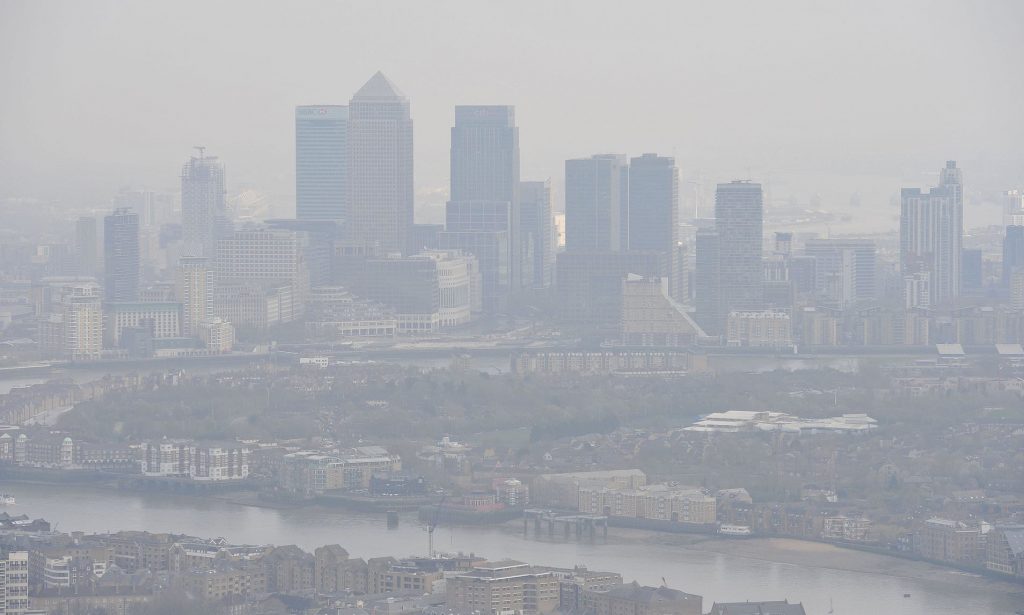
The BHF calls for the UK to adopt the World Health Organization (WHO) guidelines on air pollution and meet them by 2030 to avoid unnecessary casualties. At the moment, the UK meets the EU limits for fine particulate matter (PM2.5) pollution, which is 25μg/m3 as an annual average. To compare, the WHO limit is 10μg/m3 as a yearly average.
PM2.5 can increase the risk of stroke and heart attack and cause existing health problems to worsen. It is a severely detrimental hazard to heart health.
NHS medical director Professor Stephen Powis said:
The climate emergency is also a health emergency, with thousands of avoidable deaths and hospital admissions every year linked to air pollution, which is why the NHS is playing its part by taking action to reduce carbon emissions, including cutting traffic by reducing the need for millions of hospital appointments through better services.
With air pollution contributing to around 40,000 deaths a year and four in 10 children at school in high-pollution communities, it’s clear that tackling air pollution needs to be everyone’s urgent business.
To present these critical air quality issues, the Department for Environment and Rural Affairs published a study in July 2019 showing that it is technically feasible to meet WHO air pollution guidelines by 2030 in most areas of the UK.
The environment minister, Rebecca Pow, said:
We all know the impact that air pollution has on communities around the UK, which is why the government is stepping up the pace and taking urgent action to improve air quality.
Alongside our Clean Air Strategy, which has been praised by the World Health Organisation as ‘an example for the rest of the world to follow’, our landmark Environment Bill will include a commitment to a legally binding target on fine particulate matter which will improve the quality of millions of people’s lives.
To further motivate action NOW, the BHF launched a new campaign that highlights how citizens are inhaling dangerous levels of PM2.5 in cities and towns across the nation daily. The campaign to reduce polluted air is called ‘You’re Full Of It.’


