
Wastewater-based epidemiology (WBE) is a scientific method used to reveal insights about public health and human behavior by examining the contents of a location’s sewage. The process involves scientists conducting chemical analyses of samples taken from sewage plants. The technology enables them to know what’s inside, and it’s an effective way to obtain information on health, disease, pathogens, and find traces of illicit drugs. Until now, the tool has been widely employed by authorities to helps governments better understand the drug usage habits of a population. But scientists want to use WBE more for the former – specifically to help monitor outbreaks of COVID-19 using sewage.
A team of researchers at Cranfield University’s Water Science Institute led by Dr. Zhugen Yang, a lecturer in sensor technology, has been focusing on how to use the WBE approach to help with the current pandemic. They are bringing together cutting-edge biomedical and chemistry techniques to make it so WBE could provide a fast and effective way to forecast the potential spread of COVID-19. The team has developed a cheap, paper-based sensor that can pick up on biomarkers in feces and urine from coronavirus carriers that enter the sewer system. This strategy of detection will inform authorities whether there are potential COVID-19 carriers in local areas.
Dr. Yang said:
In the case of asymptomatic infections in the community or when people are not sure whether they are infected or not, real-time community sewage detection through paper analytical devices could determine whether there are COVID-19 carriers in an area to enable rapid screening, quarantine, and prevention. If COVID-19 can be monitored in a community at an early stage through WBE, effective intervention can be taken as early as possible to restrict the movements of that local population, working to minimize the pathogen spread and threat to public health.
The team has already created sensors that can detect bacteria to indicate community obesity levels, antibiotic-resistant genes to track superbugs, and pathogens that can cause outbreaks of diseases. Now they have turned their attention to COVID-19. The research has been published in the journal Environmental Science & Technology.
Dr. Yang added:
We have already developed a paper device for testing genetic material in wastewater for proof-of-concept, and this provides clear potential to test for infection with adaption. This device is cheap (costing less than £1, US$1.25) and will be easy to use for non-experts after further improvement. We foresee that the device will be able to offer a complete and immediate picture of population health once this sensor can be deployed in the near future.
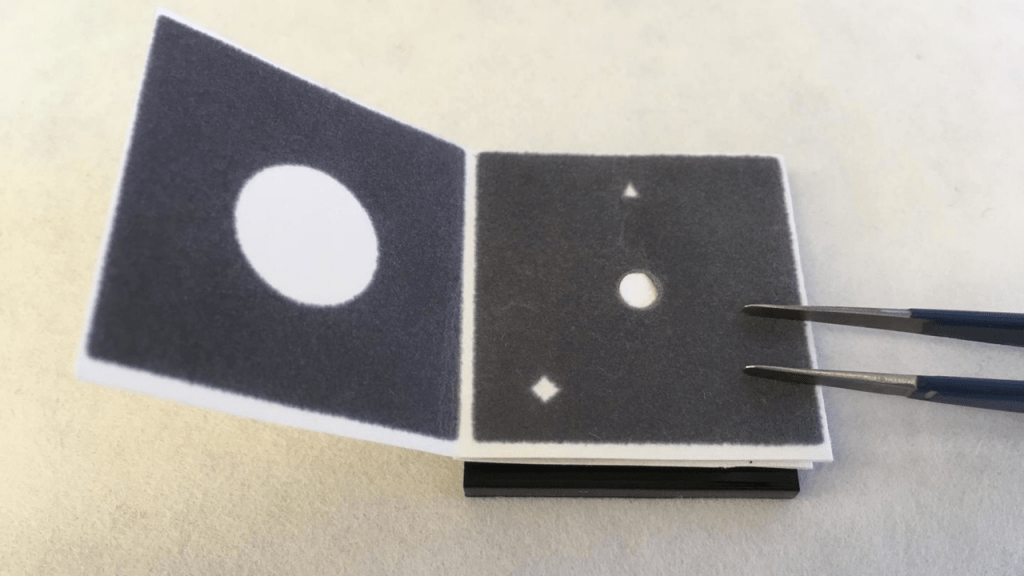
The device is easy to use, and the results can be seen with the naked eye – a green circle means positive. It works by folding and unfolding the paper to filter the nucleic acids of pathogens from a sample of wastewater. The biochemical reaction from preloaded reagents detects whether the nucleic acid of SARS-CoV-2 infection is present. Recent studies have found that live SARS-CoV-2 can be isolated from the feces and urine of infected people. Furthermore, the virus can survive for several days in an appropriate environment after exiting the human body.


