
Earlier this month Wuhan, China where the coronavirus outbreak originated, Smart Field Hospital opened, where the entire staff is comprised of robots.
Beijing-based startup company CloudMinds, who also has a facility in San Francisco had the robots performing tasks like taking temperatures and checking blood oxygen levels and heart rate. Officials said the trials were aimed to relieve exhausted healthcare workers.
As reported by CNBC, all medical services were carried out by robots or other IoT, which are “things” capable of collecting data and then send it to the internet. When the patients entered the hospital, they were screened by 5G thermometers that would alert the “staff” if someone had a fever.
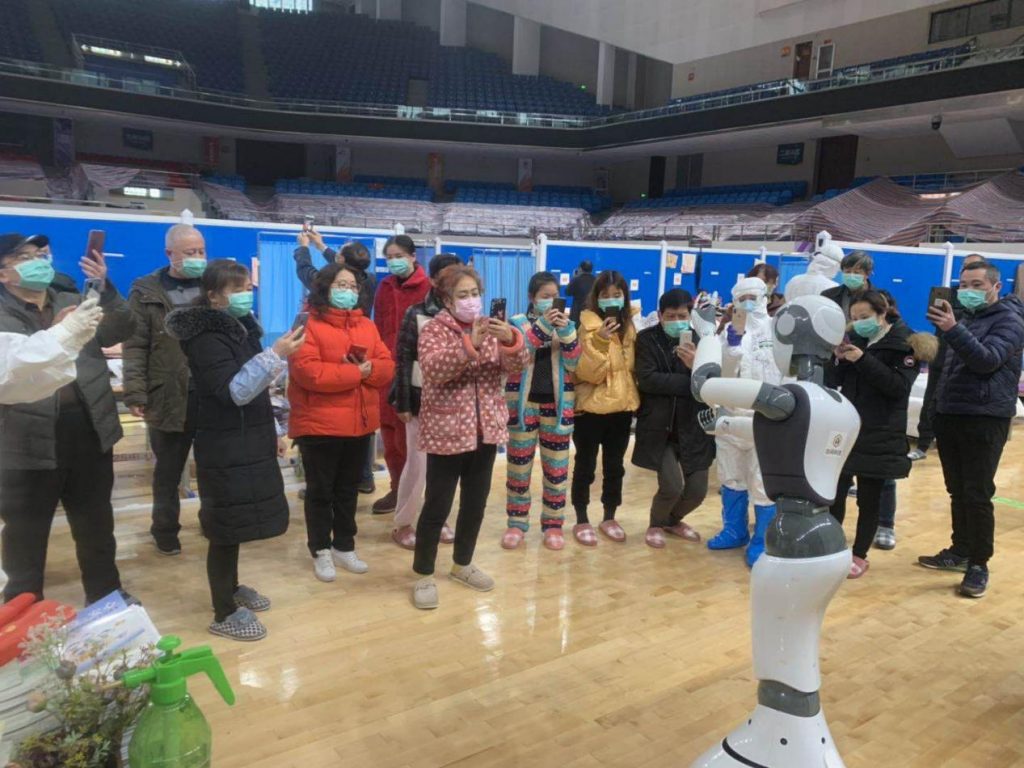
The patients wore rings and “smart bracelets” that were synched up with CloudMinds’ AI platform. The rings and bracelets allowed for monitoring of vital signs such as temperature, heart rate, and blood oxygen levels. The devices were also worn by doctors and nurses to help catch any early signs of infection.
Other robots were used to provide medicine, food, and drinks, and even provided entertainment to the patients in the waiting areas, that included dancing. While other autonomous droids went around spraying the floors and cleaning with disinfectants.
Founder and CEO of CloudMinds Bill Huang told CNBC:
Doctors have found the robots and smart devices helpful in monitoring patient vital signs remotely without direct contact.
Researchers then successfully demonstrated that a robot can swab patients’ throats remotely.
The field hospital in Wuhan is designed to accommodate 20,000 patients in times like these when regular hospitals are overburdened. After undergoing the testing phase the hospital will remain on standby.
Huang also commented: “Bored patients in quarantine found the humanoid robots such as Cloud Ginger very helpful, as they offered useful information and much-needed interaction and entertainment.” Cloud Ginger (XR-1) was specially programmed to help deal with the coronavirus.
CloudMinds is not alone in their preparedness to roll out helping robots. Denmark robotics company Odense UVD Robots deployed hundreds of robots to help with the coronavirus. The specialized robots were sent to Wuhan, and in Italy to Rome and Veneto to help fight infection.

The UVD robots emit powerful ultraviolet lights capable of decontaminating surfaces. They begin by mapping out the area, then move around autonomously via lidar guidance, shining a 360-degree-UV-C light.
Camilla Harkjær Frederiksen, a UVD spokesperson commented:
The UVD Robot will kill the coronavirus, as it has a proven efficacy against MERS CoV and MHV-A59, showing over 6 log reductions in viral particles within 30 minutes.
It is also reported the UV robots can kill 99.99% of bacteria within 10 minutes. For each 2.5 hour charge, they can disinfect around 9 or 10 hospital rooms.
CNBC reported the U.S. has expressed interest in the robots for hospitals, airports, prisons, and hotels. The robots’ ability to fight infection will help keep the staff safe, said Frederiksen.
A Texas-based company called Xenex Disinfection Services is another company sending out robots to help with infections to Houston, Italy, and East Asia. The LightStrike robots also use UV light to disinfect rooms and common areas.

Xenex reported orders have increased 400% in the first quarter of 2020 compared to all of 2019 combined. Xenex CEO Morris Miller;
Hundreds of our customers are treating suspect (and now confirmed) coronavirus patients and using our robots to disinfect rooms where those patients are treated. What makes our robots different is the use of pulsed xenon to create intense flashes of germicidal UV light.
It sounds like virus detecting/disinfecting robots is something that is about to become much more commonplace.


