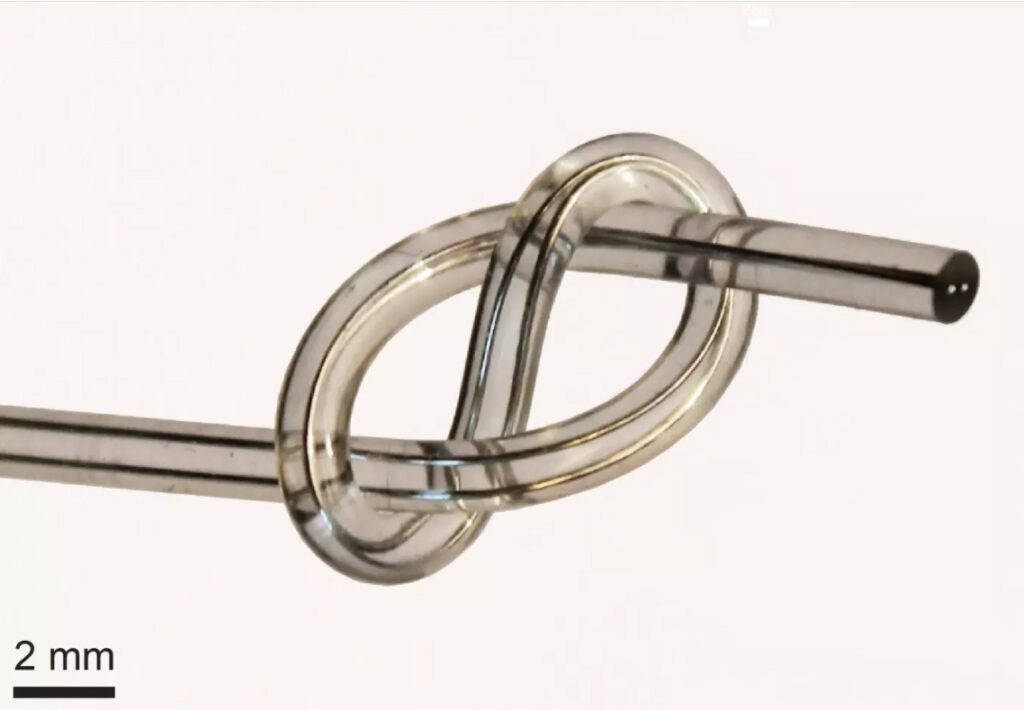
Scientists have previously developed smart fabrics, which are capable of monitoring the wearer’s heartbeat or respiration by detecting deformations in the material. However, these fabrics are not very efficient. Recently, a pair of engineers have developed a new one that utilizes soft transmission lines instead of individual sensors and is claimed to work better.
Most existing smart fabrics comprise of multiple linked sensors, integrated into the material at several positions. A significant number of those sensors, which are also fragile, are needed to cover a large area of the fabric. Also, each sensor can only detect one kind of deformation, such as pressure or stretching.
Prof. Fabien Sorin and doctoral asst. Andreas Leber, from the FIMAP laboratory in Switzerland’s EPFL School of Engineering, has developed an alternative that has none of those drawbacks. Their fabric has rows of thin and soft transmission lines, rather than a bunch of stiff sensors.
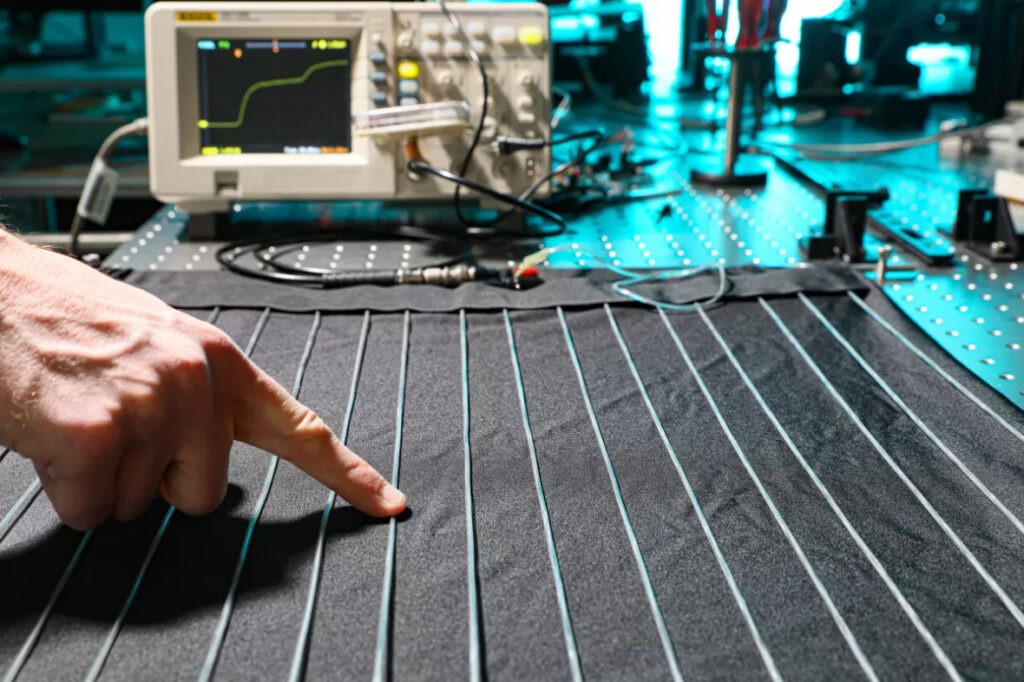
Each transmission line is made of a stretchable, flexible elastomer, with many liquid metal “sub-lines” running along its length, inside of it. When electrical pulses are fed into one end of each line, the pulse travels through the liquid metal, and then it’s detected at the other end. It’s possible to simultaneously determine if that line is being twisted, stretched, or compressed, based on how long each pulse takes to travel the length of the line.
Leber said:
Imagine clothing or hospital bedsheets capable of monitoring your breathing and other vital movements, or AI-powered textiles that allow robots to interact more safely and intuitively with humans. The soft transmission lines that we’ve developed open the door to all of this.
The team’s research, published on June 1st in Nature Electronics, drew on a variety of disciplines including mechanical engineering, electrical engineering, and materials science. Now, the researchers plan to miniaturize the electronic components so that the entire system is more compact and truly wearable.