
Tesco is set to embark on an exciting new renewable energy project to cut carbon emissions. All unsold food from the British chain’s Irish stores will be converted into renewable gas to power six of its stores. To make this happen, the company launched a partnership with a renewable energy organization Green Generation.
Tesco Ireland’s chief executive Kari Daniels said:
This new partnership with Green Generation aligns with our Little Helps Sustainability plan which guides us in tackling climate change and food waste and allows us to support indigenous and creative solutions to the increasing challenges faced by society as a result.
Green Generation has a £2.2 million anaerobic-digestion plant in Nurney, where it will convert the food waste into biomethane, a clean carbon-neutral fuel that can be used for transport, heating, and electricity. The by-product of gas production can be used as fertilizer.
Tesco will then purchase the electricity generated from green energy supplier Naturgy. The project is part of the grocery chain’s plan to become a net-zero-carbon retailer by 2050.
Daniels added:
This new initiative will help us in our ambition to become a zero-carbon retailer by 2050, as we work together to support national and international climate action.
Until this initiative, Tesco was donating surplus food to the charity FoodCloud or sending it to Northern Ireland to be converted into energy. It says it will continue to donate any leftover meat to the charity, but everything else it will now give to Green Generation. It intends to supply over 6,400 tons of food waste per year, which should allow the chain to cut carbon emissions by 1,200 tons yearly.
Green Generation’s Billy Costello said:
We have been generating energy from waste for a number of years and know that renewable gas can not only solve our energy issues, but it can also help deliver a truly sustainable circular economy, by harnessing food and animal waste to deliver clean energy.
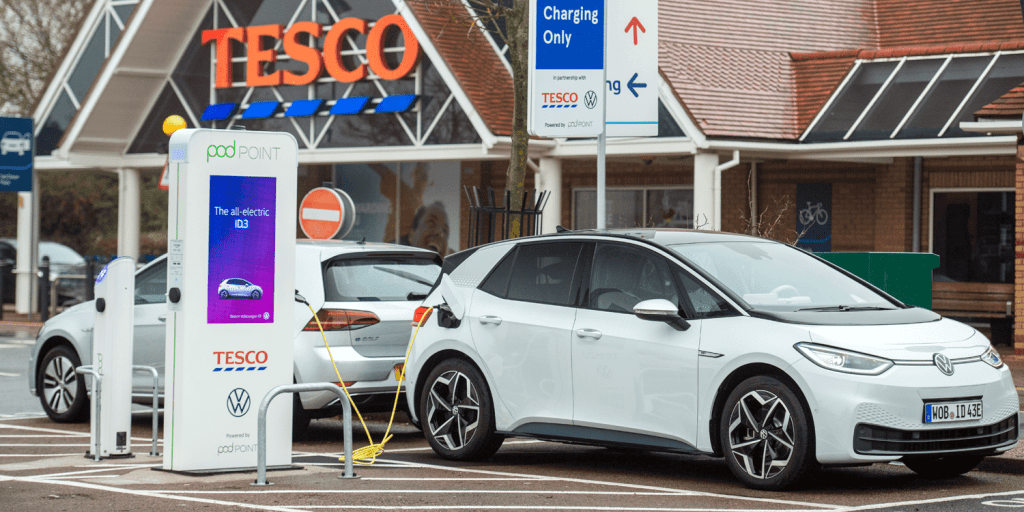
Last year Tesco announced a partnership with Volkswagen and Pad Point to provide UK electric vehicle owners with free charging points in the parking lot so they can top up while they shop. At least 100 shops are going to be involved in this scheme, with 2,400 charge points installed in total.
Tesco states on its website:
We recognize climate change as the biggest environmental threat the world faces, and one which could pose particular challenges to a number of our supply chains. As a business, we impact the climate in both our own operations and supply chain. This includes greenhouse gas emissions from electricity, refrigeration, agriculture, and transport.
The company’s climate change commitments include a 60% absolute carbon reduction from its operations by 2025 (100% by 2050), and achieving zero-net deforestation in the sourcing of soy, palm oil, Brazilian beef, and wood/paper for Tesco Brand products. It plans to achieve these targets by committing to source or generate 100% of its electricity from renewable sources by 2030 and collaborating with governments, industry, and civil society to govern sustainable land-use planning.
Over the past century, the world has lost about half its forests, and the little that remains is increasingly under threat. Preventing further degradation and deforestation is as critical to a sustainable future as reducing carbon emissions.


