
The world is struggling to decarbonize, which is a terrible thing because it needs to happen to keep global average temperatures from rising. Cutting down on emissions is in all ways possible is something that needs to be done immediately. Searching for solutions, researchers are coming up with smart ways of reducing current emissions while others are finding ways for them not to happen in the first place. Sometimes the answer lies closer than you think, even directly in the vehicle exhaust system itself.
In Switzerland, a team of researchers from École Polytechnique Fédéralede Lausanne (EPFL) has developed a method for capturing carbon emissions from exhaust pipes of trucks. The system can be retrofitted to any existing vehicle and reduces its emissions by 90%!
The transportation sector (in Europe) is responsible for nearly 30% of total carbon emissions, and 72% of that comes from road transportation (cars, trucks, buses). Meaning, cutting emissions in transport has become a priority.
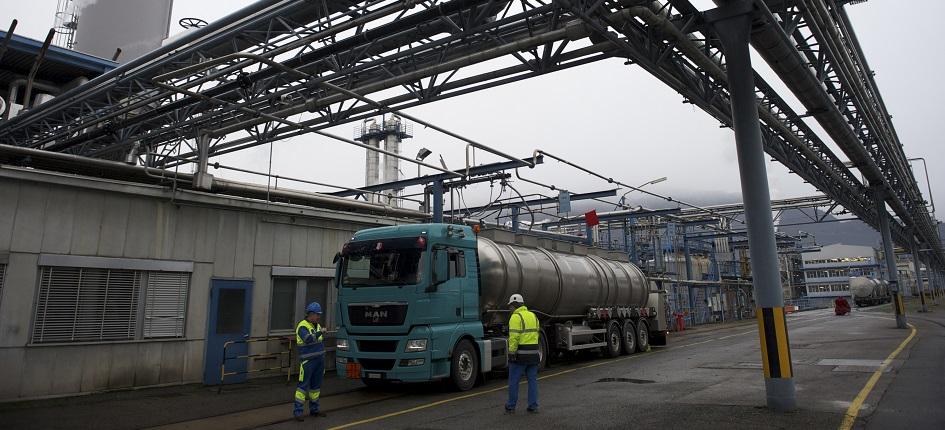
It is not enough to only push towards low-carbon personal electric vehicles. Public and commercial transport vehicles also need to decarbonize, but that is proving to be a stubborn challenge. It is much more expensive to replace them. Nevertheless, something has to be done so that big vehicles waiting to be replaced by zero-emissions electric versions could emit less CO2. That is precisely the sort of dilemma EPFL engineers designed their carbon-capturing system for!
The device captures carbon straight from the vehicle exhaust, then liquefies it to be stored in a tank on the roof. The capsule within which the process takes place before the CO2 can be stored could be placed above the driver’s cabin. The weight of the capsule and tank are only 7% of the vehicle’s payload.
As reported by E&T:
By cooling the vehicle’s flue gases, it is possible to separate water from the gases, and then isolate the CO2 from the nitrogen and oxygen in the fumes with a temperature swing absorption system, which uses frameworks designed at EPFL to absorb CO2. Once the system is full of CO2, it is heated (using heat from the vehicle’s engines) to extract pure CO2, which is then compressed into a liquid. This liquid can be stored in a tank and transported to a service station to be turned into conventional fuel, via a process powered by renewable energy.

Professor François Maréchal, who led the project said:
The truck simply deposits the liquid when filling up with fuel.
The process itself uses little energy because all of its stages have been optimized.
For this study, the model vehicle was a delivery truck. The method could, however, work for buses and boats as well. It can also work with any fuel. The system can be used to neutralize any current combustion engine vehicle’s contribution to climate change. For now, it is only a concept with prototypes in the works.


