
3D screens aren’t currently realistic because the view is the same from every position when you look at them. The objects are 3D from one perspective only. For example, when you go to a concert, where you sit will change how you see the performers on the stage. That’s real. But in a 3D movie, the actors will look the same from every seat in the auditorium. So, as much as they may look 3D, they’re artificial.
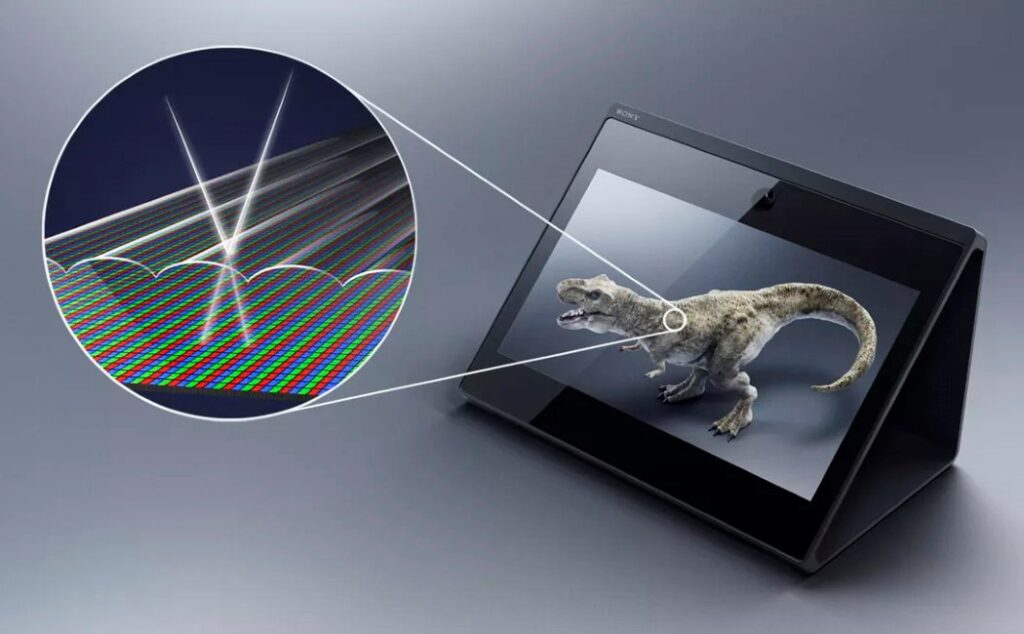
Sony has found a way around this. Its 15.6-inch Spatial Reality Display lets you see objects in 3D without glasses, and the display changes in real-time depending on what angle you look at it from. It’s a pro monitor explicitly designed for looking at 3D models on a desktop.

The display tracks your eyes to know where you’re looking at it from and adjusts the model accordingly. So, if you’re looking at it from above, it’ll show you the top of the model; if you’re looking at it from the left, it’ll show you the left side of the model, and so forth.

The content floats within a little stage, extending deep within the display. Only moving around makes you feel like you’re interacting with the content. It’s as realistic a 3D representation as you can get. The company’s proprietary high-speed sensors follow your eye movements to the millisecond.
It senses your pupils’ position through space on the vertical and horizontal axis and even depth. The display’s lenticular lens creates two different views for your right and left eye to create a sense of depth and make the model feel 3D.
The only downside is that only one person can use it at a time since it’s serving up an image tuned to one viewer’s eye position. And it’s not made for watching 3D movies, just 3D files. It’s the perfect tool for architects, game designers, automotive designers, industrial designers, etc. They can visualize their designs in virtual 3D without having to fabricate or print them for better understanding.

Sony writes on its website:
Designed to stimulate the imaginations of creators in various disciplines, the Spatial Reality Display is a radical new expression of 3D and a new medium for artistic innovation.
It requires a mighty PC to work. However, since the experimental device is made for filmmakers and designers who already have such equipment, that shouldn’t be an issue.


