
Air travel may have taken a backseat this last year, but designers and architects are still thinking about improving airports and making them more sustainable for a better future. This year, the theme for the annual Fentress Global Challenge student design competition hosted by Fentress Architects was: “Airport of the Future.” Students were tasked with reimagining airport mobility in the year 2100 for one of the top 20 busiest airports on the planet.
The Fentress Global Challenge has been running since 2011, intending to attract young talents and advance innovative public architecture design. The competition has attracted thousands of entries from more than 75 countries. This year, the winner was a zero-emission multimodal airport titled “The Green Gateway” by Kaushal Tatiya and Nikhil Bang from the Southern California Institute of Architecture. They received a $15,000 prize for their efforts.

Curtis Fentress, FAIA, RIBA, the firms Principal in Charge of Design, said:
A deep passion for design and a creative mindset are the cornerstone of any successful design competition submission. Each year, the submissions we receive are more innovative, spirited, and dynamic than the prior year, which shows an exciting outlook for the future of terminal design. We’re greatly impressed by this year’s winners and every submission we received.
There were over 100 submissions received from over 15 countries. All the proposals were evaluated by seven jurors from aviation and architecture, including representatives from KRAMER Aerotek and Richard Meier & Partners Architects. Many important factors were addressed throughout, such as passenger experience, flexibility, security, project feasibility, futuristic transportation technologies, globalization, and urbanization. The winning proposals reflected the quality, radical innovation, and curiosity required to advance airport terminal designs.
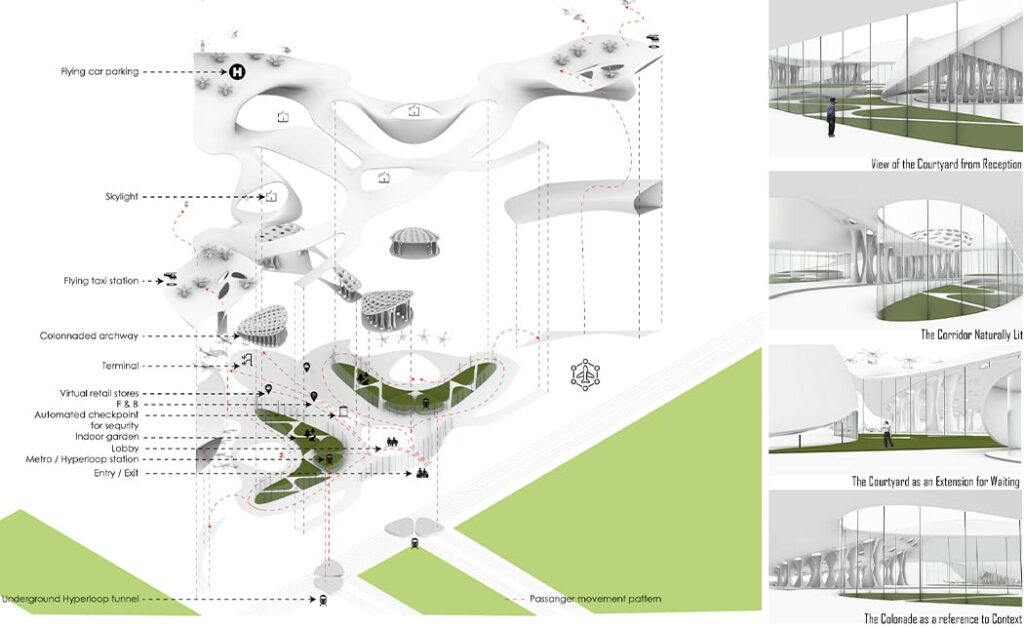
The Green Gateway transforms New Delhi’s Indira Gandhi International Airport into a sustainable and culturally responsive destination capable of stationing flying cars and purifying the air. They chose that airport because it’s located in one of the most polluted cities globally, and their design could help improve the situation. They created a structure that would reduce air travel’s environmental impact while enhancing public transportation across the city.
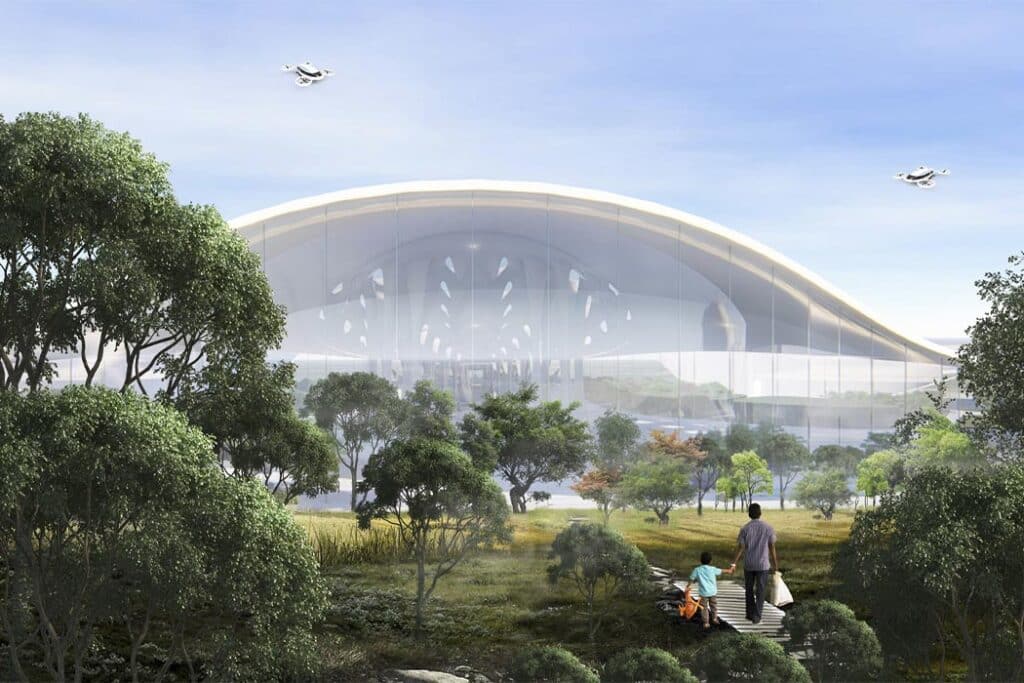

The Green Gateway envisions a future where airports are more than buildings – they are a link between passengers and sites. The design is formed on the concept that flying cars are the norm, so domestic air travel increases dramatically.
Bang and Tatiya said:
As a result, we redesigned the existing terminal as a hub for six air-purifying dual-purpose towers scattered throughout New Delhi. Indoor greenery, an abundance of daylight, and arched architecture visually unite the buildings in this decentralized system.
[The Green Gateway is] zero-emission at the macro and micro level, improving mobility across the city by replacing domestic flight as one of the major sources of pollution and making air travel a personal affair.
The dispersal of six towers across the capital help to evenly purify the air throughout the area. They also make it easier to regulate all the flying cars by zoning and providing multiple docking stations.
It doesn’t say anything about charging stations. Still, perhaps the central hub and its complimentary towers have charging points for the flying cars, with the entire network powered by renewable energy. How else could it be a zero-emissions airport?


