
Fujifilm and IBM researchers have developed a tape prototype that blows hard drives out of the water. Their tape prototype has a capacity of 580TB (or 0.58PB), which is equal to 29 Seagate Exos+ 20TB hard disk drives or almost six Nimbus Data 100TB (the world’s biggest SSDs).
It’s also over 32x the current LTO-9 tape technology, containing a record-breaking areal density of 317Gbits per square inch. Fujifilm used Strontium Ferrite (SrFe) particles and several other techniques to achieve this significant capacity boost, including longer tape lengths and thinner tapes.
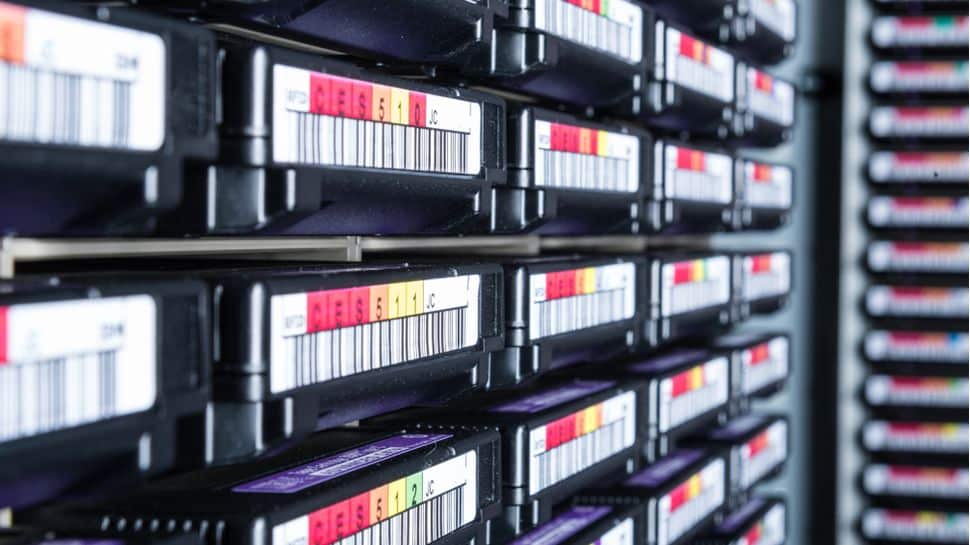
There is no commercial launch date set. This achievement is merely a research milestone reached. An IBM spokesperson said:
There is a standardized roadmap that has to be followed, and that will put this on the market in a little less than ten years. This is the driver of this demonstration — to show enterprises that tape will be viable for decades whereas HDD has hit a wall.
However, the technology will undoubtedly find its way into LTO tape at some point seeing as Fujifilm is an LTO (Linear Tape Open) foundation founding member. The current LTO-9 will reach 18TB. Gen 10 through 12 will reach up to 144TB native. That means that the prototype tape at 560TB could be the precursor of a theoretical Gen 14, which put its launch date to well after 2030.
Tech Radar explained the troubles to come for hard drive manufacturers:
Hard drive manufacturers are well aware of the challenge facing that industry but are left with few options. An 18TB disk, for example, has an areal density of more than 1Tb per square inch, about 85 more than an LTO-9 tape. In other words, to match the capacity of a 560TB tape, hard disk platters must reach 85Tb per square inch, which could break the laws of physics.
This year is the beginning of hard drive bumpy road since 5-bit-per-cell flash or PLC flash will become mainstream. When that happens, it will profoundly affect the capacity mix and push hard disk drives further into a niche market.


